

The Darkened Gardens of the Sabeans
We all know what the word “kafir” means in Arabic. It is so widely used by the masses that it has become part of our national languages.
But not everyone knows that this word has another meaning: “ungrateful”, “denying” and “not recognizing the gifts of the Almighty”. There is also a third meaning: “darkness”.
When applied to the unbeliever, all meanings apply with striking synchronicity. Disbelief is, in essence, both ingratitude to one’s Creator and darkness of conviction. If we turn to the pages of history, we will see dozens and hundreds of such examples.
The people of the Prophet Hud (peace be upon him), the Ad, were endowed with powerful bodies but they rebelled against the Creator who gave them these bodies.
The Thamud mastered the art of building spectacular cliff dwellings but they believed that these cliffs would protect them from God’s punishment.
The Sabaeans also suffered the bitter fruits of ingratitude, their flourishing gardens turning into a lifeless desert.
The Sabaean people traced their roots back to a common ancestor named Saba’, the forefather of the Yemeni Arabs. Among his ten tribes was the Azd tribe, from which descended the Khazraj and Awsi (the inhabitants of Medina, the very same Ansar who supported the Prophet Muhammad (peace and blessings be upon him)).
Saba’s proper name was Abdu Shams ibn Yashhub, and he was related to Qahtan, from whom some modern Arabs trace their genealogy. Saba’ was aware of the Prophet Muhammad’s (peace and blessings be upon him) prophetic mission. Ibn Kathir, in his commentary on the Koran, cites verses about the Messenger of God (peace and blessings be upon him), in which he calls the future Prophet ﷺ pious, humble, and the best of people.
The first mention of the Sabaean kingdom in the Koran occurs during the time of the Prophet Suleiman (peace be upon him), when he sent his renowned hoopoe, Hudhud, to southern Arabia for reconnaissance purposes. Hudhud successfully completed his mission and reported on the people of Queen Bilqis, who worshiped the sun (the meaning of the commentary): “After a short time, [a hoopoe appeared and] said [to Suleiman (peace be upon him), ‘I have learned what you do not know. I have come to you from Saba with reliable news. I have found there a woman who reigns over them (the Sabaeans). She has been granted everything and she has a great throne. I have found that she and her people worship the sun, not Allah ﷻ. Satan has made their deeds seem beautiful to them and has led them astray, and they are deprived of guidance.” (Sura An-Naml, ayat 22-24).
Bilqis’s story had a happy ending, as she found true faith and followed the Prophet Suleiman (peace be upon him), but the Sabaean kingdom continued to err. The Sabaeans were not at all concerned about their spiritual world and were blinded by material wealth. Despite possessing gardens of extraordinary beauty and abundant harvests, they became arrogant and rejected the thirteen prophets who vainly tried to bring them to their senses. In the struggle between good and evil, the Sabaeans chose evil and thereby sealed their bitter fate. The instructive story of the Sabaean kingdom is told in the eponymous Sura Saba’, where the Almighty calls their land a beautiful land (the meaning of the commentary), “And among the tribe of Saba’ there was a sign – two gardens, one on the right and one on the left. Eat of the provision of your Lord and give thanks to Him. A beautiful land indeed, and a Lord of Forgivingness!” (Sura Saba’, ayah 15).
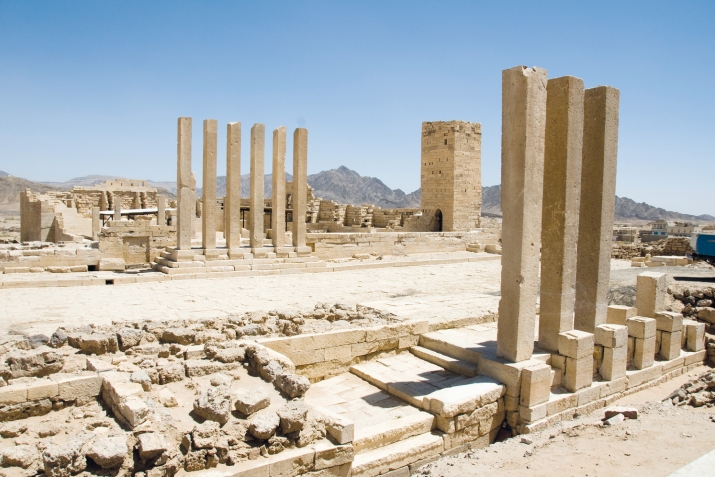
The events described in the Holy Koran took place in the Yemeni city of Marib, where one of the greatest engineering marvels of the ancient world, the Marib Dam, was built. The dam improved the irrigation system, protected people from natural disasters and also helped end the constant disputes between the kingdom’s inhabitants over water. During periods of rainfall, the reservoir’s floodgates were closed and during periods of drought, the Sabaeans drew on the water reserves, which lasted for long periods.
Two blooming gardens on either side, with a city between them. Such a sight one could only dream of. The harvest in the gardens was so bountiful that a Sabaean woman carrying a basket on her head would walk between the trees and fruit themselves would fall into her basket. Moreover, their kingdom was free of flies, mosquitoes, snakes and scorpions.
The Sabians should have sincerely praised the Almighty for such a paradise on earth, but they did exactly the opposite, saying, “Tell your Lord to deprive us of these blessings, if indeed He is able to do so.” This is what they said to the prophets of the Almighty and the Lord punished them (the meaning of the commentary), “But they refused [to show gratitude], so We sent upon them a flood that burst the dam [and destroyed the beautiful gardens], and We replaced those gardens with two gardens of bitter fruit, tamarisk, and a few jujube trees. Thus, We requited them for their disbelief. Do We punish anyone except the ungrateful (disbelievers)?” (Sura Saba’, ayah 16).
It only took a single mouse to tame the Sabaeans’ arrogance, by gnawing through a small section of the dam. But this breach was enough to cause the dam to burst and flood their magnificent gardens.
It is reported that the Sabaeans knew of the impending tragedy from previous scriptures and were even aware that a rodent would cause the flood. They took precautions, tying a cat to each opening, but they were unable to stop that unfortunate mouse, who broke through to fulfill the will of Allah ﷻ. Not only their vaunted gardens, but the kingdom itself, were submerged under the raging torrents of water.
After such a devastating flood, life for the Sabaeans could never be the same. The once-mighty Sabaean kingdom came to an end. Almost half of its inhabitants decided to leave southern Arabia forever and settle in Sham (present-day Syria and the surrounding states). Some of them, despite all odds, decided to remain in their historical homeland, while others emigrated to the oasis city of Yathrib (Medina) in northern Arabia. This group of Sabaeans, as noted above, were fortunate enough to become the assistants of the Messenger of God, peace and blessings be upon him, (the Ansar).
“Every cloud has a silver lining.” This Russian proverb applies perfectly to them. The history of the Sabaean kingdom’s ingratitude is a living example for all time.
