

The Great Scholar Ibn Khaldun
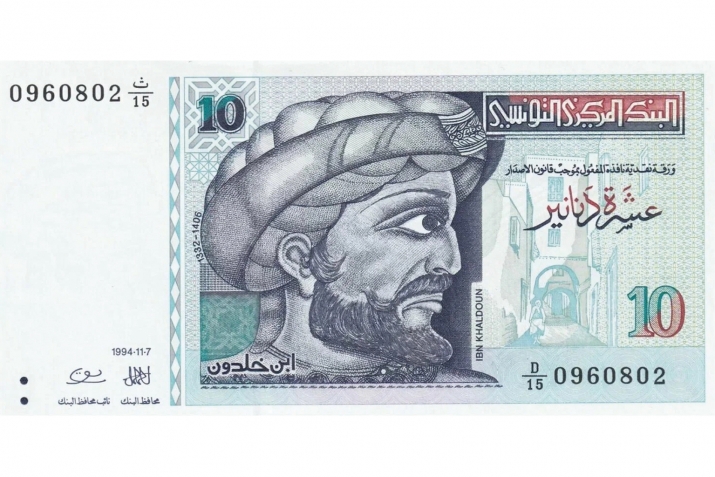
About ten years ago, while in Tunisia, I used the local currency, dinars.
My attention was caught by a striking portrait of a man wearing a Muslim turban on a 10-dinar banknote. Who was this man? I became curious. The portrait was labeled in both Arabic and French: “Ibn Khaldun,” along with the years of his life: “1332–1406”.
Years later, I set out to learn more about the figure featured on the Tunisian banknote. It turned out to be the Muslim scholar Ibn Khaldun – a philosopher, historian, practicing qadi (judge) and professor at the University of Cairo, a man well-known to specialists in history and economics. While Western education is built upon the discoveries of Western scholars, the works of Muslim thinkers, with few exceptions, remain largely unknown to the rest of the world. This is a pity, and it applies to more than just Ibn Khaldun.
As I explored Ibn Khaldun’s scholarly legacy, I was struck by his writings, which contained ideas that were remarkably advanced for his time. His work was deeply informed by his own practical life experience, as well as an extraordinary capacity for profound analysis and a uniquely logical approach to the historical and economic issues he examined.
Ibn Khaldun was born in 1332 (732 AH) in the city of Tunis. In the middle of the seventh century AH, when the Crusaders captured Seville, Ibn Khaldun’s ancestors fled to Ceuta, a small Spanish enclave on the northern coast of Morocco, opposite Gibraltar and later moved even further, to Tunis.
In one of his books, At-Ta’rif, Ibn Khaldun provides a detailed account of his life. As a child, he memorised the Koran, then went on to study hadith (the traditions of the Prophet ﷺ), fiqh (Islamic jurisprudence) and Arabic grammar. His father served as his first teacher but his education did not end there; prominent scholars living in Tunis at the time shared their knowledge with the diligent and inquisitive young man. By the age of eighteen, Ibn Khaldun had already acquired a solid grounding in fiqh and other religious sciences. By then, he had also studied the science of hadith, had mastered the fundamentals of logic and philosophy and had begun to produce his own early writings on these subjects.
Ibn Khaldun entered the service of the Marinid Sultan Abu Inan in the city of Fez. Sometime later, court intrigues compelled him to leave for Spain. There, he composed a treatise on logic and several poems; at the behest of the Emir of Granada, he even took part in peace negotiations with Peter of Castile.
Subsequently, Ibn Khaldun served as a secretary to the sultans of Tunis and Fez. Furthermore, he worked as an educator at the University of al-Qarawiyyin in Fez, the renowned Al-Azhar University in Cairo, the Madrasa al-Zahiriyya, and various other academic institutions across the Maghreb. He served as the supreme qadi (Sharia judge) for the Maliki school of jurisprudence. The integrity inherent in his character earned him many enemies, leading to his dismissal from the position on several occasions, only for him to be called back to serve as qadi once again.
We have inherited his books, in which he examines many aspects of daily life. His conclusions remain as relevant and timely today as they were in his own time.
In his historical work, the “Muqaddimah (Introduction to History)”, Ibn Khaldun analysed the causes behind the rise and decline of nations and peoples. He emphasised the importance of reducing state expenditures on mercenary armies and argued against excessive taxation and tariffs, which hinder trade and production. Ibn Khaldun viewed these and other economic principles as essential prerequisites for building a civilised society. This scholar identified a vast number of fundamental economic concepts. Long before Adam Smith, he recognised the value and necessity of the division of labour. He anticipated David Ricardo in developing a labour theory of value and, well before John Keynes, explored the role of the state in stabilising the economy.
Ibn Khaldun was the first scholar to employ the concept of an “economic surplus”. He proposed a biological theory regarding the rise and fall of nations and his coherent, comprehensive economic theory also shaped his approach to history. Before Ibn Khaldun, no other scholar had formulated such a consistent, overarching economic theory capable of explaining and predicting the rise and decline of civilizations, nations, and empires.
