

Islamic Festival Pageantry: Kano and northern Nigeria
Islamic Festival Pageantry: Kano and northern Nigeria
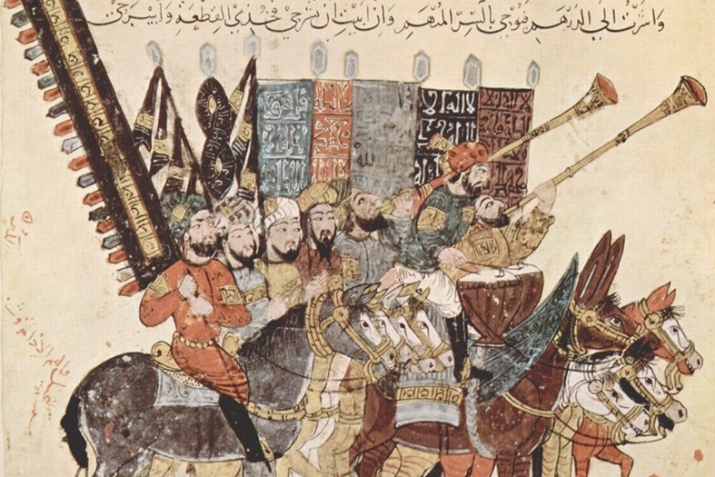
In a Hadith of the Prophet (peace and blessings be upon him), Anas related that: “When the Prophet Muhammad (peace and blessings be upon him) came to Medina they had two days of rest and amusement. The Prophet (peace and blessings be upon him) said, ‘Allah, the Exalted, has exchanged these days for two days better than them: the day of breaking the fast and the day of sacrifice.” (an-Nasai and Ibn Hibban).
From the early centuries of the propagation of the faith until the widespread adoption of motor transport throughout the Islamic world, its principal religious and customary holidays were celebrated in its major population centres by elaborate processions and other festivities in which all levels of the community participated - their most spectacular features usually being great equestrian displays of brightly adorned massed cavalry.
One of the earliest eyewitness accounts of such pageantry is the description by the famous scholar Nasir-I Khusraw of one of Fatimid Cairo’s biggest annual festivals, the Riding Forth by the Sultan to Open the Nile Canal, in the late 10th century. A large, elaborate pavilion was assembled at the head of the canal for the sultan and three days before the event “drums and trumpets are sounded in the royal stables. When the sultan mounts, 10,000 horses with gold saddles and bridles and jewel-studded reins stand at rest. On each horse is a spear or coat of armour and a helmet on the pommel along with many other sorts of weapons. On that day, the caliph’s soldiers mount in groups and battalions. On the morning when the sultan heads out for the ceremony, a parade crosses the streets of Cairo, where the whole population gathers to witness the spectacle. On his head the sultan wears a white turban and rides a camel with a plain saddle. At his side rides a parasol bearer.”
Similar processions are recorded of the Fatimid sultan al-Muizz in 973 who himself led the prayers at the al-Azhar Mosque of the newly constructed city of al-Qahira to mark the beginning of the Eid al-Fitr celebrations, following which he headed a great procession of his troops, escorted by his four sons in armour and preceded by two elephants, back to the palace. In 990, the occasion was still more pompous, the sultan riding with his troops who wore costumes of ornamented brocade and girded with swords and belts of gold. Horses lead by hand during the parade had jeweled saddles of gold and amber. The caliph himself rode under a parasol ornamented with jewels.
There is one region in the Islamic world today where such traditional festival pageantry has remarkably survived - in the principal Muslim centres of northern Nigeria, most notably in its largest city, Kano. The oldest city in West Africa, its written history goes back to 999, and by the early 19th it had become the leading emirate of the Sokoto Caliphate, one of the strongest Islamic centres of culture and learning anywhere in the world at that time.
Kano made a major impact on British travelers of the period, as it did on the first colonial officials following the British takeover of northern Nigeria in 1903. Henry Barth, who visited Kano in March 1851, wrote that it had a population 60,000 and that it was West Africa’s “central point of commerce … a great storehouse of information. A place like Kano will at some future become important even for the commercial world of Europe. (It is) one of the most fertile spots on earth able to produce not only the supply of corn necessary for the population but can also export. We must presume that Kano is one of the happiest countries in the world … so different in external form from all that is seen in a European town, yet so similar in its internal principles.”
Nigeria’s first British colonial Governor-General, Lord Lugard described it as the “Commercial emporium of the western Sudan.” Of its great city walls he noted, “I have never seen, nor even imagined, anything like it in Africa.” The British administrator, Lt Col. A.F. Mockler-Ferryman further continued the praise, stating that Kano was “a land of plenty, a land literally flowing with milk and honey”.
Nigeria has the largest Muslim population in the continent of Africa and is fifth in the world in terms of Muslim population after Indonesia, India, Pakistan and Bangladesh. Today Kano is the capital of one of 36 states of the Federal Republic of Nigeria. Its inhabitants are predominantly Muslim Sunni and Islam continues to play a major role in the lives of society in general. It administered by an elected Governor with an elected legislature and judiciary. The Emir of Kano still lives in his great traditional Hausa palace (Gidam Rumfa – built in the 15th century) at the heart of the old city next to its great new Juma mosque, continues a highly respected traditional role as a royal mentor of the people, a symbol of spirituality, morality and heritage.
A verbal description of Kano’s great Eid al-Fitr celebrations – just one of many of similar character held throughout the Islamic year - can only partly convey their actual sensory impact and the vivid impression of finding oneself back in the Muslim middle ages.
The day of the Eid itself is just the commencement of a five-day long festival. In the early morning congregational prayers are held in the open air at the vast Kofar Mata Eid ground in the centre of the ancient walled city
On the first day after at sunrise after prayers at the main Eid ground all district and village heads and other traditional title holders accompany the Emir on horseback, riding through the ancient city to the palace to meet the Governor of Kano and other members and officials of the government, the diplomatic corps, etc. At Kofar Khwaru, the gate of the Emir’s palace next to the central Juma mosque, the Emir delivers his Sallah address to the people of Kano, accompanied by chivalry, archers, lancers, gunmen, drummers, singers, horn blowers and acrobats - amidst thousands of mounted horses and camels.
To be continued…
