

Dirham of Caliph al-Mahdi
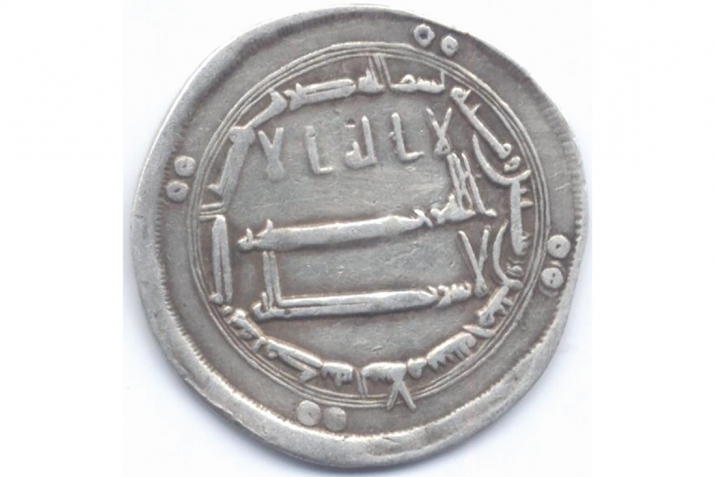
In my collection, I have a silver dirham of the Caliph (leader of the Muslims) al-Mahdi, who inherited power from his father, Caliph al-Mansur.
The future Caliph al-Mahdi was born in 126 AH (744 AD) in the village of Humayma, located in present-day Jordan. As Caliph, his father began preparing him from a young age to lead the army and the state, intending that he would eventually ascend to the throne. When al-Mahdi turned 15, his father entrusted him with the command of his army and tasked him with suppressing a rebellion led by Abd al-Rahman ibn Abd al-Jabbar al-Azdi in Khorasan. Following a successful military campaign there, his father assigned him the task of quelling an uprising by the Ispahbad, the ruler of Tabaristan, a region on the southern coast of the Caspian Sea. This successful campaign brought Tabaristan, which had previously been part of the Caliphate only in name, firmly under the control of the Caliph’s authority.
In 145 AH (762 AD), his father appointed al-Mahdi as governor of the province of Khorasan and sent him to the city of Rayy. Due to the successful reforms al-Mahdi implemented in Rayy, his father decreed that the city be renamed Muhammadiyya. In 159 AH (775 AD), al-Mahdi became the Caliph of the Muslims.
My silver coin was minted during the reign of Caliph al-Mahdi, in the year 165 AH, at the Madinat al-Salam mint (Baghdad, Iraq); it weighs 2.88 g and has a diameter of 28 mm.
This Kufic dirham bears the following inscriptions: Obverse. In the central field, there is a three-line inscription: “There is no god but Allah; He is One, and He has no equal.” The marginal (circular) inscription, providing the minting details, reads: “In the name of Allah, this dirham was struck at Madinat al-Salam in the year 165 (AH).” Reverse. The central field contains a four-line inscription: “Muhammad is the Messenger of Allah, may Allah bless him and grant him peace.” The fourth line, highlighted in red in the photograph, reads: “Al-Khalif al-Mahdi.” The marginal inscription on the reverse, known as the “second symbol”, consists of verse 33 of Sura At-Tawbah from the Koran, which conveys the following meaning: “It is He (Almighty Allah) who sent His Messenger (Muhammad) with true guidance and the religion of truth, to manifest it above all other religions, even if the polytheists dislike it.”
A description of this coin, listed as number 966, appears in the seminal work “Coins of the Eastern Caliphate”, published in 1873 by the Russian scholar V. Tiesenhausen.
The dirham issues of all subsequent rulers fall into two main categories: coins bearing the name of the reigning caliph, often including the names of his designated successors, and anonymous coins, which do not contain the name of the ruling caliph in their inscriptions.
