

The Great Mushaf and Monumental Rihal of Samarkand
The Great Mushaf and Monumental Rihal of Samarkand
“We have sent down the message and We will assuredly guard it.” (Koran 15:9)
In the summer of 1868, Vasily Vasilyovich Radlov (1837-1918), a young Turkologist, ethnographer and archaeologist, described exploring the great decaying Islamic monuments of Samarkand following bitter conflicts between occupying Tsarist forces and those of Bukhara and Kokand:
“When I rode into Samarkand, the bazaar was mostly a pile of ashes and debris, above which were high columns of smoke; the streets from the destroyed houses were half an arshin deep covered with a thick layer of clay dust; at each step the horse made, a cloud of dust rose up, filling my eyes, mouth, and nose, so it was difficult to breathe or see anything.
The population, especially the scholars, after their betrayal and fearing the revenge of the Russians, fled, and even the surviving part of the bazaar was almost completely empty. It is clear that under such circumstances I … had to be content with visiting the ancient monuments of the city …
The most magnificent of all the madrasas and truly splendid buildings of the time of Timur is the Madrasa-iKhanim (Mosque and Madrasa complex of Bibi-Khanum – the senior wife of Amir Timur [1336-1405]). … The dome of the mosque is very high. The decorations on the interior walls have completely fallen away. The dome is cracked and a gap has formed, more than an arshin in width. … Inside the mosque there is a huge table in white marble.”
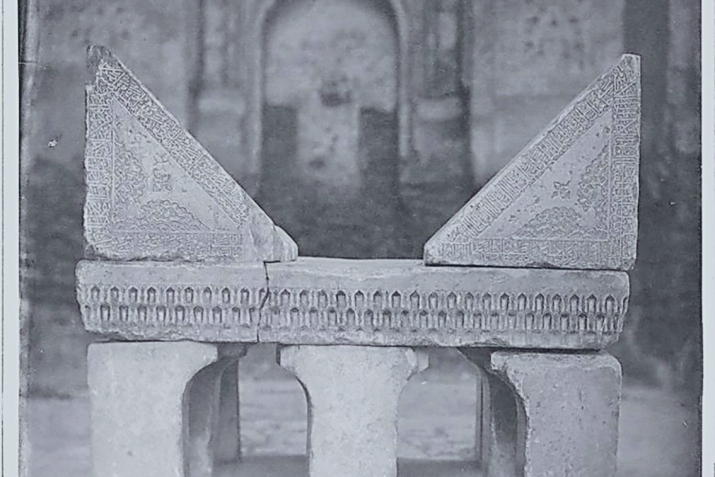
Vasily Radlov was already earning a reputation for his studies of Turkic cultures but did not recognize the significance of the great “table” he saw. Erected at the heart of what was Samarkand’s Juma mosque, it was, in fact, the monumental reading stand or rihal for one of the earliest, most important and largest surviving manuscripts (mushaf) of the Koran.
In 1863, the Hungarian Arminius Vambery recorded that he had seen a huge book of the Koran, written on gazelle skin and placed on a lectern inside the mausoleum of Amir Timur. Although this is the first known eye-witness account by a European of a great Koran in Samarkand, it had long been deeply revered there by local believers who understood it to be one of the definitive copies (mushaf) commissioned by the third caliph Uthman bin Affan (579- 656) for distribution to the main cities of the Caliphate.
What is more, it was believed to be the very Koran which Uthman was reading when assassinated in 656 – the stains of his blood still visible on the pages open at the moment he was attacked. This particular mushaf was probably brought to Samarkand by Timur from one of his campaigns in the Middle East. He built his mosque, one of the greatest in the Islamic world, in 1399- 1405 after another campaign in India where he had been impressed by its wonderful creations in marble.
His use of massive blocks of marble of the highest purity for the great rihal (decorated with exquisitely carved ornamentation and Koranic inscriptions) would have emphasized the reverence Timur accorded the Holy Book. The mushaf would have been displayed there on important religious occasions.
However, as grand as the mosque was, it was structurally unstable and soon started to collapse, accelerated by the periodic earth tremors of the region. By the time Tsarist forces took control of Samarkand in 1868, it was in a perilous state.
The great mushaf had already long been in the care of the mazar of the revered Naqshbandi sheikh Khoja Akhrar (1403- 1489) on the city’s outskirts, where it was also displayed on important religious occasions and treasured by the pious as a source of blessing.
Major General Aleksandr Abramov, Governor of the Zeravshan Military District, soon became aware of the ancient Koran’s existence and significance and quickly acted to acquire it from the leaders of the Khoja Akhrar mazar.
He forwarded it to General Konstantin von Kaufman, Governor-General of Russian Turkestan, who then sent it to Saint Petersburg as a gift to the Imperial Public Library. His accompanying letter of 24 October 1969 to the Minister of Public Instruction reads:
… The Commander of the Zeravshan District has handed over to me a Koran … which previously was in the possession of the Mosque of Khoja Akhrar in Samarkand. Being aware of the great value of this Koran, and its sacredness in the eyes of the Muslims, Major General Abramov commissioned the Commander of the Samarqand District, Lieutenant Colonel Sierov, to investigate whether the acquisition by us of that manuscript would in any way violate the religious susceptibilities of the community.
The «Ulema» of the Mosque and certain honourable citizens testified: (1) that this Koran, though it was permanently deposited in the Mosque of Khoja Akhrar, did not really belong to it, but was regarded as the possession of the Crown, being the property of the Emir of Bokhara; (2) that this Koran is at present of no importance either to the Muslim community or to the Mosque.
Formerly (indeed, very long ago) it used to attract many worshippers, but lately only the Emirs who come to Samarkand have worshipped before it; and (3) that nobody is able to read it, and that for many years it has been lying around without any use.
Thereupon Major General Abramov received the book, and in return for it donated from his own money 500 kokans (100 roubles), with which the clergy of Samar¬kand were completely satisfied.”
The donation of the mushaf of the Koran was applauded in the Tsarist capital. Interest had grown in Russia since the late 18th century in the scholarly study of Islamic texts and in popular printings of the Koran.
Although the mushaf had been removed from Muslim lands (which would spark much future controversy), it had now become available for study by Russia’s leading orientalists. A.F. Shebunin published the first detailed description in 1891, considering that the volume had being copied in the 8th century and possibly from one of Uthman’s original master copies. In 1905, S. Pissareff published a facsimile lithographic edition of some fifty copies, of which half were given to Muslim rulers and high dignitaries.
This mushaf is one of the oldest surviving Koranic manuscripts and is written in an early version of the Kufic script on parchment leaves 68 x 53 cm in size. Although only one-third of its leaves remain, by comparing it with the best preserved (and very similar) early monumental mushaf long housed in Cairo’s Al-Hussein Mosque, it would have weighed more than 80 kilos.
Scholars today agree that the manuscript is not one of those commissioned by Uthman bin Affan, but differ as to its date (opinions ranging from the second half of the 8th century to the early 9th century). Opinions differ also about where it was made but there is agreement that it ultimately derived from one of Uthman’s master copies.
Following the October coup of 1917, the Bolsheviks, led by Lenin, seized power. Since the revolutions of 1905 and 1907, Russia’s Muslims had raised an increasingly determined and influential voice. On 14 December 1917, the Territorial Muslim Congress of the Petrograd National District addressed the People’s Commissariat of Nationalities Affairs, stating that, “Osman’s Koran, a sacred treasure and heritage of the whole Muslim world, ought to be with the Muslims - all the Muslims of Russia crave for it.”
Although Lenin was an atheist, he was also an adept politician who knew that the act of returning the great Koran to the Muslim community would be positively received. On 19 December 1917, the Soviet of People’s Commissars decreed that the Koran should immediately be returned. It was brought to Ufa and received by the Muslim Spiritual Council of Russia.
However, the Muslims of Central Asia were not satisfied. Both the Turkestan ASSR administration and religious figures continually pressed for its return. Finally, on 18 December 1923, it was brought to Tashkent in a special railroad car. However, by that time official attitudes to Islam were hardening, and it was only in 1941 that the mushaf was placed on extended public view – in the History Museum of the Peoples of Uzbekistan in Tashkent.
In 1989 it was given to the Spiritual Council of Muslims of Uzbekistan and can now be viewed in the Muyi-Mubarak Madrasa in Tashkent, where it is carefully preserved. In 1997, UNESCO recognized the mushaf’s global significance to humanity by placing it on the Memory of the World Register.
Witness to the mushaf’s long presence amongst the people of Samarkand is the great marble rihal re-erected in the open courtyard of the Bibi Khanum complex in 1875 after the mosque had become unusable. It awaits its return to its place of honour before the mihrab in Timur’s mosque (now restored), where it supported that great early manuscript of the Holy Book at the heart of the Islamic faith.
GUY (GHAYDAR) PETHERBRIDGE
Professor, Expert on cultural heritage and history of Islam, Australia, Russia
