
A Coin of a Caliph Dawud
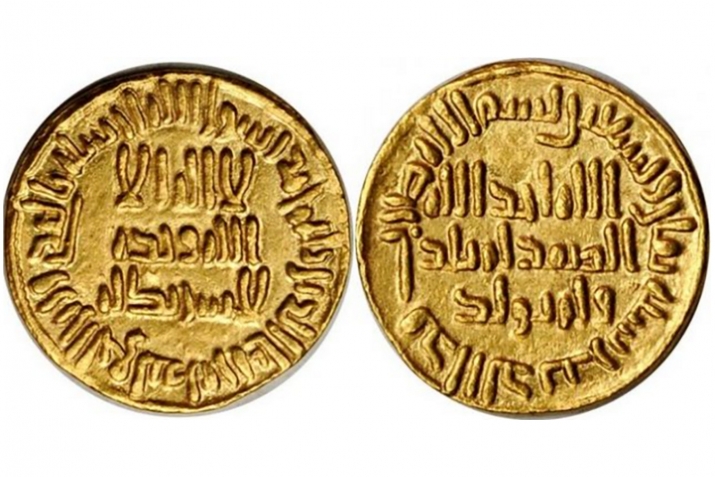
Once, the owner of an ancient Muslim coin, knowing that I am an expert on Kufic dirhams, contacted me online, asking me to tell him what kind of coin it was, where and who minted it.
According to that person, the coin was found with a metal detector on the banks of the Oka River near the city of Kashira. The coin is certainly interesting. It is a Kufic dirham of the Caliph Harun al-Rashid, minted in 171 AH at a mint in the city of Muhammadiyah (today part of Tehran, Iran).
What makes this coin so special?
Coins minted at all times and under all rulers served not only a financial and economic function, but also an informational one and Kufic dirhams also served an educational function.
How could citizens in the most remote corners of this vast state learn of a change of ruler? Only by attending Friday prayers or by reading the inscription on a coin minted freshly. Of course, the first news was always brought by merchants with their caravans, but official announcement of a change in power could only be heard from the imam in the mosque or read on the caliphal coin. The state apparatus ensured the smooth operation of these two information channels.
Anonymous Dirhams
The issue of coins was the responsibility of the governors of provinces and cities that had mints. They ensured the continuous minting of dirhams, most of which historians now classify as “anonymous”. These coins, designed according to the classical rules of Kufic dirhams, do not bear the name of the caliph and can be associated with a particular ruler only by the minting date, which falls within the reign of a specific caliph.
The obverse of these anonymous dirhams contains the following in three lines: the first part of the Kalima, the Creed: “There is no god but Allah ﷻ, He is One, He has no partner.” Around the rim are the issuing details: “In the name of Allah ﷻ, this dirham is minted”, with the place and year of minting indicated.
On the reverse, in the center of the coin: “Muhammad ﷺ – Rasulullah.” The circular inscription contains ayah 33 of Sura At-Tawbah (the meaning of the commentary), “He (Allah) is the One who sent His Messenger (Muhammad ﷺ) with guidance and the true religion, to exalt it above all other religions, even if the pagans dislike it.”
Informational Dirhams
Periodically, by order from the capital of the caliphate, Madinat al-Salam (Baghdad), requests were received for additional information to be added to the coin legend. This information was added to the established coin legend and served as irrefutable proof of the legitimacy of this nationally significant news. Such coins were considered highly important, as mentioned above, and the provincial governor or a specially appointed official was personally responsible for their minting.
Mint workers and die cutters were not allowed to independently make changes to the coin legends. This was out of the question. However, the name of the person who ordered the change in the coin legend could be placed on the new coin. The name of a specific person, an official, confirmed the legitimacy and reliability of the information.
The coin sent to me is one of such issues.
Special Dirham
The coin legend is identical in content to the one mentioned above, differing only in the addition to the text in the central part of the reverse: after “Muhammad ﷺ - Rasulullah” (Muhammad ﷺ is the Messenger of God), comes the phrase “sal Allahu wa sallam” (may Allah bless him and grant him peace); and the name of the ruler: “Al-Khalifa ar-Rashid.”
In essence, the text on the coin announced the new Caliph ar-Rashid, who ascended the caliphal throne with the blessing of Allah ﷻ. Historians call this coin a throne coin.
To confirm the authenticity of this information, the name of the person responsible for issuing “information” coins in the city of Muhammadiyah, Dawud, was added to the coin.
Here, the die cutter took an original approach to the text, dividing the proper name into two syllables and placing the first syllable, “da”, at the top of the central legend on the obverse, and the second syllable, “wud”, at the bottom of the coin.
This division of the name into two syllables is a rather unusual calligrapher’s decision.
Who is this Dawud?
In the book by the Russian orientalist Vladimir Gustavovich Tazenhausen, “Coins of the Eastern Caliphate”, published in St. Petersburg in 1873, a similar coin is described under the number 1124, and in this description it is indicated that “Dawud could have been the son of Yazid ibn Hatim, who ruled Egypt in 174 (Hijra), and in 175 was the governor of Khorasan, Jurjan and Sejistan and in 184 was the ruler of Sindh.”
According to written sources, Dawud was not a random individual, but a real statesman during the reign of Caliph Harun al-Rashid, and his name on the coin is not someone’s whim, but a direct confirmation of the fulfillment of his national duty.
Coins of the Arab Caliphate, minted in the name of Allah ﷻ over a thousand years ago, are still found in Russian lands and remind us of the deep historical ties between East and West, as well as the connection we, living today, have with our predecessors.