
The Mazar (Ziyarat) of Sheikh Bahauddin Naqshband: Revelations of the Earliest Photographic Documentation
The Mazar (Ziyarat) of Sheikh Bahauddin Naqshband: Revelations of the Earliest Photographic Documentation
Part 1- The Holy Tomb Precinct (Hazira)
As presented in the No.22 November 2017 issue of As-Salam, the Russian photographer Sergei Mikhailovich Prokudin-Gorskii (1863-1944) helped us enter into the life of Muslims of the Caucasus in the early 20th century through his pioneering colour images of mountain villagers, clerics, mosques and natural landscapes. Through the imperial sponsorship of Tsar Nicholas II he was also able to visually document the Islamic communities of Bashkiria and Central Asia, as part of his ambitious project to compile “a systematic collection of photographic images, in natural colours, of sights of interest in Russia”
This article, published in two parts, is devoted to the earliest photographs of the mazar (ziyarat) of Sheikh Bahauddin Naqshband in present day Uzbekistan taken by Sergei Prokudin-Gorskii in 1907 and 1911. Part 1 describes the images recording the Sheikh’s immediate tomb precinct, while Part 2 describes those of the Sufi lodge (khanaqah) built close by.
In the 1860s and 1870s, Russian photographers began the systematic visual documentation of the peoples and cultures of Central Asia, resulting in the production in 1871-72 of the six volume “Turkestanskii albom” (“Turkestan Album”) commissioned by the first Governor-General of Russian Turkestan and the “Tipy narodnostei Srednei Azii “(“Types of Nationalities of Central Asia”) presented to the Third International Congress of Orientalists in Saint Petersburg in 1876.
While the early technical processes available to the photographers of these albums limited them to the production of monochrome black and white prints, Prokudin-Gorskii’s pioneering technology allowed the visual world of these regions to be conveyed in full natural colour. From December 1906 to January 1907, the photographer first visited Central Asia where he began to capture the polychrome richness of its peoples, cultures, architectural heritage and environments. In the spring and autumn of 1911, he again worked in the region. As in the Caucasus and on his first expedition to Russian Turkestan, the photographer continued to show a particular interest in documenting Muslim society, its clerics and students and the Sufi tarikats so integral a part of Central Asian Islam.
Prokudin-Gorskii captured his images on glass plate negatives of which he kept a record in the form of black and white contact prints pasted into registration albums. Soon after the October Revolution of 1917, he emigrated to France taking about half of his negatives and albums with him. After his death, these were sold to the Library of Congress in Washington, where they lay largely unused until the advent of digital reproduction technologies allowed them to be copied efficiently: in 2004, Prokudin-Gorskii’s whole oeuvre was made available through the internet.
When based in Bukhara in 1907 and 1911, Prokudin-Gorskii visited Qasr-i Arifan (now called Bogoudin), a little village 10 km to the north-east of the city where the revered Muslim sheikh known as Muhammad Bahauddin Naqshband (1317-1389) was born, taught and died. His tomb became revered throughout Central Asia and beyond, particularly by the brotherhood of his followers which came to be known by his name, the Naqshbandi tarikat or Naqshbandiyya. During the later years of his life, Sheikh Bahauddin became the pir (spiritual mentor) of the powerful ruler Amir Timur (1336-1405). He continued to be revered by the Timurid dynasty which followed (1405-1500), the Naqshbandi tarikat becoming deeply integrated within the religious and social fabric of Central Asian life.
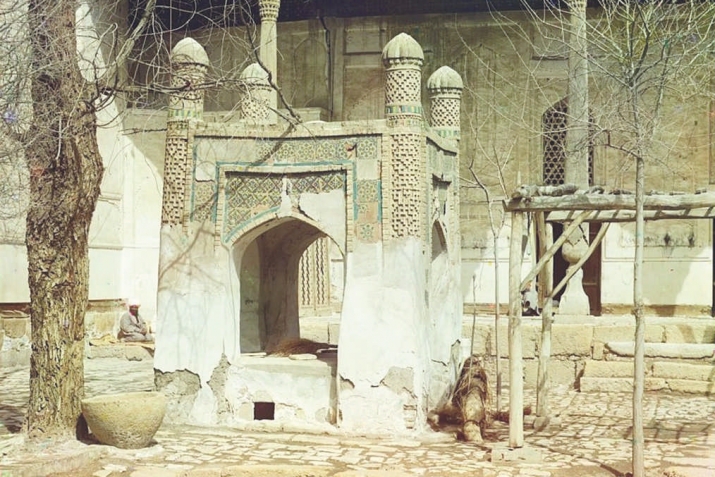
The rulers of the Shaybanid dynasty which followed the Timurids continued to devote themselves to Sufism and in 1544-45, Abd al-Aziz Khan dedicated his attention to the mazar of Sheikh Bahauddin. There he built a marble enclosure over the Sheikh’s grave and a perimeter wall defining the holy precinct (hazira), within which was a haus (open water tank) for ablutions and a little well head (sakhana) over a spring of sweet healing water associated with the sheikh. The khan also built a modest mosque abutting the precinct and a magnificent domed khanaqah (Sufi lodge) close by as a centre of worship, study and accommodation for the Naqshibandiyya. Over the course of next three and a half centuries, the mazar continued to be a major centre of pilgrimage and learning with successive rulers adding to its rich endowments.
Amongst the images of Prokudin-Gorskii acquired by the Library of Congress are seven photographs which he took at the mazar. Five of these are glass plate negatives, while the other two survive only as black and white prints in the album recording the photographer’s visit to Bukhara. Although all these images are unique and important historical records, they have not been the subject of a detailed and comprehensive scholarly analysis prior to that currently under being prepared for publication by the present author.
Five of the surviving seven photographs were taken at the holy tomb precinct of Sheikh Bahauddin. All five are in colour. One is of the little sakhana whose canopy is decorated with mosaics. Two other colour images are details of the portal to the precinct known as Bab-i Salam. One records the upper part of the portal’s exterior with a panel and spandrels decorated in blue and white glazed tile mosaic, while the other is of its red- and green-painted wooden doorway, noteworthy for its diverse assortment of metal door knockers. According to local tradition, these are offerings left in gratitude at this revered threshold by those healed by the waters of the spring adjacent to the Sheikh’s grave.
A fourth surviving colour image taken at the holy tomb precinct is of the upper part of a mihrab with richly decorated glazed ceramic elements. Key to the understanding of the location of this photograph is another colour image in the collection of the Library of Congress which has been incorrectly catalogued. Although the Russian International Research Project: The Legacy of S.M. Prokudin-Gorskii has since identified the image as being taken at the mazar, its exact positioning and significance have not hitherto been elaborated.
In fact, both these photographs are of an area within the inner tomb precinct of great importance to our understanding of the local Naqshbandi devotional rituals of that time. They are of an open devotional gallery (ayvan) situated on the perimeter of the holy precinct immediately to the west of the Sheikh’s tomb, just some metres away. The previously unidentified photograph is a general view of part the gallery in which a portion of the decorated mihrab can be seen. The gallery is bordered on the south by the Bab-i Salam entrance passageway and to the north by the Mosque of Muzaffar Khan built in the second half of the 19th century.
“Brought to life” by colour photography, we see two dark-turbaned men clad in traditional khalats kneeling in prayer in the gallery close to the qibla wall (i.e. in the direction of Mecca) and to the right of the mihrab. Near the mosque doorway a small circle of turbaned men, possibly students, are consulting religious texts together. The gallery is busy with religious inscriptions painted or hanging on its walls, decorative and inscriptional tilework, carved and painted woodwork and great hanging metal candelabras. Nothing has survived of the ornamentation of this devotional ayvan, which today no longer fulfills its original function as a dedicated devotional space where pilgrims were accustomed to worship in the intimate presence of their beloved Sheikh. Besides the rich contextual information it contains, the general photograph of the gallery has a particularly poignant religious and emotional resonance as being not only the earliest but the sole image – photographic or otherwise – known of pilgrims worshipping in the tomb precinct of Sheikh Bahauddin Naqshband prior to the dramatic transformations to Muslim life during Soviet rule, when worship at the mazar was strictly prohibited.
When Uzbekistan attained independence in 1991, the faithful were free to worship once again. Since then extensive reconstruction has been undertaken on the mazar’s historic buildings and the entire complex has been given a new configuration. Now known as the Bahoddin Nashband Bokhari Memorial Complex, the ziyarat has regained its importance and is visited by a constant stream of pilgrims from across the world.