

A Dirham of Caliph al-Amin
Caliph Harun al-Rashid, drawing on his own experience of ascending the caliphal throne, decided to address all potential succession issues for his sons in advance, especially given that he had many children.
He designated three of his sons as heirs, provided them with an excellent education, trained them as military and state leaders and established a clear order of succession for the caliphate. He announced this order before witnesses during the Hajj and required everyone to swear an oath on the Koran to abide by his will.
A Father’s Will Is Law for His Sons
The first heir was al-Amin; the second, al-Ma’mun; and the third, al-Qasim. Harun al-Rashid’s written testament stipulated that if al-Amin attempted to remove al-Ma’mun from power, he would forfeit his right to the throne. Al-Ma’mun was granted broad authority and designated as the ruler of Khorasan and Rayy; as Caliph, al-Amin was prohibited from interfering in al-Ma’mun’s affairs. In effect, al-Ma’mun was to become a virtually independent ruler. Significant authority was also granted to the third son, al-Qasim, who was appointed ruler of al-Jazira. Al-Amin and al-Ma’mun endorsed the testament and deposited it within the Kaaba. Thus, the rights and interests of each brother were safeguarded, ensuring a stable succession of power within the state.
Following Harun al-Rashid’s death in 193 AH (March 24, 809 CE), events unfolded exactly as he had planned: al-Amin was proclaimed Caliph. Al-Ma’mun took charge of Khorasan, while al-Qasim assumed control of the regions entrusted to him.
Contemporary accounts attribute the rift between the brothers to their viziers, who gave their masters poor counsel.
During the reign of Caliph al-Amin, gold, silver and copper coins were struck at numerous mints across the state.
Silver dirhams featured at least ten textual variations, all based on the standard established during the reign of Caliph al-Saffah. These variations differed only in minor details, such as benedictions for the Caliph, his titles and the names of the provincial governors under whose authority the coins were minted.
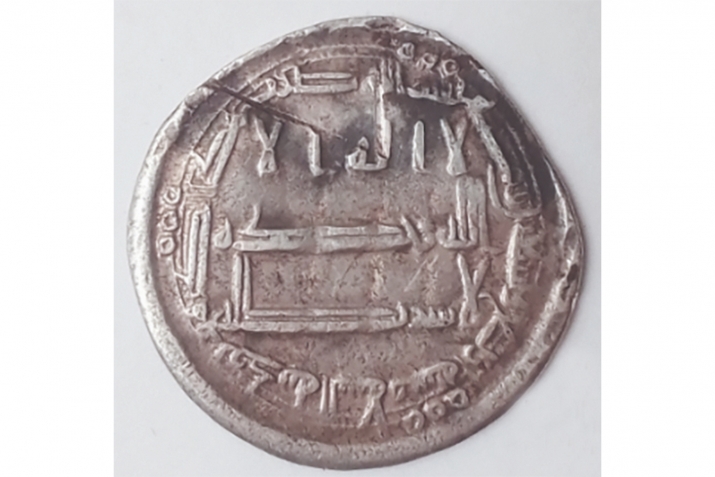
My collection includes a silver dirham of Caliph al-Amin. While the coin does not bear the Caliph’s name, it displays the date of minting: 194 AH. Another distinctive feature is the phrase “Rabbi Allah” (My Lord is Allah) inscribed in a unique script at the top of the reverse field, an inscription not found on other dirhams.
The inscription, highlighted in red, reads: “Rabbi Allah”» (My Lord is Allah). Obverse: The centre of the dirham bears a three-line inscription: “There is no god but Allah; He is One and He has no equal.” The marginal inscription reads: “In the name of Allah, this dirham was struck at Madinat al-Salam in the year 194 AH.” (corresponding to 787 CE).
Reverse: The central field of the coin features a three-line inscription: “Rabbi Allah” (My Lord is Allah) and “Muhammad is the Messenger of Allah.” The circular inscription on the reverse side, the so-called “second symbol”, consists of ayah 33 of Sura “At-Tawbah” from the Koran (paraphrased), “He (Almighty Allah) is the One Who sent His Messenger (Muhammad) with true guidance and the religion of truth to exalt it above all other religions, even if the polytheists dislike it.”
The silver dirham weighs 2.9 grams and has a diameter of 21 millimetres.
