

Aggression in Children: Causes and Proactive Approaches
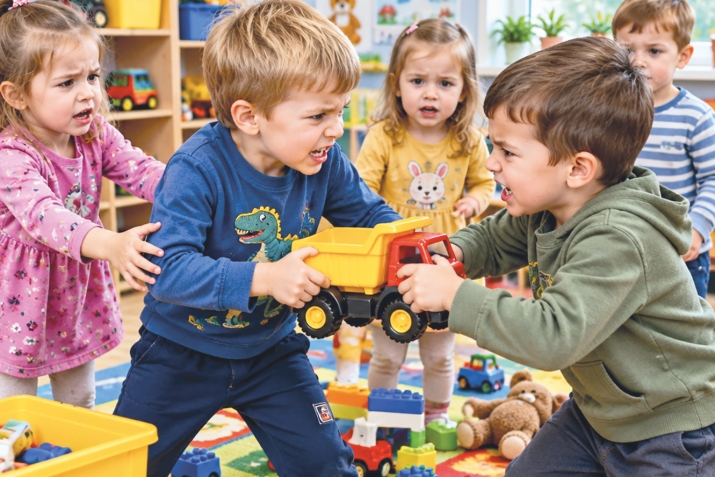
All children are born with aggressive impulses; this is a natural part of being human, serving to help them protect themselves and explore the world. As they grow, most people learn to manage these impulses.
Research from the University of Montreal, which tracked 35,000 children from the age of five months to twenty years, shows that aggression tends to peak around the age of one and a half: toddlers frequently get into arguments, bite, push, and express their displeasure quite loudly. By the age of five, many children begin to master peaceful ways of achieving their goals and the number of conflicts decreases. However, some children require more time and support to internalise social norms.
The instinct for aggression is innate and serves important functions. The task for adults is to cultivate human qualities such as compassion, tenderness and the ability to regulate emotions. These traits do not emerge on their own; a child learns to express affection gently and develop empathy through positive experiences, observing adult behavior and consistency in upbringing.
Modern Approaches to Parenting
Many parents today grew up in environments characterised by strict or harsh child-rearing practices, potentially experiencing a lack of attention or material deprivation during their own childhoods. It is understandable that they might want to provide their own children with what they themselves lacked. Yet, in practice, parenting often swings toward one of two extremes: total permissiveness or excessive strictness. Both approaches are harmful.
Permissiveness prevents a child from learning to consider the needs of others and leaves them without a clear sense of boundaries. Excessive strictness, on the other hand, leads to an accumulation of frustration, which can manifest as aggression. Often, outward cruelty masks a deep-seated need for attention and understanding. If a child begins to derive satisfaction from the suffering of others, it is a concerning sign; this is no longer merely an impulsive reaction but a developing behavioral pattern.
Punishment without explanation triggers a vicious cycle: punishment → irritation → further aggression → harsher measures. This does not mean that aggression should be ignored. It is important to distinguish between senseless, punitive action and the establishment of consistent, fair boundaries.
Consistency helps a child see the consequences of his actions and teaches him responsibility. Without such boundaries, an immature brain fails to grasp limitations, and a lack of consequences can lead to bullying and unchecked cruelty.
What does a modern approach to child-rearing look like in practice? It is neither authoritarianism nor total permissiveness, but rather a balance:
– love and support combined with clear, stable rules;
– teaching children how to manage negative emotions, with adults modeling constructive behavior;
– explaining the consequences of actions and using restorative practices to help mend any harm caused;
– the ability of adults to listen to the child, understand the underlying reasons for their behavior and manage their own reactions;
– children often mirror the behavior they see in the adults around them.
Raising a child is a long-term process of working on oneself and on the relationship. True care does not mean shielding a child from every difficulty; rather, it means providing them with the necessary tools: the ability to empathize, regulate emotions and take responsibility. In this way, aggression remains a manageable impulse rather than turning into a destructive force.
Causes of Childhood Aggression: Why This Might Affect Your Family
Adult behavioral models. If conflicts within a family are resolved through shouting or force, the child will remember the behaviour rather than any moral lessons. Research indicates that children from families where violence is present are more likely to exhibit aggression at school. When adults fail to acknowledge their own mistakes or apologise, the child receives no signal that aggression is unacceptable.
Overprotection and total permissiveness. Without clear boundaries, a child fails to learn how to consider the feelings of others and instead tests the limits of rules through behaviour that can manifest as the humiliation of peers or the violation of social norms.
Encouraging retaliation. The “hit them back” mentality fosters a habit of resolving conflicts through force rather than by seeking compromises.
A lack of time and attention. The fast pace of modern life leaves less time for meaningful interaction. When children lack adult guidance, they often seek out alternative authority figures online or among peer groups on the street.
Research indicates that a significant number of adolescents believe the content they encounter on social media influences their behavior more than the advice of their parents.
Emotional deprivation. A lack of closeness, attention and the ability to truly listen to a child fuels frustration. Punishing a child without providing an explanation or support only reinforces this cycle.
Understanding the root causes of cruelty provides a roadmap for action. Simple steps, such as apologising when appropriate, explaining the consequences of actions, setting clear boundaries and spending quality time together without distractions, can alter a child’s developmental trajectory. Monitoring what a child watches and who they interact with online also helps to mitigate the influence of aggressive external models.
Preventing Aggression in Children
A key tool for prevention is the development of emotional intelligence. Fostering empathy and a sense of responsibility is equally important. Teach your child to take accountability for his actions using concrete examples: if he breaks someone else’s toy, suggest apologising together and brainstorming ways to set things right.
When boundaries are crossed, a conversation, such as “You hurt your sister’s feelings and now she does not want to talk to you”, helps a child see the consequences of his behavior and discover ways to make amends through apologies and restitution. An environment where adults calmly articulate their own emotions: “I am feeling angry because...” – provides children with a foundation for self-regulation.
In today’s world, it is essential to be mindful of the content a child consumes and the environment he inhabits. While gadgets and the internet offer valuable resources, they also shape behavioral patterns. Rather than imposing strict prohibitions, try watching videos together and discussing them. Explain the dangers of online aggression and suggest alternatives, such as going for a walk, playing sports or visiting the theater. Experience shows that children who regularly engage in sports or creative activities are less prone to aggression, as they find constructive outlets for self-expression and socialization.
Teach your child how to defend himself without resorting to aggression. Ignoring provocations and using brief, calm responses can help de-escalate a situation. Phrases like “That is not funny” or “Are you doing okay?” deny the aggressor the emotional reaction he expects and may even prompt him to reflect on his behavior. Teach your child that asking for help is not a sign of weakness but a sensible decision.
Ultimately, prevention is impossible without a trusting, open dialogue. Make it a daily habit to ask: “What brought you joy today and what made you feel upset?” Do not justify misbehavior; instead, help the child find alternatives: “You got angry, how could you express that anger differently next time?” Ongoing dialogue and the active involvement of adults reduce a child’s sense of loneliness and lower the risk that they might seek to prove their own strength by causing harm to others.
Preventing cruelty is a long-term endeavor for adults and those in the child’s environment. It requires patience, consistency, and a willingness to work on one’s own reactions. By being ready to listen, explain, provide tools for expressing emotions and limit the harmful influence of one’s surroundings, you do more than just reduce the risk of aggression –you help the child grow into a person capable of feeling for, understanding and respecting others.
