

Al-Karaji’s Method of Calculation
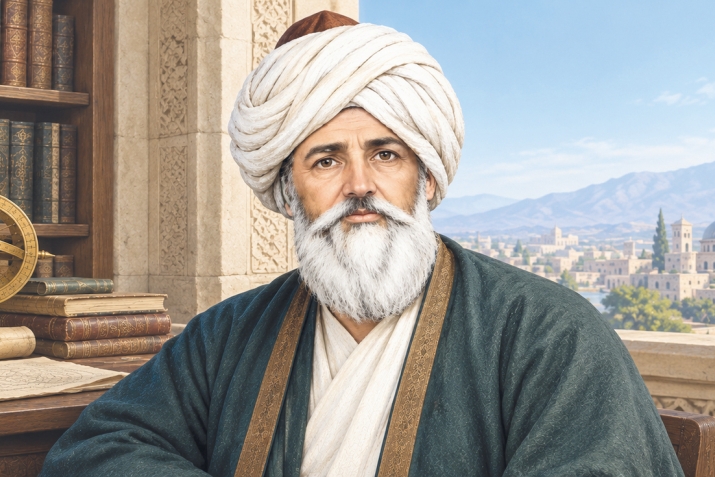
Abu Bakr al-Karaji, a prominent Persian scholar, is one of the founders of algebra.
The full name of this 10th-century mathematician was Abu Bakr Muhammad ibn al-Husayn but he became famous under the name al-Karaji, as he hailed from the city of Karaj in present-day northern Iran.
Relatively little information about his life has survived, as is the case with many scholars of his era. It is known that al-Karaji lived in Baghdad for a long time, conducting scientific research, and died in the 11th century.
Al-Karaji defined algebra as a “method of calculation that allows for finding unknown quantities using known ones.” His major achievement was that he began solving algebraic problems using purely mathematical methods, without recourse to geometric figures. Thus, al-Karaji pioneered an algebraic method that did not rely on geometric diagrams, thereby demonstrating that algebra could exist as an independent discipline.
The historian, orientalist and mathematician Franz Woepcke noted that al-Karaji was “the first mathematician to propose the most advanced algebraic theories of calculation in the Islamic world.” Al-Karaji also created a table of binomial coefficients and described the principle of their additive generation as well as the binomial formula. He was the first to systematically employ algebraic methods of calculation, working with both determinate and indeterminate equations and deriving not only square roots but also cube roots.
Abu Bakr Muhammad succeeded in taking algebra beyond the confines of Euclidean geometry and establishing it as a distinct discipline. Thanks to his work, algebra took on its modern form, and his writings remained relevant well into the 17th century. In his work “The Book on Algebra and Muqabala”, he presents methods for determining the sum of an arithmetic progression, as well as the sums of the squares and cubes of consecutive numbers.
In the treatise “The Sufficient Book on Arithmetic”, he provides a practical guide for calculators, paying special attention to fractions in the traditional Old Arabic format.
Furthermore, al-Karaji was a hydrologist. In the book “On the Extraction of Hidden Waters”, he describes the physical characteristics and vegetation of soils containing water sources and outlines definitions of water sources and techniques for extracting groundwater. This allows him to be described as the first hydrological engineer.
