

Al-Khwarizmi: An Islamic scholar, the founder of algebra
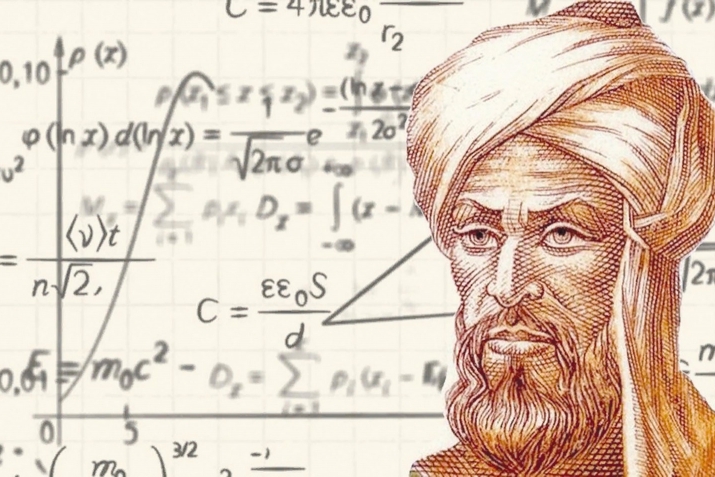
We all study algebra at school. What is it for anyway? I found the answer on the Internet: “it helps to develop logical and analytical thinking, to find an unconventional solution”. And the great Mikhail Lomonosov was convinced that “mathematics should be taught only because it puts the mind in order”. It turns out that it improves thinking.
Who became the founder of algebra?
The father of algebra is al-Khwarizmi. The founder of algebra, zero, algorithm and sine, Abu Abdullah Muhammad ibn Musa al-Khwarizmi, is known throughout the planet for many discoveries. Thanks to his creation of the algorithm, we have computer technology. When launching a GPS system, you should thank this great scientist, because it was he who divided our planet into parallels and meridians, as a result of which every point on our earth was allocated to have clear coordinates of longitude and latitude.
In Khorezm in 1978, on the territory of modern Uzbekistan, this outstanding scientist was born. He received an excellent education and lived in his hometown for 28 years. Later, at the invitation of the ruler al-Mamun, he moved to Baghdad, where he was appointed head of the famous centre of knowledge “Bayt al-Hikma”, which can be considered the Islamic predecessor of an Academy of Sciences. This institution was famous for its extensive library of ancient manuscripts, as well as its unique observatory, where numerous studies were carried out.
In Baghdad, the scientist worked in a creative team with other outstanding scientists of his time and was able to create twenty scientific works. Nine of these works were so significant that their formats could be described as folios – large books measuring about 45 cm in height and weighing approximately 7 kg.
This Muslim scholar had wide knowledge and worked in various fields of science, including geography, history, astronomy and mathematics. However, his greatest contribution to science is considered to be the work called “A Short Book on Restoration and Contrast”. This book is the fundamental text of a new direction in mathematics – algebra (from the Arabic “al-jabr”). In it, the author describes his approaches to algebraic calculations, setting out both simple and complex arithmetic problems that were relevant for his time.
Another of the scientist’s most important works was “The Book of Addition and Subtraction in the Indian Method”, which also had a significant influence on the development of arithmetic, an important part of mathematics. The method he created became known first in Europe and then throughout the world. With the help of the mathematical discoveries of this Arabic-speaking Muslim, European scientists became familiar with Indian numerals and called them Arabic and the decimal system became known as the algorithm.
“The Book of the Picture of the Earth”
The fruitful mind of Abu Abdullah Muhammad was interested not only in algebra. Thinking about the planet, he equipped a scientific expedition to Byzantium, Khazaria and Afghanistan, where he engaged in scientific field research. Thanks to him, the length of one degree of the earth’s meridian was calculated and the circumference of the Earth was measured. For this, the expedition visited the area of the Iraqi city of Sinjar, and the scientist calculated that the length of a degree is 56 Arab miles (113 km), and also determined that the length of the circumference of the Earth is 40,680 km. And this was the 9th century!!! The current determination of the circumference is 40,075 km.
His work in the natural sciences fostered the development of geodesy, geography, and cartography. In his work “The Book of the Picture of the Earth”, written in Arabic, al-Khwarizmi was the first to describe the inhabited part of our planet, drew a map indicating 2,402 residential areas and the coordinates of the principal points. This data was taken as a basis by geographers and published in 1037 in the Arab and Muslim East. This map was used for 700 years. In the 20th century, this work on geography became of interest in Western Europe. Al-Khwarizmi, who made relevant discoveries in the 9th century, showed the world the constant importance of knowledge in the general social plan.
The works of the great scientist are carefully preserved across the globe in highly respected museums, libraries and universities. In the 20th century, he was written about with admiration: “Al-Khwarizmi influenced mathematical thinking to a greater extent than any other medieval writer.”
Al-Khwarizmi, like most outstanding scientists, had immeasurable power of spiritual perfection. He understood that the Holy Koran contains the highest knowledge and is the source leading to the secrets of the universe.
