
Britain’s First Mosques – Part 2
The founding of the first mosques in Britain -by Englishmen in the late 19th century and by ethnic Muslim immigrants in the mid-20th century-was pivotal in the long process of the absorption of Islam into the living tissue of British society. Since at least the 16th century ethnic Muslims in modest numbers had resided in or visited Britain where -beyond the public eye-they used private spaces for their devotions. However,the first mosques to be acknowledged as formal Muslim places of worship by the British establishment were those of the Muslim Institute in Liverpool (founded in 1897) and of the Oriental Institute in Woking near London (founded in 1899). Each was the outcome of initiatives led by individuals from the ruling echelons of British society,in the first case,by Sheikh Abdullah Quilliam, and the second by Dr Gottlieb Wilhelm Leitner (1840-1899).
Transplanting Islam – Imperial Elites and Humble Seamen
Leitner was born in Hungary as Gottlieb
Wilhelm Saphir to a family of Jewish ancestry who converted to Protestant Christianity. His father died when he was very young and his mother took him and his sister to live in Istanbul, where she married another Jewish convert to Protestantism, Dr Johann Moritz Leitner, whose new family took his surname. An Anglophile, Dr Leitner was a physician working in the Ottoman domains for the Society for Promoting Christianity among the Jews. Gottlieb demonstrated a prodigious ability in languages and when eight years old began studying Arabic and Turkish in an Istanbul madrasa. He later studied at Malta Protestant College which gave students from the Levant a British education as well as training in divinity and in the principal languages of the region; with the aim of creating a vanguard for Protestant Christianity.
At fifteen years of age, Leitner was appointed Interpreter (First Class) to the British Commissariat in Crimea during the Crimean War. He entered King’s College London as a student in 1858, but soon began lecturing in Arabic, Turkish and Modern Greek and in 1863 was appointed Professor of Arabic and Mohammedan Law (in 1862 he had become a British citizen). In 1864 he moved to India as Principal of Government College, Lahore, later becoming Registrar of the new University of Punjab. He was a prolific scholar and was considered one of the world’s foremost orientalists. He wrote a history of Islam in Urdu as well as an Arabic grammar and founded Al-Haqa’iq, an Arabic quarterly journal. Although he adopted the Muslim name Abdur Rashid Sayyah and could recite the Holy Koran from memory, it is unclear whether he actually converted to Islam.
In 1883 Leitner founded the Oriental Institute in Woking, his vision being that it would become the acknowledged centre for oriental studies in Britain and that in time it would be granted full university status: by the late 1890s it was already awarding degrees through affiliation with the University of the Punjab.

His plan included building places of worship to cater for students and others from the major religions of Islam, Judaism and Christianity. He was only able to build a mosque before his premature death in 1899. It was named after its patron Begum Shah Jahan, the ruler of the Indian princely state of Bhopal, patron of the Government College, Lahore and founder of the Taj-ul Masajid at Bhopal, one of India’s largest mosques. Opened in late 1889, the Shah Jahan Mosque was the first purpose-built mosque in Britain - a small, elegant building in faithful Indo-Islamic style designed by a local architect William Chambers.
Within a few years the mosque had become a centre for Muslims in the south of England, including prominent converts from the nation’s ruling strata. Following Dr Leitner’s early death, the Oriental Institute closed as did the Shah Jahan Mosque, until it was bought in 1912 by an eminent Indian lawyer and Ahmaddiya Muslim scholar Khwaja Kamaluddin who founded the Woking Muslim Mission and Literary Trust with the collaboration of Syed Ameer Ali, a member of the Indian Privy Council, Mirza Sir Abbas Ali Beg, Sir Thomas Arnold and other British converts. The mission became an international hub for the dissemination of Islam in the West and for inter-confessional dialogue. The mosque mainly served a congregation of socially privileged converts, highly placed Indian Muslims resident in Britain and official representatives of Muslim countries - a face of Islam accepted by the British establishment. The Woking Muslim Mission provided valued support for Muslim Indian Army soldiers deployed in Britain in both world wars.
Almost completely bypassed in the conventional narrative celebrating the part which the first ‘official’ British mosques and their congregations played in the transplantation of Islam into Britain is the experience of another group of Muslims already embedded there. In the late 18th and 19th centuries Britain had become the world’s dominant sea power. Its vessels, both naval and commercial, relied to a considerable degree on Muslim sailors recruited in western Indian Ocean ports of the British Empire or its protectorates. Ships manned by Muslim Indians, Yemenis, Adenese and Somalis regularly used the principal British ports of London, Liverpool, South Shields and Cardiff (in Wales), where their crews developed permanent communities immediately adjacent to the docks.
British attitudes to Muslims and other colonized non- Europeans in the 19th and the first half of the 20th century were dominated by intransigent beliefs in British cultural, moral, racial and religious superiority. Thus, paradoxically, while Muslim seafaring subjects were an essential human resource for British shipping and served valiantly in both world wars, their reality was decades of exploitation, xenophobia and discrimination, and the segregation of their port communities. It was not until World War II that the broader British public began to accept them as a consequence of their gradual societal integration and in acknowledgement of their sacrifices in the war.
During these trying times, Islam was the solace and source of social cohesion for these Muslim Indian and Arab seafarers and their families and provided their strength to persist in asserting their rightful place in British society. Many Muslim sailors married British women who converted to Islam, valued and vocally supported their husbands publicly and brought up their children to be exemplary members of society. Unable to build mosques as visible places of worship in the public space, these tight-knit traditional Muslim communities adapted interiors of buildings in their communities as places of prayer, education and community service, which fulfilled the functions of a mosque: which they called ‘zawiyas’, Sufism being a major element of their religious practice.

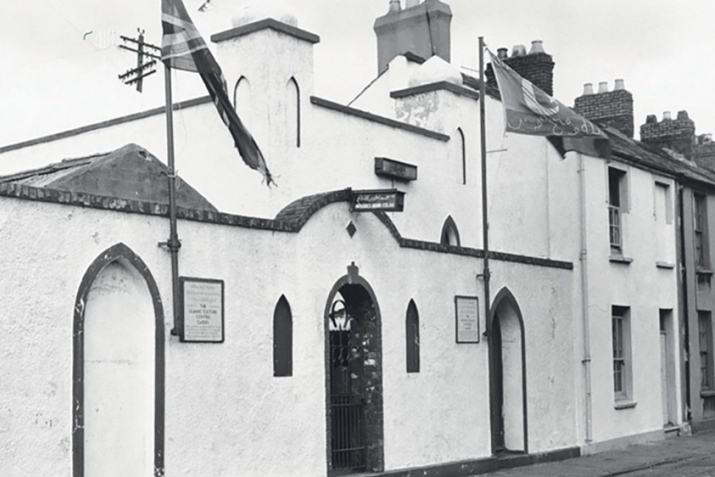
It was not until just after the end of World War II that an ethnic Muslim immigrant community - that of the Yemenis of Butetown, Cardiff - was able to construct a mosque, architecturally distinguishable as such and in full public view. Partly built with government funding, their Nur al-Islam Mosque – a neat modest building with a small dome and four low minarets, reflecting the modest nature of their working class residential suburb – was opened in 1946 with great community celebration, including the participation of King George VI’s Lord Lieutenant, emphasizing the official acknowledgement of Islam in Wales.
Today there are more than 1,750 mosques in Britain. Islam is the second largest religion after Christianity and is the fastest growing in the country. Between 2001 and 2009 the Muslim population of Britain increased almost ten times faster than the non-Muslim population and by 2016 exceeded three million (5.4% of the total population). Muslim birth rates are soaring: some 10% of British children under five years of age are Muslim. The name ‘Muhammad’ (or variants thereof) was the most commonly given name for baby boys born in England and Wales in 2015. Muslims are playing an increasingly prominent role in political life, including the present Lord Mayor of London, Saddiq Khan, fifteen Muslim Members of Parliament elected in 2017, and twelve peers in the House of Lords. A remarkable history, indeed.

GHAYDAR PETHERBRIDGE, PROFESSOR,EXPERTONCULTURAL HERITAGE AND HISTORY OF ISLAM, AUSTRALIA, RUSSIA