
History of hajj in Russia
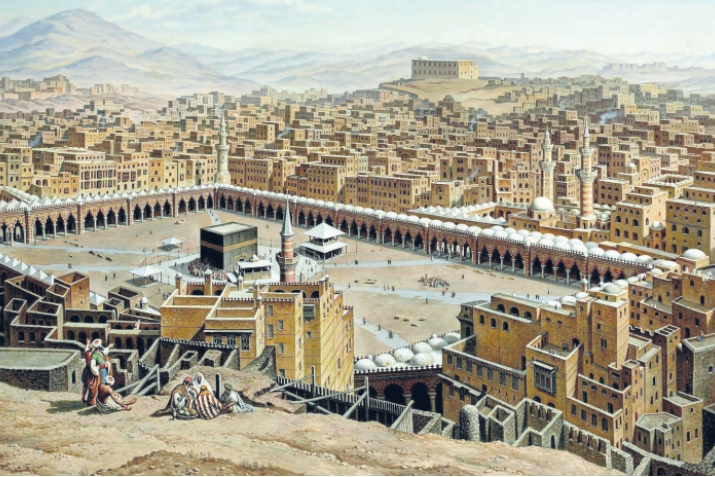
The Soviet period of the history of the Russian State is marked, beginning with repression and ending with the collapse of mosques and their transformation into cattle yards, the expulsions of Alims (scholars) to Siberia (and often simply their unaddressed disappearances), the prohibition of prayers, the reciting the of the Koran and the performance of the Hajj pilgrimage.
Several decades have now passed and the attitude to religion in our country has changed radically. There is a construction boom in mosques, madrasas, Islamic universities, prayer can be done in a university corridor, at a bus station or at a petrol station and nobody will point a finger at you. But until this change, a Muslim had to do all the duties that are supposed to be performed according to the requirements of Islam secretly, hiding in secluded corners.
In Soviet times the fulfilment of the fifth pillar of Islam the pilgrimage to the shrines of Mecca and Medina Hajj was almost impossible. Almost impossible, but still reality for those who had Iman (faith) the desire to accomplish fard and at the same time possessed the skill and ability to break through ideological barriers and prohibitions.
Historical background
The first Russian decree on the Hajj, which allowed Bukharans residing in the territory of Russia to receive passports and perform the pilgrimage to Mecca, was signed by Tsar Alexander the First on 23 March 1803.
Since the 1870s the Hajj related problems of Muslims who were Russian subjects had become actively discussed in foreign affairs agencies: the Russian Ministry of Foreign Affairs, the Russian Embassy in Constantinople and in the Russian Consulate in Jeddah which was opened in 1891.
Moreover, the heads of administrations of those regions where Muslims lived compactly were also involved: the Novorossiysk, Turkestan and Bessarabian governors general and the governor of the Caucasus.
This was mainly a consequence of the Caucasian War of 1818-1864 and the accession of the greater part of Turkestan, territories with a Muslim population which differed sharply not only from the centre but also from those parts of internal Russia where Muslims lived compactly (the Volga region). Higher level authorities demanded from local officials that they report the situation concerning the pilgrimage of Muslims and make decisions based on this information.
The Russian authorities issued passports to Muslims with extreme reluctance because they believed that “Hajj brings huge material benefits to Turkey by donations which are used for military needs” and also that “during the Hajj, various epidemic diseases appear and develop, mainly cholera and the plague.”
Statistics gathered by the Russian administration also caused concern. Thus, it was established that in 1898 some 1,793 Russian citizens visited Mecca: pilgrims from Russia also travelled to Mecca without passports.
At the turn of the 19th and 20th centuries the annual Hajj was undertaken by about 5,000 to 10,000 Russian Muslims travelling to Mecca.
What happened subsequently
Very different people came to power in our country and there was no talk about thousands of “Hajj” pilgrims anymore. As noted above, it was forbidden to do everything prescribed by Islam: pray, fast, visit mosques (that were destroyed, turned into stables or cultural centres in short, religion was destroyed as best the authorities could.
This concerned not only Islam but other faiths as well. However, those who engaged in such unseemly acts certainly did not know that you may destroy, damage and trample on the external manifestation of faith but the internal content is never destroyed. Faith still remained in the souls of Muslims.
Successive generations of many ethnic Muslims became so Russified that it is still difficult for them to find their roots. However, this does not mean that they do not realize their nationality and their confessional identity.
The Hajj itself has always been quite difficult to accomplish because of the material cost and varying physical, psychological and moral challenges. Whenever there has been a ban “from above” additional complications have had to be met. For those who still managed to achieve this, the hajj became a heroic deed. During the Soviet years, no more than 20 people from the USSR travelled annually to Saudi Arabia to perform the pilgrimage. Many historians say that this period has been little studied in relation to the Hajj due to many archival materials being still classified and thus inaccessible to the general public for reading and analysis.
There is minimal information. It would seem that, although much is known to us about those not the best of times, the fifth pillar of the Islamic faith the Hajj during the Soviet era still remains largely a mystery.
Personal stories
Jabrail:
“Today I’m already over 70. At the time when I decided to fulfill my duty at any cost, I was just under 40. To perform the Hajj, I had to employ all my ingenuity. Going abroad, and especially to Saudi Arabia, was simply unrealistic, and it could cost me a certain punishment. What did I do? I just decided to go abroad anywhere, on vacation for spa treatment. To do this, I had to buy the test results of actual sick patients, so that based on them doctors would provide me with a medical assessment that I needed to undergo a course of treatment abroad.
Then it happened. Using such documents, I got a ticket to Bulgaria, to one of the best sanatoriums. Having broken out of our country, I had a great opportunity to go wherever I wanted. My path lay to the homeland of the Prophet Muhammad (peace and blessings be upon him). From Bulgaria through other countries I reached Saudi Arabia. So I fulfilled my duty as a Muslim, Alhamdulillah. Then I managed to return again to Bulgaria and from there to my home.”
Yusuf:
“I went to Hajj on foot. The route, of course, was very difficult, complicated and long. But at my own peril and risk I decided to perform the Hajj. It is our duty fard and it cannot be abandoned, if there is an opportunity to fulfil it. To go on such a long trip together with a group was also impossible; too great a risk. When alone, however, somehow it was easier, but here at home everyone could suffer.
Therefore, I warned all my relatives on the day of leaving home that everyone should keep their mouth shut. Taking with me very few things only the most necessary I went out on my way, trusting only in Allah. I was to see many interesting things but most of all I was pleased with the hospitality of Muslims from other countries: they helped me, provided me somewhere for the night and fed me. Three months later I reached Saudi Arabia. So I did the Hajj. I returned by the same route. Praise be to Allah that by His grace and will all boundaries and barriers are relieved, when there is pure intention.”
Hajj today
After the collapse of the Soviet Union, all prohibitions on religion were lifted. You could openly present yourself as a Muslim: pray, visit the mosque and, of course, perform the Hajj!
In 1990, some 1,500 pilgrims went to Mecca from Russia. From 1990 to 1993, the number grew slightly. But since 2003 it has almost doubled every year. By 2019 this figure was more than 20,000.
It is absolutely real and possible to perform the Hajj these days, and opportunities are open via any route. Alhamdulillah, we have survived to such a day that, without being embarrassed by anyone and not hiding from anyone, we can fulfill our duty!
The Hajj is performed by persons who have the physical and financial opportunities to do so. And May Allah grant the opportunity to everyone who wishes to fulfill the fifth pillar of Islam! Amin.
Source: Islam.ru