
The 11th-Century Nizamiyya Madrasah in Dagestan
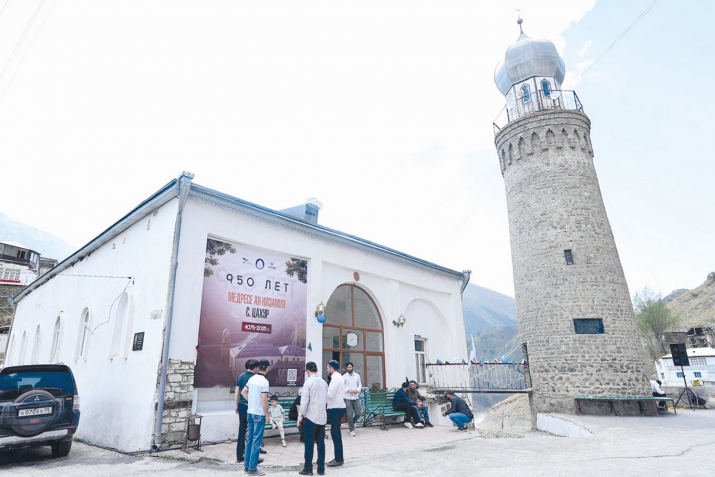
Find yourself in the high mountains of the Dagestani village of Tsakhur and you will literally touch history.
Just reach out and touch the walls of the first university-type madrasa in the North Caucasus, which is located here.
Almost 950 years ago, in 1075, a madrasa was opened in Tsakhur by order of the famous Seljuk vizier Nizam al-Mulk.
The vizier was so persistent in his pursuit of education that by the end of the 11th century, a whole network of Nizamiyya madrasas had sprung up across the Middle East, in the cities of Nishapur, Herat, Isfahan, Merv and Mosul.
The contribution of the educational institution opened in Tsakhur to Islamic education was truly invaluable. Its graduates included scholars who later became renowned far beyond the region, including Osman Efendi, Abdullah Efendi of Tsakhur, Kurban Efendi of Mishlesh, Ismail Efendi of Gelmets and Abdurakhman-Jamaletdin al-Sugyuti. They were well known in the Golden Horde, Bukhara and Baghdad.
The madrasa had an excellent library and students were provided with free food and accommodation. A large number of young people from various corners of Dagestan, as well as from neighboring countries, came here to gain valuable knowledge.
According to the Islamic historian A. M. Salyabi, “one of the conditions for teaching at the Nizamiyya Madrasah was that the teacher must adhere to the Shafi’i madhhab.” Emphasis was placed on two main areas: Islamic law according to the Shafi’i madhhab and the fundamentals of the Ash’ari faith. In addition, such subjects as hadith, Arabic syntax and Arabic language and literature were taught.
According to the historical and geographical chronicle of the Arab traveler Zakariya al-Qazwini, all residents of Tsakhur were Shafi’i. According to him, madrasa teachers translated al-Muzani’s “Mukhtasar” into Lakzan, as well as the book of Imam al-Shafi’i, and taught students from these two books themselves.
Madrasah occupied a middle position in this educational hierarchy, and its curriculum was comparable to a secondary school. Unlike maktabs, madrasas were not ubiquitous and functioned only in large settlements of Dagestan. For example, in the 14th and 15th centuries, such madrasas existed in the large Dagestani villages: Kumukh, Akhty, Rutul, Tpig, Richa, Khunzakh, Khuduts, Gubden, Khnov, Arkas, Ansalta and Endirey.
In his essays on Dagestan, the Russian ethnographer and linguist P.K. Uslar wrote about this phenomenon, “If public education is judged by the proportionality of the number of schools to the population, the Dagestani highlanders in this regard are ahead of even many enlightened European nations. Education is accessible to every mountain boy.”
The “heart” of the Tsakhur mosque is its rare manuscripts and Quran, some several centuries old. It is worth noting that the long-term preservation of such valuable manuscripts requires appropriate conditions. Consequently, the village has come to the conclusion that it is necessary to open a museum to house these ancient manuscripts. Ancient manuscripts contain both the history of the entire village and memorable events associated with the madrasa: arson attacks, earthquakes and hostile raids.
The building was destroyed twice and both times it was rebuilt by local residents. During the Soviet era, a comprehensive school operated here. Only in the 1990s, at the request of the villagers, was a mosque opened within the madrasa’s walls. Today, the Nizami Madrasa is in need of serious renovation. This is clearly evidenced by the numerous cracks both inside and outside the building.