
The Golden Horde and Islam
When studying the history of the Golden Horde, Russian school textbooks, as a rule, do not see a special difference between Mongols and modern Tatars, and this in turn leads to such a widespread but obviously erroneous view - that the warriors of Khan Batu represented the Muslim army.
This opinion is formed as if by default. An in depth approach to the coverage of this topic in the study of the Golden Horde period of Russian history is practically absent.
However, historical facts show us that the clashes with the conquerors did not follow the principle Christians against Muslims, and even not Slavs against the Turks. The battle of Kalka already makes one consider the obvious fallacy of this approach, as it is known that the army of Subede was confronted by the united army of Russians and Polovtsians, who, as it is known, were Turks.
Another historical fact, which makes it clear about the error which has crept in, is the defeat of Batu in Muslim Volga Bulgaria, after which part of the Bulgars even find shelter in the Russian territory.
But what was the ethnic and religious background of the warriors of Genghis Khan? Obviously, the leaders of the army were Mongols, although there were many Turks in the army. But were they Muslims? It can be said that if there were followers of Islam in the army, they were 0.01%, since the overwhelming number of soldiers were ordinary non believers.
But within a short period of time the Chingizids turned to Islam, which is undoubtedly a kind of miracle, since the conquerors actually accepted the religion of the peoples they have conquered. Approximately from the mid-13th to the mid-15th centuries, the Islamic dogma, significantly expanding its borders, became the ideological basis for many tribes and peoples of Eastern Europe and Western Siberia. The first Muslim khan was Batu's brother, Khan Berke, who accepted Islam from Sufi preachers.
Despite this, no religious harassment in the virtually independent state was followed. However, the Muslim tribes and peoples that entered the new state received additional impetus for their further development.
However, the Chingizids almost never interfered in the internal way of life of the conquered peoples, as evidenced by the history of Orthodoxy in Russia. Even the notorious historian, N. Karamzin, who did not evince much sympathy towards the Tatars, had to admit that Khan Berke “allowed the Russians to freely observe Christian worship, so that Metropolitan Kirill in 1261 established for them a special exarchy called Sarskaya”.
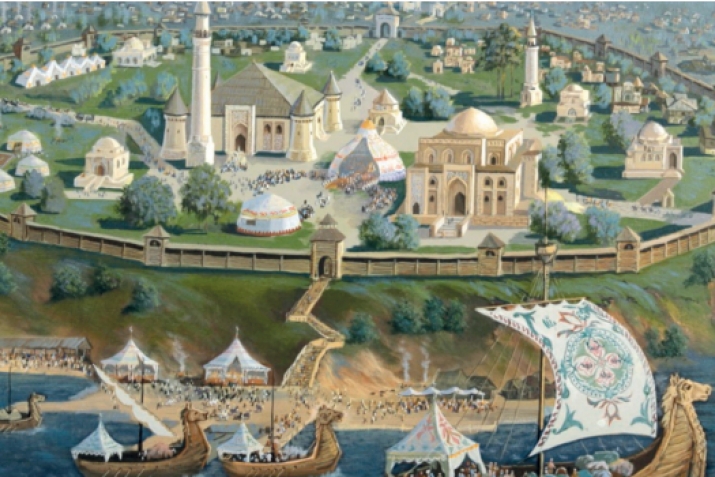
Under Khan Berke, close contacts were established with the state of the Mamluks in Egypt, which, naturally, spiritually enriched the peoples of the Golden Horde. At the same time in the capital, named after the Khan, Saray Berke, as well as in many other cities, the construction of mosques and madrassas was encouraged.
However, soon such a policy met with fierce resistance from the elite surrounding the khan, who demanded that he observe the Yasa of Chingizkhan. As a result, the spread of Islam came up against tangible obstacles, especially of the supreme shamans, who still had a certain weight in nonbeliever circles, whose representatives made up a large part of the Horde elite.
After the death of the first Muslim khan, non-believers rose to the throne but many representatives of the elite were already subdued by the strength of the spirit of Islam, which eventually helped Uzbek Khan, who not only officially professed Islam, but also elevated it to the rank of state religion. The new ruler of the Golden Horde, unlike his ancestor Khan Berke, did not tolerate the resistance of the shaman nobility and after their frank declarations he dealt with them according to the laws of wartime (especially since disagreeable khans often died under unclear circumstances, such as Khan Berke).
With the rise of Islam to the rank of official religion, an unprecedented flourishing of this powerful and vast state began. It was at this time marked by the rapid construction of new cities, in which mosques and madrassas were almost everywhere erected.
Does this mean that non-Muslim nationals were oppressed and discriminated against? Some historians speak of the extreme intolerance of Uzbek Khan, proclaiming him to have been an “Islamic fundamentalist”, citing the example of the destruction of the shaman elite, the reasons for which have already been outlined. But at the same time, the attitude of the Khan to Christians, and first of all to the Orthodox, is ignored.
What was it like? “It's amazing”, writes the famous historian R. Landa, “but the strengthening of Islam in the Horde was accompanied by the strengthening of Orthodoxy in Russia.” Yes, for many it really seems amazing but not for those who are familiar with the history of the spread of Islam.
As we know, it was numerous Christian communities were preserved in the territory of the Caliphate, which were constantly oppressed by the official Church, be it Roman or Byzantine. Thus, a tolerant attitude towards Orthodoxy was the normal continuation of a true Islamic policy towards the Gentiles. And if one or another ruler rejected such a policy, this was a departure from the norms of the Islamic code of laws and regulations.
The reign of Uzbek Khan is considered to be the highest point in the history of the Golden Horde, because at this time military actions have become so subtle that many cities, including the capital itself, did not even possess barriers and fortifications. Naturally, with such realities, science and trade were in the front row.
As already noted, educational institutions and libraries were being built everywhere, an integral part of any madrasa. In addition to religious institutions, a range of social and social structures were built from chambers of justice to hospitals.
Despite the fact that at the level of popular mass consciousness in Russia the Golden Horde is perceived as a kind of barbaric “parasite state”, it is obvious that this does not correspond to the truth at all. After all, in such states, one could hardly expect the appearance of all that has been described. And one more example, testifying against such an unfair and biased approach, is the flowering of poetry and literature of the time, which could not be expected of ignorant barbarians.
As for trade, the geographical position of the Golden Horde simply provided all the necessary prerequisites for the successful development of this vitally important activity. The famous ‘Great Silk Road’ ran practically through the entire territory of the state, which, of course, contributed to the prosperity of the superpower of that time. In fact, the ‘steppe’ state was turned into a ‘merchant-trade’ state, which, undoubtedly, was due to Uzbek Khan and his Islamic policy.
In addition to relations with the countries of Central and East Asia, relations with the Arab region, and especially with Mamluk Egypt, were also strengthened. As already noted, such connections had been established by the first Muslim Khan Berke but under Uzbek Khan relations reached a new level connected with another interesting and remarkable historical fact.
The fact is that the Mamluks were in a very difficult situation, being in close proximity to other Chingizids. Khan Khulagu, being a non believer, went through the remnants of the Caliphate with fire and sword, almost reaching Egypt. In this situation, Khan Uzbek rendered his resolute support to his co religionists and sent troops to the rescue.
After the defeat of Khan Khulagu, the army of the Golden Horde defeated the army of his son, who had inherited his father's throne. Naturally, this contributed to the revival of Muslim lands, ruined and overturned by these invasions.
Unfortunately, the Khan was not followed by worthy successors, as a result of which, within two decades, the state entered a period of internal feuds. But even in these conditions, Islam continued to rapidly conquer an increasing number of tribes and peoples.
For example, according to archaeological data from about the 14th-15th centuries in the steppes of Eastern Europe previous burial practices were replaced by the Muslim rite. All this once again proves the mighty potential of Islam, both the religion proper and its way of life.
The history of the Golden Horde, undoubtedly, still awaits its objective researchers, who would reveal to Russians much of what remains behind the scenes.
MUSLIM ABDULHAKOV