

The one who was brought up in the house of the Prophet ﷺ
The one who was brought up in the house of the Prophet ﷺ
Hasan al-Basri went to a meeting place, where a palace was in construction, in order to address people with instructions, remind them of important truths and urge them to be indifferent to worldly goods and to strive for what is with the Almighty.
Having reached the place, he saw many people walking around the majestic palace in amazement: the builders were so skillful, the palace was so huge and the patterns and decorations covering it were so beautiful and intricate.
Al-Hasan, having risen, addressed those gathered there with a speech, “We examined the palace and this is one of the worst buildings.” We know that Pharaoh built something greater and higher than this but Almighty Allah destroyed Pharaoh and what he built. Let al-Hajjaj know that the inhabitants of the heavens hate him, and that the inhabitants of the earth are hypocrites before him.
And he continued to speak in this spirit until one of the listeners, overcome with pity for the scientist fearful of the wrath of al-Hajjaj threatening him, said, “Enough, Abu Said, enough...”
Al-Hasan answered him, “Allah ﷻ took a covenant from the possessors of knowledge: they are obliged to explain it to people and not to hide it.”
The next day, al-Hajjaj came out to his entourage mad with rage and addressed those present with the words, “Go to hell!” One of the slaves of the people of Basra rises up and speaks about us as he pleases but none of you answers him or condemns him! I swear by Allah ﷻ, I will give you his blood to drink, O assembly of cowards!
And he ordered that a sword and a leather mat be brought for execution, then he ordered the summoning of the executioner, who immediately appeared. After this, he sent guards for al-Hasan, ordering them to bring him before him. After some time, al-Hasan came. All eyes immediately turned to him and hearts began to flutter. Seeing the sword, the mat and the executioner, al-Hasan moved his lips, after which he turned to al-Hajjaj, while the solemnity and grandeur of a true believer emanated from him.
Seeing him like this, al-Hajjaj felt awe at him and muttered, “Here, O Abu Said. Right here.” And he moved, making room for the scientist and continuing to repeat, “Here.”
People watched all this in amazement. Finally, he seated al-Hasan next to him. When he sat down, al-Hajjaj turned to him and began to ask him questions regarding religion and al-Hasan responded with steadfastness and composure, demonstrating excellent command of language and deep knowledge. Finally, al-Hajjaj said, “You are the master of scholars, O Abu Said.”
Then he ordered incense to be brought, anointed al-Hasan’s beard with it and said goodbye to him. When al-Hasan left him, the gatekeeper of al-Hajjaj followed him and asked him, “O Abu Said! After all, al-Hajjaj called you to execute you in front of the people. And, truly, I saw how you moved your lips when you saw the sword and the mat. What were you repeating?”
Al-Hasan replied, “I said: O Possessor of the mercy shown to me and the One to whom I turn for protection in difficult times! Make his revenge cool and prosperous for me, just as You made fire cool and prosperous for the prophet Ibrahim.”
Advice to Rulers
Al-Hasan had many similar incidents with governors and leaders and in each of them he came out with dignity, with honour and respect in the eyes of the holders of power. This majesty was granted to him by Almighty Allah, and He preserved and protected him. When the Muslim ruler (caliph), Umar ibn Abd al-Aziz, indifferent to worldly goods, left this mortal world and power passed to Yazid ibn Abd al-Malik, he appointed Umar ibn Hubairah al-Fazzari as governor of Iraq, after which he expanded his sphere of influence, also subjugating Khorasan (now the territory of Iran). Yazid ruled very differently from his great predecessor. He sent message after message to Umar, demanding that he carry out the orders contained in them, which were not always fair. And then one day Umar ibn Khubayra summoned al-Hasan al-Basri and Amir ibn Shurahbil, known as al-Shaabi, and said to them, “Truly, Allah ﷻ made the commander of the believers, Yazid ibn Abd al-Malik, the ruler for His servants and made obedience to him obligatory for the people. And, as you see, he entrusted me with the rule of Iraq, after which he also pronounced Persia under my rule. Sometimes he sends me decrees, the validity of which raises my doubts. Can you find a justification for me in religion if I obey him in this and carry out his commands?” Al-Shaabi gave an answer that expressed a loyal attitude towards the ruler (caliph) and a desire to alleviate the difficult situation in which his governor found himself. Al-Hasan remained silent.
Umar ibn Hubayra looked at al-Hasan and asked, “What do you say, O Abu Said?”
He replied, “O Ibn Hubayra!” Fear Allah ﷻ in your attitude towards Yazid. Know that Almighty Allah will protect you from Yazid and that he will not be able to protect you from the wrath of Allah ﷻ. O Ibn Hubayra, the time is approaching when a rough and strong angel will descend to you, who does not disobey the Creator in what He commands him, and will take you from this bed and transfer you from the vastness of your palace to a cramped grave. And there you will not find anything except your deeds, by committing which you contradicted the Lord. O Ibn Hubayra, truly, if you remain in submission to Him, He will save you from the harm that Yazid ibn Abd al-Malik can cause you in this world and in the hereafter. And if you disobey the Almighty, He will entrust you to Yazid. And know, O Ibn Hubayra, that there should be no obedience to the created in disobedience to the Creator!”
And Umar ibn Hubayra cried so much that his beard became wet with tears, and al-Shaabi bowed to al-Hasan, showing respect to him.
Relation to this world
Al-Hasan al-Basri lived for about 80 years, filling the world with knowledge, wisdom and understanding of religion. The most valuable of the legacies he left for future generations were his statements, which became blessed rain for hearts, and his instructions, which to this day make hearts tremble and eyes shed tears. He showed to those who were lost the path to their Lord, revealing to them the essence of this world and the desire to achieve the satisfaction of the Creator in the eternal world.
One day he said to a man who asked him about this world and his situation, “You are asking me about this world and the eternal world! Truly, this world and the eternal world are like east and west: approaching one, you will certainly move away from the other. And you ask me to describe this abode to me. What is there to describe here: if its beginning is suffering and its end is disappearance, there will be a reckoning for what is permitted in it, and punishment for what is forbidden. The rich in it fall into deception and the poor are sad.”
To another man who asked about the situation of the people, al-Hasan said, “Woe to us, for what we have done with our souls! We have exhausted our religion and fattened our earthly life. We have worn out our good manners to the limit but are renew the furnishings of our houses and our clothes. One of us leans on his left hand and eats from property that does not belong to him. His food was obtained by dishonest means and his servants run about tirelessly. He orders that there be brought to him sweet after sour and cold after hot and fresh after dried. And when he begins to burst with gluttony and belches from overeating, he says, “Hey, servant, bring me medicine for indigestion. Fool! I swear by Allah ﷻ, you will not digest anything except your own religion. Where is your needy neighbor? Where is the hungry orphan from among your fellow tribesmen? Where is the poor man who looks at you? Where is what Almighty Allah commanded of you? If only you knew that you have a certain number of days allotted to you and this number decreases with each sunset and each passing day takes a part of you with it...”
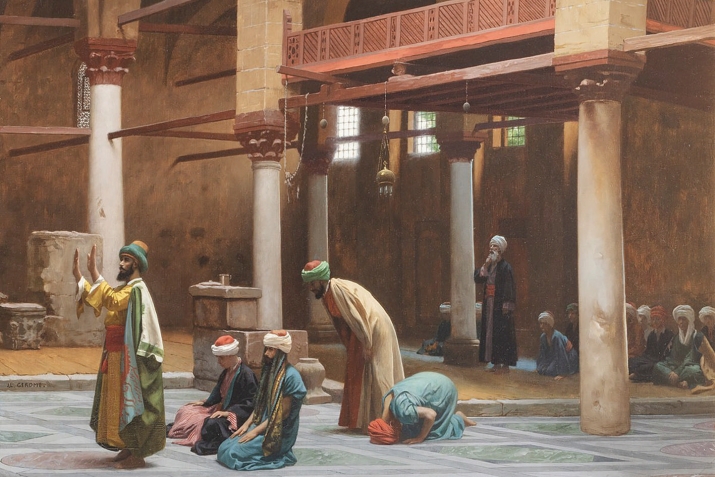
On Friday night, in the first days of the month of Rajab in the 110th year of the Hijra (Muslim calendar), al-Hasan al-Basri heeded the call of his Lord and left this mortal world. In the morning, the news of his death spreading around the city came as a shock to the people. His body was washed, wrapped in a shroud and a funeral prayer was performed after Friday prayer in the mosque, under the arches of which he spent most of his life, being both a student and a teacher, calling for the religion of Allah ﷻ.
