
The German Kaiser on Salahuddin: A Knight Without Fear or Reproach
The German Kaiser on Salahuddin: A Knight Without Fear or Reproach
On Mount Zollernberg, 50 kilometres from Stuttgart, rises the enormous castle of the Hohenzollerns, a dynasty that once ruled Germany for many years.
One of the most famous representatives of this family, Emperor Wilhelm II, once visited the tomb of the famous Salahuddin al-Ayubi in Damascus...
In 1888, Wilhelm II ascended the German throne. He is often cited as one of the culprits behind the outbreak of World War I. From some perspectives this tragedy, which claimed the lives of millions of people and buried entire empires under its rubble, might seem like a trivial family squabble. On the one hand, German Emperor Wilhelm II was the grandson of Britain’s Queen Victoria; on the other, another of her grandsons, George V, who became the leader of Britain in 1910; and finally, the ruler of the Russian Empire, who was (through his mother) a cousin of the aforementioned George V. It would seem, why would England, Germany, and Russia fight if their rulers were related? They could have sat down over dinner and come to an agreement. But this is a rather simplistic view and only one side of the coin. Besides, you cannot ask this question of the dead. Moreover, we are not talking about war today. Rather, we are talking about how the German Kaiser ended up at the grave of Salahuddin al-Ayubi.
Here is how it happened: from October 25 to November 12, 1898, Emperor Wilhelm II paid a state visit to the Ottoman Empire. While still gaining political experience as a young official in the German Foreign Ministry, the future Emperor Wilhelm noted the enormous benefits England and France derived from their overseas territories and the harm Germany suffered from lagging behind in the colonial race. As he himself admits in his memoirs, he was unable to fully convey these ideas to the empire’s leaders, but as soon as he assumed the helm, he began implementing them energetically.
And so, he turned his attention to the “sick man of Europe”, the Ottoman Empire, then in its twilight years. The state visit to Constantinople was intended to strengthen Germany’s political and economic interests in the Ottoman Empire, which was losing control of its provinces and to facilitate the German government’s increased colonial expansion.
Wilhelm II, with his vast retinue, was greeted as befits a king. He visited Constantinople, Jerusalem and finally ended up in Damascus, where he indulged in a visit to the tomb of the famous commander and statesman of the past, the gatherer of Muslim lands, Salahuddin al-Ayubi.
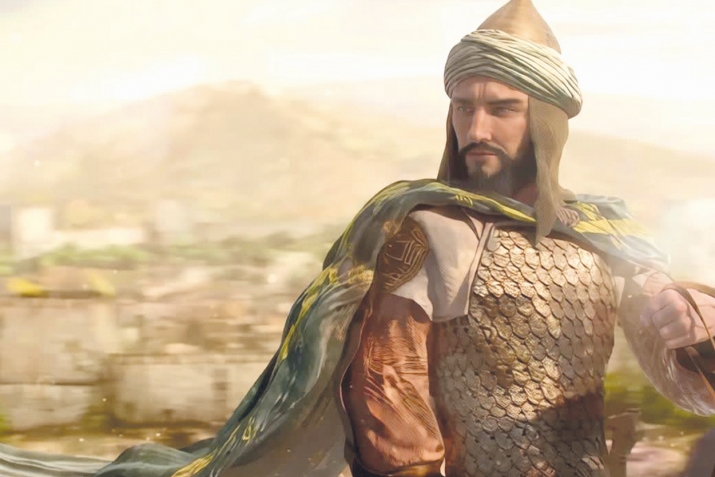
Speaking at the tomb of the scourge of the Crusaders on November 8, 1898, the German Kaiser called Salahuddin al-Ayubi one of the noblest rulers of all time, a great sultan, a knight without fear or reproach, who “often taught his adversaries the true meaning of chivalry.”
“I feel I must thank you on my own behalf and on behalf of the Empress for the warm welcome we received in all the cities through which we passed and especially for the magnificent reception we received in Damascus.
Deeply moved by this majestic spectacle and also by the knowledge that I stand on the site of one of the noblest rulers of all time, the great Sultan Saladin, a knight without fear or reproach, who often taught his adversaries the true meaning of chivalry, I gladly take this opportunity to express my gratitude, first and foremost, to Sultan Abdul Hamid for his hospitality.
Let the Sultan and the three hundred million Muslims scattered throughout the world who revere him as their Caliph, rest assured that the German Emperor will always be their friend,” declared Wilhelm II, addressing those gathered at the mausoleum of Salahuddin al-Ayubi.
The visit to the Ottoman Empire left a lasting impression on the German Kaiser. They say that after visiting Constantinople, he wrote to Tsar Nicholas II: “If I had arrived there completely without faith, I would certainly have become a Muslim!”
His fate was not easy. Having initiated Germany’s entry into World War I, he not only lost the war and cost millions of his subjects their lives, but also lost his throne and was forced to flee his own country to the Netherlands, where he died on June 4, 1941. He was unable to repeat the story of Salahuddin al-Ayubi, no matter how much he professed admiration for the scourge of the Crusaders.