

Prayer in Airplane
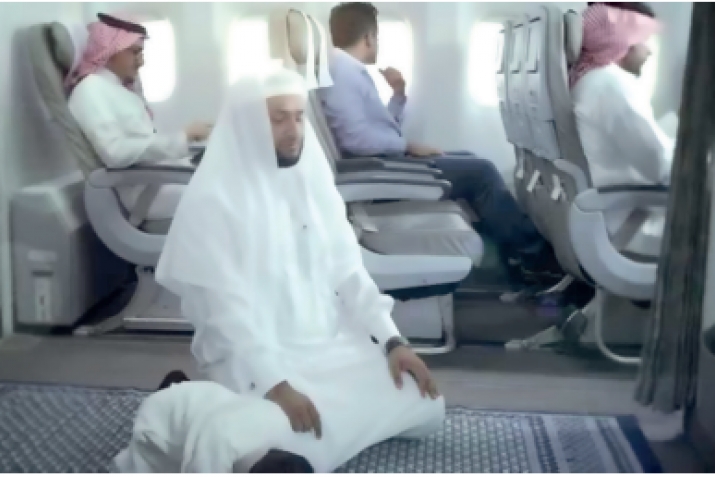
How to perform fard/ compulsory prayer, while in a flight?
If, while in flight, a person assumes that before the arrival of the following prayer time, he will manage to perform the timely obligatory prayer turning towards the qibla, then he should postpone it for this time and perform the prayer canonically. If, however, assuming that he will not have enough time, then he should immediately proceed with prayer.
If a person performed prayer in flight not in the direction of the qibla, and on arrival he found out that the time of the next prayer has not yet arrived and there is an opportunity to perform it, turning towards the qibla, then he is obliged to perform the prayer again. If (after the prayer) the circumstances that do not allow praying in the direction of the qibla, do not change until the next prayer, then it needs to be reprayed, desirably as soon as possible.
In the absence of the opportunity to perform a compulsory prayer standing up, for example, due to dizziness or the passenger transportation rules do not allow him to perform namaz as required, a person must perform it while sitting, and he is not obliged to repray it if it was performed turning towards the qibla.
While performing prayer in sitting, one should bow down as close to the ground as possible, and for the ground prostration should bow slightly lower than for the knee bow. “The one who performs the obligatory prayer on the ship must do it standing, but if there is a reason for which it is difficult for him to stand, for example, dizziness, etc., then it needs to be done in sitting and one is not required to pray it again (if it was prayed facing the qibla).
“If a person can make a full bow and prostration, he is obliged to make them fully. If she/he cannot do it, then one needs to bend for the bowing so that the forehead is as close to the ground as possible, and for the prostration bow slightly lower than in the belt bow.” While performing prayer in sitting, one should bow down as close to the ground as possible, and for the ground prostration should bow slightly lower than for the knee bow.
Argumentation: “Performing prayer facing towards qibla is a condition of the prayer. As for the person who cannot do this, for example, cannot leave the transport because of fear for life or property, he is obliged to perform prayer in the direction of his movement, and the prayer is considered valid, but it must be performed again afterwards. If there is a choice to perform prayer in sitting but turning towards the qibla and standing but facing different direction, then one should perform it in sitting, and he should not compensate it.”
“If a person assumes that before the time of the next prayer, s/he will be able to perform it facing the qibla, then she/he is obliged to postpone it until this time and perform it as required. If she/he assumes that the time is not enough, then she/he immediately proceeds to prayer. If then, before the next prayer such an opportunity arises, she/he is obliged to pray it again, turning in the direction of the qibla. If the reason for which he could not perform the prayer facing the qibla did not disappear until the time of the next prayer, then this prayer is considered to be missed for a valid reason, and therefore it needs to be reprayed, desirably as soon as possible.”
Source: “Tuhfat al-Muhtaj”, vol. 1, p. 485; “Hashiya ashShirwani”, vol. 1, p. 485-493; “Tuhfat al-Muhtaj”, vol. 2, p. 27.
