
Why do men wear a turban?
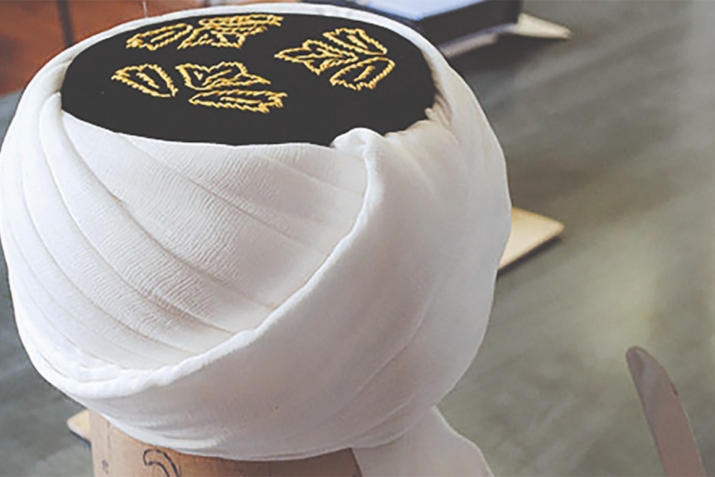
A turban, an amama is a special headdress familiar to many from films and fairy tales about the wonderful East, where Aladdin and other characters showed off in amazing headdresses.
It is widespread in many countries, in particular, among the Arabs on the Arabian Peninsula, in Sudan, Egypt, Morocco, the Levant, as well as among the Tuaregs and Sikhs - this headdress is one of their distinctive features. In the post-Soviet space, a turban is often worn in the countries of Central Asia.
Men with a turban on their head can be seen not only in films about Turkish sultans; representatives of different peoples proudly wear it as an element of national culture, personifying the ancient traditions of men’s clothing.
In fact, a turban is a piece of fabric wrapped around the head or headdress and has a length of 1.5 to 8 meters. Its color scheme and shapes vary depending on the culture of the peoples who wear this element of the costume. Differences are also expressed in the number of folds, the location of the knot in front or behind, whether the end hangs to the side or the back, etc.
In Russia it is mainly worn by religious figures: muftis, imams-khatibs and hazrats. Many modern Tatar religious figures wear turbans during official events and religious rites. They are usually white and, less often, green.
Turbans are made of a range of materials, including cotton, brocade, wool or other synthetic and combined fabrics.
The turban is often wound around the headdress, it serves as protection from heat, cold and wind. By the way, modern skullcaps also have elements that symbolize a turban. These include a ribbon stitched around the cap, a kind of light version of a turban.
Jabir ibn Abdullah reported that the Prophet Muhammad ﷺ entered the day of the capture of Mecca wearing a black turban on his head. (Narrated by Muslim, Abu Dawud, At-Tirmidhi).