
Sindhi topi – a symbol of Sindh culture
Sindhi topi – a symbol of Sindh culture
Sindh is the southernmost province of Pakistan; a region with its own unique culture, traditions and a thousand-year-old heritage. It is here that the majestic Indus flows and runs into the ocean, which gave its name to the entire region – Hindustan.
Some of the most ancient civilizations of the East arose and developed on this land and here they died under the onslaught of fresh young forces and new peoples, so that it was reborn as an even stronger and more powerful state.
An integral part of the culture of Sindh (and now of all of Pakistan - and even neighboring countries) are small men’s headdresses, which are called in Urdu “Sindhi topi” – a Sindh cap.
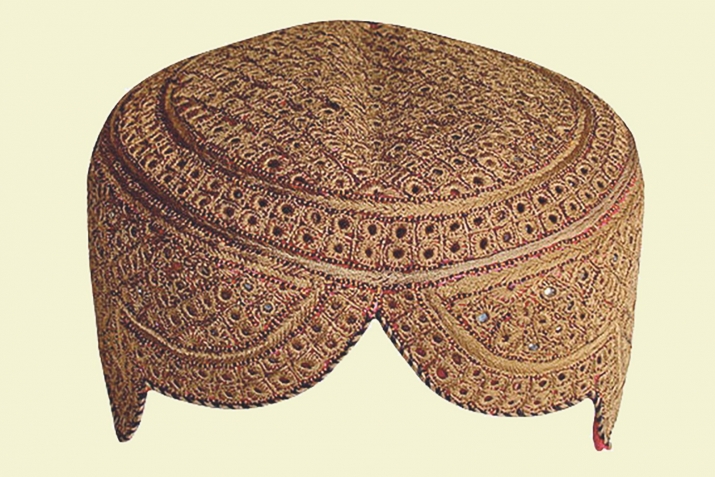
It has a round or cylindrical shape, has a characteristic cutout in the front and is embroidered with beads or mirrors. Very often it is given as a sign of respect to the most honored guests and dearest friends.
Sindhi topis come in two different varieties - hard and soft. Hard ones hold their shape well and do not lose it even after washing. Soft ones are more convenient - they are easy to take with you by putting them in a normal pocket.
The embroidery on the cap is very interesting. As a rule, it is done by hand; in addition to multi-colored threads, it includes the use of beads and small round mirrors. The cap is usually round, but in front on the forehead there is a cutout in the form of a minbar or mihram (or rarely in the form of a mosque dome). This latter element appeared later, when the peoples of Sindh adopted Islam - so that the forehead of the worshiper was open and could touch the ground.
Sindhi topis can now be found throughout Pakistan. There is not a single large mosque that does not have a shop with them in front of its entrance. In Punjab, in Baluchistan, in the North-West Province ... they are popular even in neighboring Afghanistan, India and Iran, not to mention Western countries, where Pakistanis bring them with them as part of their homeland. They are worn underneath (as a base) for a turban or just on the head. Some wear them constantly, some wear them only before entering a mosque and some only on holidays - it depends on the mentality and beliefs of the owner.
The history of Sindh, as well as most of the territories of Pakistan, is associated with fairly frequent migration of tribes, their movement and mixing of cultures and with raids of conquerors, starting with Alexander the Great, the Persians and Mongols and ending with the British. However, many of the newcomers preferred the land of Sindh to their homeland and stayed there forever, adding something of their own to the complex local culture.
Sindhi topi as a type of head covering emerged quite a long time ago. In the culture of Sindh it was initially not welcome for a man to appear in public without a headdress. Its first prototype was probably a cotton cape with a seam in the middle, giving it the outline of a tetrahedron. And on its basis, several types of caps were formed which changed over time.
Of the five existing styles (cap, circular, tetrahedral, fantasy and betel leaf shape), one gradually began to be most popular - the one that has survived to this day.
In the pre-Islamic period and later, it was customary for non-Muslims to decorate the cap with embroidery using silk, gold and silver threads. Such caps were often worn under a turban, leaving only its upper part on display. At that time, the minbar-shaped neckline had not yet been adopted but one with a crescent-shaped neckline appeared. Currently, this option is considered outdated and can only be admired in museums.
A little later, pieces of enamel, pearls and precious stones began to be sewn onto the cap.
Traditional patterns began to be applied in embroidery: squares, rectangles, circles and ovals, stars, the sun and the moon. Pieces of mirrors of various shapes began to predominate among the decorations. They gave the cap a sparkling, festive look, reflecting dozens of sunbeams on the walls of the premises and the faces of those around.
It is worth noting that in the 17th-19th centuries, a man leaving the house with an uncovered head was considered to have committed an administrative offense and could be detained. Even at the beginning of the 20th century, society did not encourage going outside without a hat; this was a sign of a person’s low culture. At present, due to the pursuit of Western fashion, this tradition exists only in remote and most economically backward areas of the country, - and is more common among the older generation. Young people perceive the traditional headdress as a tribute to history, that is, it can sometimes be worn on a national holiday or religious ceremony.
It is in this connection that in 2009, in order to increase the sense of religiosity and to preserve the national identity of the country, the National Day of Culture of the Sindh Province was established, the main symbols of which were the Sindhi topi and ajrak (a unique national cape, the design of which is printed in block printing). This holiday is held annually in early December. Despite the fact that for the most part it is more addressed to the people of Sindh, many Pakistanis consider it obligatory for themselves, since it helps them not to forget their roots and their culture under the pressure of another.
On the eve of the holiday, they say, “At present, youth does not understand the value of their culture, considering the Sindhi topi and turban outdated and unnecessary, forgetting that once their fathers and grandfathers were proud of them and considered them a sign of respect and dignity.”
On this day, most men wear the national white shalwar kameez with the obligatory Sindhi topi of various colors on the head, often covering their shoulders with ajrak. Women in traditional Punjabi costume replace the dupatta (scarf) with an ajrak (its color and pattern are slightly different from the men’s). National bazaars and sales of local folk-art products are organized and mass festivities are held in parks.
The organizers say that, “this day in the province of Sindh does not belong to any political party and does not serve any government goals. Within its framework, we want to show the world the beauty of our national culture, its versatility and richness of internal content. On this day, we celebrate the significance of our cultural heritage, which we in Sindh value very much!”
This day is now celebrated not only in Pakistan: many of the representatives of the country living abroad also sometimes want to remember their roots and the origins of their culture.
Sindhi topi is not just a cap decorated with embroidery and mirrors. It is now a symbol of Pakistan’s national culture.