

Vorontsov and the Alupka Shahada: Architecture linking East and West
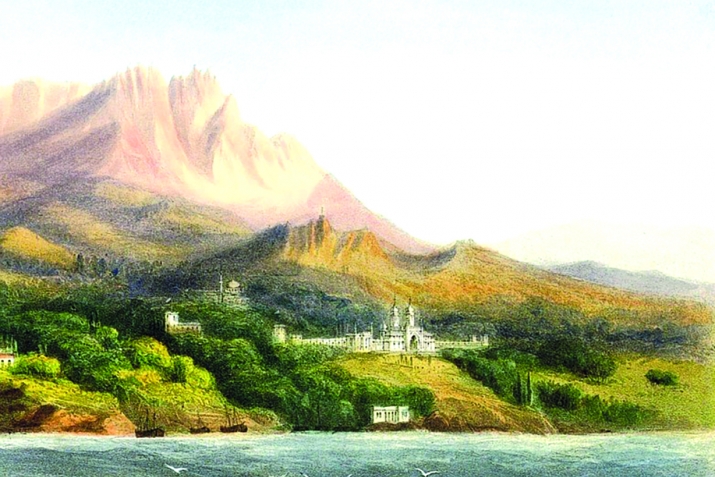
“The setting of our abode was impressive. Behind the villa, half Gothic and half Moorish in style, rose the mountains, covered in snow, culminating in the highest peak in the Crimea. Before us lay the dark expanse of the Black Sea, severe, but still agreeable and warm even at this time of the year. Carved white lions guarded the entrance to the house, and beyond the courtyard lay a fine park with subtropical plants and cypresses.” Thus the English statesman William Churchill described his impressions of Prince Mikhail Semyonovich Vorontsov’s palace at Alupka where he was hosted during the famous meeting at nearby Yalta with World War II allies Josef Stalin and Theodore Roosevelt in February 1945.
“Half Gothic and half Moorish in style”: the grand seaside palace was built between 1828 and 1848 with stylistic elements evoking historical architectural traditions of the ‘West’ on its north and those of the Islamic ‘Orient’ on its south. Dominating its southerly aspect was a great entrance portal iwan with a frieze of the Shahada (the Muslim profession of the faith) in Arabic repeated six times.
To understand the background and intentions behind this remarkable building - and in particular those features which strongly refer to Muslim culture - one must understand Mikhail Vorontsov’s unique personal history. Born in Saint Petersburg in 1782 into inner circles of the imperial court (Empress Catherine II was his godmother), his mother died when he was very young. In 1785, he and his younger sister, Ekaterina, were taken to live in London by their father, Count Semyon Romanovich Vorontsov (1744-1832), who served as Russian ambassador to Britain where he resided until his death.
He was close to the English court and involved in much that was progressive and innovative in the upper echelons of society at the time. In this intellectually fertile environment the young Mikhail was raised, not returning to his homeland until he was twenty years old. Mikhail Vorontsov would have engaged in the most fashionable aristocratic pastimes of the day, including visits to Kew Garden on London’s outskirts. This was an extensive royal botanic and pleasure garden built by Augusta, mother of King George III, and adorned with imaginative recreations of exotic architecture of the Orient, including a Chinese pagoda, a ‘mosque’ and another structure evoking the Muslim Alhambra in Spain.
While evocations of the decorative arts and architecture of the Far East (‘Chinoiserie’) were already popular across Europe, in the second half of the 18th century a new fashion for things Islamic in style (‘Turquerie’) started to become what today we would call a craze. Designed by Sir William Chambers in 1761 to “collect the principal particularities of the Turkish Architecture”, the Kew Garden ‘mosque’ had a central dome flanked by two smaller ones and a minaret on each side. Although not intended to function as a religious building, the Shahada in Arabic script featured prominently on its façade. Vorontsov’s visits to Kew would have been his first actual exposure to ‘Muslim’ architecture.
In Russia, Mikhail Vorontsov rapidly advanced an illustrious career as a soldier and diplomat. Military campaigns in the Caucasus (1803-1805) and the Ottoman Balkans (1808-1811) threw him into contact with the realities of the Muslim world, its architecture, culture and political dynamics (in which over the course of time he was to develop a sophisticated knowledge).
He played a significant role in the Napoleonic Wars and was a commander of the Russian forces under Tsar Nicholas I which took Paris in 1814 (with the participation of Tatar and Kamyk cavalry units). From 1815-1818 he led the Russian occupation of the French capital, where - a fluent French speaker – he was immersed in a world of culture and scholarship then captivated by the Muslim east following Napoleon’s occupation of Egypt from 1798 to 1801. A number of volumes of the massive defining scientific work of that venture, the ‘Description de l’Egypte’, were published in Paris under his administration.
Vorontsov’s leadership abilities led to his appointment in 1823 as GovernorGeneral of Novorossiya, which included the Governorate of Taurida (Crimea). Before taking up residence in Odessa, Russia’s vibrant new southern capital, he had visited Crimea and had fallen under the spell of its dramatic landscapes and its Islamic ambience - particularly of Bakhchisaray, the capital of the Crimean Khans.
He bought a beautiful tract of coastal land at Alupka in 1824 where he proceeded to build a palace in 1828. That year he had introduced the first steamship to Novorossiya - access to his new estate from Odessa would therefore be convenient, safe and fast. Vorontsov was extremely wealthy with the human resources and political power to create his own personal world at Alupka.
In Odessa the Neo-classical architectural style dominated as it did throughout Russia and Vorontsov initially commissioned architects to produce designs for the palace in that mode. However, in 1831 Vorontsov abruptly changed course, deciding that his new palace would instead highlight Crimea as a unique place where East and West met by blending architectural elements which he most admired of both.
These new plans coincided with an eruption of Islamic orientalism in English architecture of which he was well aware through personal visits and contacts. Most talked about was King George IV’s Royal Brighton Pavilion, an extensive seaside pleasure palace remodeled in 1815-1822 by the architect John Nash in an extravagant Neo-Mughal manner.
While Brighton Pavilion’s impact on Alupka has already been noted by historians, another more local experience has been overlooked which may have contributed significantly to Vorontsov’s change in direction at that time. Just as he was starting work on his palace in 1928, he was called by Tsar Nicholas I to the attack on the Ottoman stronghold of Varna on the western Black Sea coast. As commander of the Russian forces Vorontsov took the city and for the first time had before his very own eyes a vast traditional Turkish cityscape of mosques, minarets, elaborate traditional wooden houses and bazaars – his beloved Bakhchisaray writ large as it were.
While drawing on European historical styles for the ‘Western’ elements of the palace, Edward Blore was inspired by the Delhi’s great Juma Mosque built by Mughal emperor Shah Jahan in 1644-1656 for his design of its great south-facing iwan entrance. Above a dome was erected in Neo-Mughal style flanked by two minaret-like towers. Influences of Bakhchisaray are evident in various ways including the palace’s thin chimneys which recall those of the Khanate palace.
More significant in understanding the Muslim aspects of Alupka is that Vorontsov also did something which no person of power in Europe had dared to do: an integral part of his vision was to build both a fully functioning mosque for his Crimean Tatar neighbours and a church for Christian worshippers. The Alupka mosque was built just above the palace and incorporated similar NeoMughal features: it was already in use by 1833.
Three years before Alupka was completed, Mikhail Vorontsov was ordered to the Caucasus as Viceroy. He was to spend little time in his palace and eventually retired to Odessa, where he died in 1856. His creation at Alupka drew the admiration of imperial visitors and nobility, a number of whom created their own magnificent palaces along the southern Crimean coast, some of which included Islamic decorative elements. Paradoxically perhaps, the last to be built in neo-Islamic style was in Yalta by Abdul-Ahad bin Muzaffar al-Din, Emir of Bukhara, in 1907-1911.
It was designed by Nikola Georgievich Tarasov and employed master craftsman from Bukhara. It was nationalized after the Emir’s son’s exile in 1920 and housed Yalta’s Oriental Museum before being allocated to the ‘workers of Uzbekistan’ as the «Uzbekistan» Sanitorium. Its little mosque and Bukharan minaret no longer exist – nor does Vorontsov’s Alupka mosque.
The architectural complex which Vorontsov created at Alupka was intended as a symbol of the linkages he promoted between the cultures of East and West. The prominent positioning of the Shahada over the main southern entrance to the palace is both in recognition of the faith of the Muslim world across the waters and a blessing at the threshold of a local world where Islam was also strong. While it may not have been a personal declaration of faith it was no mere fashionable ornament – it was an expression of respect best understood in the spirit of inter-confessional and international coexistence.
GUY (GHAYDAR) PETHERBRIDGE
