
The Essence of the Place of Communal Prayer: The Open Air Mosque
The Essence of the Place of Communal Prayer: The Open Air Mosque
On a high mountain pasture in the locality of chikhtil in the tabasaran region of the southern caucasus of dagestan there is a large open air mosque. It has a rectangular perimeter delineated by large stone slabs and a simple three-stepped minbar carved from a single stone. Built in the late 17th century, it served the nearby settlements of vertil, furdag, kulik and djuli as a summer place of prayer and for discussion of important issues affecting the whole district community. There were many such open air mosques in the caucasus. Indeed such a place of prayer may have been used before the construction of region’s earliest mosque - the 8th century juma mosque of derbent, the oldest in the russian federation.
A number of Hadith of the Prophet Muhammad ﷺ refer to Islam’s earliest places of prayer and their elemental nature, for example:
Ibrahim b. Yazid al-Tazmi transmitted: “I used to read the Koran with my father in the vestibule (before the door of the mosque). When I recited the ayat concerning prostration, he prostrated himself. I said to him: Father, why do you prostrate yourself in the pathway? He said: I heard Abu Dharr saying: I asked the Messenger of Allah ﷻ what was the first mosque that was set up on the earth. He said: al-Masjid al-Haram. I said: Then which was next? He said: al-Masjid al-Aqsa. I said: What was the space of time between the two? He said: Forty years. He further said: The earth is a mosque for you, so wherever you are at the time of prayer, pray there.” (Sahih Muslim 520 b)
Anas b. Malik transmitted: “The Messenger of Allah ﷻ used to pray in the folds of sheep and goats before the mosque (in Medina) was built.” (Sahih 524 b)
The most intimate of Islamic prayer spaces – that around the Ka’aba – has always been open to the heavens above. When the Prophet Muhammad ﷺ left Mecca for Medina in 622, the first place of prayer he established was at Quba on the outskirts of Medina. It is recorded that this was a simple open air mosque demarcated by stones he himself positioned as soon as he arrived there. In Medina too the Prophet’s ﷺ first mosque - where he led the first Juma prayer - was also a simple demarcated open air space beside his house (subsequently built up as the roofed structure of al-Masjid an-Nabavi).
Such outdoor spaces represent the very essence of the Islamic place of prayer. By simply delineating a rectangular sacred area by drawing in the sand, placing rows of stones or forming low boundary walls - orientated with a mihrab in the direction of Mecca - a ritually pure space is formed for a congregation of worshippers.
Archaeological researches in the Negev Desert have revealed a number of simple open air mosques demarcated by stone walls in permanent settlements of the 7th to 9th centuries. Nomads and travelers for centuries have also delineated such places of prayer – both temporary and permanent - along customary routes of travel and seasonal migration and often near a well from which water can be drawn to quench the thirst, for ritual ablutions and for watering animals. They are still being erected along modern highways in parts of the Arabian Peninsula.
In regions of Islam strongly influenced by Persian culture, outdoor mosques are called namazgah (Persian namaz – ‘prayer’ and idgah – ‘place of’). Where winters are severe, they were built for summer use on city outskirts, in locations where the community went to picnic and relax, and along major roads linking cities. They were also served as places to farewell or welcome home soldiers or pilgrims and to pray for rain in times of drought.
Some namazgah were very substantial. Noteworthy is the great Bukhara namazgah built just outside the city in 1119 by the Qarakhanid ruler Alp Arslan Khan Muhkammad. Similar monuments were erected at Merv and Nissa in what is today Turkmenistan. Much more modest namazgah has survived along the principal arteries of the Bodrum peninsula in south-west Turkey. These simple whitewashed structures accommodated a small number of travelers for communal prayer and rest in the shade of a specially planted plane tree (cinar). A cistern providing refreshing cool, pure water was constructed nearby.
Beside the obligatory mihrab, open air mosques may also have a permanent minbar. These are usually quite simple, such as that at Chiktil in the Caucasus, whose form recalls the three-stepped minbar of the Prophet’s ﷺ mosque of 629. Others may be elaborate in form and structure. Perhaps the most significant example is the outdoor minbar of Burhan al-Din in Jerusalem on the Haram al-Sharif platform of the Dome of the Rock and the al-Aqsa Mosque in Jerusalem. Its original date of construction is unknown but it was restored during Mamluk rule in the 14th century and again in 1843 by Ottoman Sultan Abdulmecid (1839-1861).
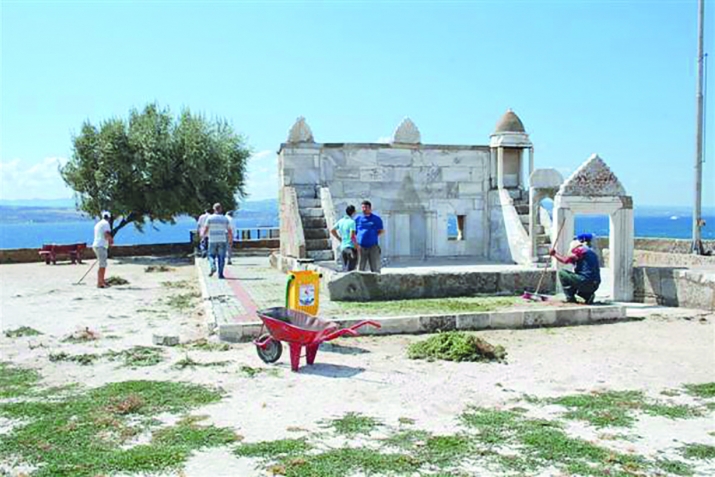
A special category of open air mosque was the Ottoman military namazgah, serving troops who could not practicably worship together within an enclosed mosque building or laid out when Ottoman armies established bases in newly conquered territories - and then made more substantial if necessary. The best preserved is the Acebler Namazgah at Gelibolu, a fortified naval base defending the southern entrance to the Sea of Marmara. Built in 1407, it sits on a hill overlooking the waters of the Dardanelles straits. Here sailors (acebler) of the Ottoman navy had a place to pray (it was also used for communal prayers for rain).
The most beautiful of Ottoman namazgah is considered to be that built for Esma Sultan, daughter of Sultan Ahmet III, in Istanbul in 1779 below the ancient Byzantine hippodrome. Other highly positioned Muslims also sponsored the erection of grand namazgah. For example, Prince Muhammad Akbar, the rebellious son of the devout Mughal emperor Aurangzeb built a splendid namazgah in the Goan city of Bicholim where he fled in the 1680s - a rare example of Turco-Persian architecture in India.
In recent years there has been a revival in interest and nostalgia for open air mosques. Thus thousands of local worshippers gather on important religious holidays in a great open air mosque high up on the Kadirga plateau behind Trabzon in Turkey. Fatih Sultan Mehmet II is believed to have performed Juma namaz here with his troops when visiting the ziyarat of the revered Kadir Aga. The mosque is unusual in having two tall permanent minarets of classical Ottoman style.
In other places new formal outdoor prayer spaces are being built in reverence of this ancient tradition. In Turkey’s capital, Ankara, a splendidly carved marble mihrab and minbar have been built on a platform adjacent to the Haci Bayram Mosque and overlooking the city below. Similarly placed on a terrace overlooking the community is a new outdoor mihrab in the heritage city of Safranbolu in north-central Turkey. Beautiful simple - but extensive - outdoor mosques of traditional local materials have been built in Oman - in Nizwa, for example.
Among the many new ventures in mosque design across the modern world of Islam, an open air mosque planned for Dubai in the United Arab Emirates has provoked much interest. Named the Vanishing Mosque, it was conceived by the New York-based group, Rux Design, winning an international design competition ‘Mosque through Architecture’ in 2010. Its key feature is an open air raised triangular prayer plinth whose apex points in the direction of Mecca. Its floor and walls decrease in size towards its apex creating an illusion of heightened vanishing perspective in the qibla direction. Below the raised prayer plinth and in its shade is an ablution pool.
As awareness is growing of the spiritual legacy of Islam’s surviving historical places of open air worship, local initiatives are energizing to preserve them. The Goa Heritage Action Group in Bicholim, for example, is working to save its elegant namazgah from the encroachment of a nearby mine. In the Bodrum region of Turkey local heritage activists are working to preserve its simple roadside namazgah. In Prizren, capital of Kosovo, restoration work on its first namazgah built just after the city was conquered in 1455, the city’s earliest Islamic monument, has recently been sponsored by the Turkish Cooperation and Coordination Agency (TIKA).
Turkey’s first six Ottoman sultans resided in Bursa where an open air mosque had been built soon after its conquest. Although many splendid religious buildings were to be constructed in the city, it was in this namazgah that Ottoman army troops continued to pray before and after military campaigns. It survived - long neglected though largely intact - until municipal and local efforts to revive the historic identity of the city resulted in the first communal prayer to be held there for 600 years – the tarawih namaz of the first day of Ramazan in 2011.