
The Mazar (Ziyarat) of Sheikh Bahauddin Naqshband: Revelations of the Earliest Photographic Documentation in Colour
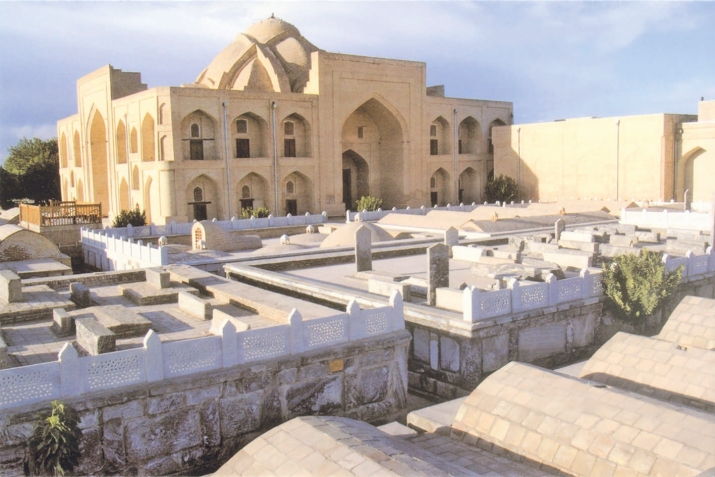
Part 2 – The Khanaqah of Abd al-Aziz Khan (1544-45)
This is the second part of an article dedicated to the earliest coloured photographs of the mazar (ziyarat) of Sheikh Bahauddin Naqshband in present day Uzbekistan taken in 1907 and 1911 by the Russian pioneer of colour photography, Sergei Mikhailovich Prokudin-Gorskii (1863-1944), a corpus of images which has never been described in scholarly detail. His work was part of an ambitious project, sponsored by Tsar Nicholas II, to compile “a systematic collection of photographic images, in natural colours, of sights of interest in Russia” that would “arouse love for the motherland, interest in studying its beauties and inexhaustible riches, without which it is unthinkable to teach truly patriotic feelings to the youth.” Prokudin-Gorskii travelled to Central Asia in 1906, 1907 and 1911. As in the expeditions which he also undertook to the Caucasus and Bashkiria, he showed a particular interest and empathy in capturing the richness of Muslim life and environments.
Prokudin-Gorskii captured his images on glass plate negatives which were recorded as black and white prints pasted into registration albums. After the 1917 October Revolution, he moved to France taking about half his negatives and albums with him (the rest no longer survive). After his death, these were sold to the Library of Congress in Washington which made them available as digital reproductions through the internet in 2004. Since then many of Prokudin-Gorskii’s vivid colour images of Central Asia have become the subjects of exhibitions, of learned and popular publications and of tourism promotion. However, those photographs which have survived solely as monochrome album prints have received little attention.
When based in Bukhara, in both 1907 and 1911, Prokudin-Gorskii visited Qasr-i Arifan (now Bogoudin), a nearby village where the revered Muslim sheikh known as Muhammad Bahauddin Naqshband (1317-1389) was born, taught and died. His tomb became revered throughout Central Asia and far beyond, particularly by adherents of the Sufi brotherhood which came to be known by his name, the Naqshbandi tarikat (Naqshbandiyya). A complex of buildings gradually developed around the sheikh’s burial place to serve those seeking his blessing and intercession with the Almighty, to worship and to follow the Sufi path.
Sheikh Bahauddin became the pir (murshid) or spiritual mentor of the powerful ruler Amir Timur (1336-1405) and continued to be revered by his descendants and the Shaybanid dynasty which followed. Because of their unwavering emphasis on strict adherence to the Sharia and Sunna, their respect for scholars and learning and their avoidance of disruptive religious and political controversies, Naqshbandi sheikhs found acceptance as pillars of social stability and religious legitimacy and as trusted advisers and allies by rulers - irrespective of dynastic affiliation - throughout the succeeding centuries of indigenous Muslim rule in Central Asia.
In the middle and second half of the 16th century the Shaybanids made Bukhara their political centre. Abd al-Aziz Khan (ruled 1540-1549), a disciple (murid) of Naqshbandi Sheikh Jalal Vaiz, became renowned as a patron of learning and established a great library there. In 1544-45 he dedicated his attention to the mazar of Sheikh Bahauddin Naqshband, building a marble enclosure over his grave and constructing a perimeter wall around the immediate holy precinct (hazira) among other improvements.
Abd al-Aziz Khan also built a large khanaqah (Sufi lodge) adjacent to the tomb precinct to serve as a centre of worship, study and accommodation for followers of the Naqshbandi tarikat. Like other Sufi khanaqah in the region, at its heart was a large lofty central hall (zikrkhana) with a mihrab, where daily prayers were performed as were group dhikr (zikhr), meditation and other celebrations of the divine. Cells (hujra) for the accommodation and study of devotees were later built by Nadir Khan (1642-45) adjoining the central devotional space.
The great khanaqah visually dominates the mazar complex. It is the largest such building in the world and was among the most graceful buildings in the region. Its most prominent external feature was a very tall entrance portal iwan behind which rose its massive dome with immense intersecting supporting arches. Four axial entrance portals were orientated to the cardinal points with the cells grouped at its corners. In subsequent periods the mazar of Sheikh Bahauddin Naqshband continued to grow as a major focus of pilgrimage and learning with successive rulers of Bukhara adding to its buildings and financial endowments.
In the collection of Prokudin-Gorskii’s images in the Library of Congress there are seven photographs taken at the mazar. Five are in the form of glass plate negatives and document aspects of the holy tomb precinct itself, as have been described in Part 1 of this article. The other two survive only as black and white prints pasted into one of the photographer’s registration albums.
These latter monochrome prints are both of the great khanagah. They are of historical interest and significance not only because they are the earliest known images of the structure, but because both the building and its immediate environs have since been radically transformed.
One of these two images shows the southern façade of the khanagah with its tall entrance portal and the arched embrasures of cells on either side. Part of the mazar graveyard in shown in the foreground. The second image is of the entire western aspect of the building, showing the dome with its prominent structural ribbing and its western axial portal. In this photograph one can see how high the original southern portal rose above the core of the building – and to what degree it was leaning out perilously from the vertical. Prokudin-Gorskii’s photographs provide the sole surviving documentary evidence of the original façade. The original entrance portal is no longer extant, probably having collapsed as a result of one of the region’s not infrequent earthquakes.
People from across society sought burial near Sheikh Bahauddin. The section overlooked by the façade of the khanaqah was closest to the qibla side of the sheikh’s tomb – under his gaze and nearest him on the Day of Judgment – and was thus considered the most precious. It was here that members of the ruling families of the Shaybanid and succeeding Bukharan dynasties were interred in the noble stone grave enclosures of the Dahma-i Shohon. Individuals of more modest background were buried further to the east and west. Thus entire generations of Bukhara’s inhabitants – rich and poor – found their resting place near their beloved pir.
The decade following Prokudin-Gorskii’’s last visit in 1911 was one of fundamental and extreme change throughout Central Asia. A local imam described what transpired at Qasr-i Arifan: “After the revolution, the government fought against the tarikatlar. All the books, everything was destroyed. All functions, the way of life was destroyed. During seventy years of Communist rule, they didn’t allow anyone to visit the shrine. They would take the license plate number of anyone who dared to come and then report him to his workplace. Then he would be discharged from his job and thrown into despair. This place (the Naqshbandi mazar) became dilapidated. The door was locked, everything fell apart.”
When eventually reconstruction work was undertaken on the khanaqah of Abd al-Aziz, this was done without knowledge of or consideration for its original form. Today, one hundred years after Prokudin-Gorskii’s departure from Russia, his long-hidden photographic documentation enables us to see how much the structure was altered: practically no detail or proportion of its external architectural features remained the same.
Following Uzbekistan’s indepen-dence in 1991, believers from across the world have been once again free to worship at their beloved mazar. A debt is owed Sergei Prokudin-Gorskii for providing today’s Muslim faithful with a glimpse of the worship and ambience of the ziyarat of Sheikh Bahauddin Naqshband prior to the disruptions of the 20th century. The photographer was indeed prescient in his conviction that (in his own words) “leaving a precise document for the future” was one of the most important goals of the pioneering method of colour photography he had developed.