

Islam in the homeland of the Italian mafia
Islam in the homeland of the Italian mafia
The series “Octopus,” popular in the early 90s and then the film “The Godfather,” which became popular among young people, gave the island of Sicily a bad reputation as the ancestral home of the Italian mafia.
This is partly true, because it was here that the Cosa Nostra mafia group appeared, whose cruelty was known far beyond the Apennine Peninsula.
But this was not always the case, and even today, walking along the streets of Syracuse or Palermo, you will encounter the remnants of the civilization that previously dominated the island. More than a thousand years ago, the flourishing cities of Sicily were decorated with mosque minarets, Arabic speech could be heard on the streets and the island itself was under the authority of the Emirate of Sicily...
The five million people of modern Sicily live in several large cities and a hundred or so villages, some of which still bear names that came from Arabic. For example, the city of Corleone, which became world-famous thanks to the “Godfather” trilogy, was called Curliyun and the Mount Etna volcano was called “Jabalu Nar”, in Arabic “Mountain of Fire”.
Muslim Arabs appeared on the island in the second half of the 7th century. Gradually, Muslim power spread throughout Sicily. From approximately the 9th to the 11th centuries, the Sicilian emirate existed here.
Muslims carried out land reform, replacing large plantations traditional since the Roman Empire with small farms, improved the irrigation system and also began to grow citrus fruits (oranges, lemons), almonds and sugar cane on the island.
As often happens, internal strife led to the weakening and fragmentation of the emirate into small principalities, whose leaders resorted to the help of Norman mercenaries in their civil strife. In the end, the Normans completely seized power over Sicily, eliminating the remnants of the emirate by 1091. But even after this, Arabic remained one of the official languages for at least a century and its traces remain in the modern Sicilian language.
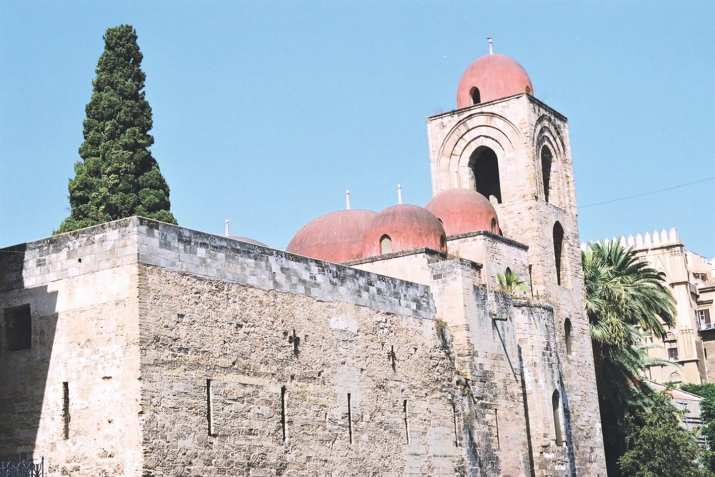
Most of the architectural monuments of the Norman period contain features of Arab-Muslim influence. In Palermo, for example, there is the typically Arabic bell tower of the monastery of San Giovanni degli Eremiti. There is still an Arabic inscription on one of the columns of the Cathedral in Palermo. And there are Kufic inscriptions on the walls of Cuba, the country palace of the Sicilian kings in Palermo.
In 1184-1185, Sicily, already under Christian rule, was visited by the poet and traveler Ibn Jubeir. He visited several cities, but the greatest impression on him was made by “the most beautiful of the cities of Sicily - the capital of their state.”
“Muslims call it al-Madina, and Christians call it Palermo. Muslim townspeople live in it; here they have mosques and markets located in many suburbs. Other Muslims live in towns, villages and other cities - Syracuse and others,” wrote Ibn Jubeir.
He told how upon arrival in the city they were met by guards who took the delegation to an appointment with a local high-ranking nobleman. “The man who stood in for the king came out to us with a solemn step, accompanied by two servants who held the hem of his robe. We saw in front of us an old man with a long white mustache, full of dignity. He asked us about the purpose [of our arrival] and about our country, speaking fluently in Arabic, in which we answered him. He treated us favorably and dismissed us, finishing his greetings and questions. We were delighted with his attitude,” the traveler recalled.
“The Muslims in this city retain some remnants of their faith; they visit many of their mosques and perform prayers according to a clearly audible call. They live in the suburbs, separate from the Christians; they visit markets and conduct trade in them. They do not perform Friday prayers, because preaching is prohibited to them. But during the holiday prayers they are allowed to preach; this invokes a blessing on the caliph.
They have a qadi to whom they turn with their lawsuits and a main mosque where they gather for prayer and the illumination of which they take great care in this blessed month. And there are so many ordinary mosques here that it is impossible to count them; for the most part, they are meeting places for those who teach the Koran.” Thus he shared his impressions.
The ruler of the island, according to Ibn Jubeir, spoke Arabic, read and wrote in it and also had a “wonderful” attitude towards Muslims.
“He treats them well, choosing servants and eunuchs from among them and all of them, or at least most of them, secretly maintain their faith, remaining devoted to the institutions of Islam. The king completely trusts Muslims and relies on them in his affairs and concerns to such an extent that even the manager of his kitchen is a Muslim,” said the surprised traveler.
Having stayed in Palermo for seven days, he went on further and, reaching the city of Atrabunche, found the end of fasting in the holy month of Ramadan.
“We prayed on this blessed holiday in one of the mosques of Atrabunche together with some residents of the city. We prayed here like foreigners. Residents of the city go to their chapel along with the city mayor; they come with drums and trumpets. We were surprised by this and that the Christians were lenient about it,” wrote Ibn Jubeir.
The consequences of the collapse of the emirate and the loss of power by Muslims on the island, coupled with increasing pressure on the community from local rulers, had an adverse effect, year after year reducing the number of Muslims in Sicily, until, finally, their remnants in the 13th century were finally evicted deep into the Apennine Peninsula.
