
Magnificent mosques: The Kalon mosque of Bukhara
Magnificent mosques: The Kalon mosque of Bukhara
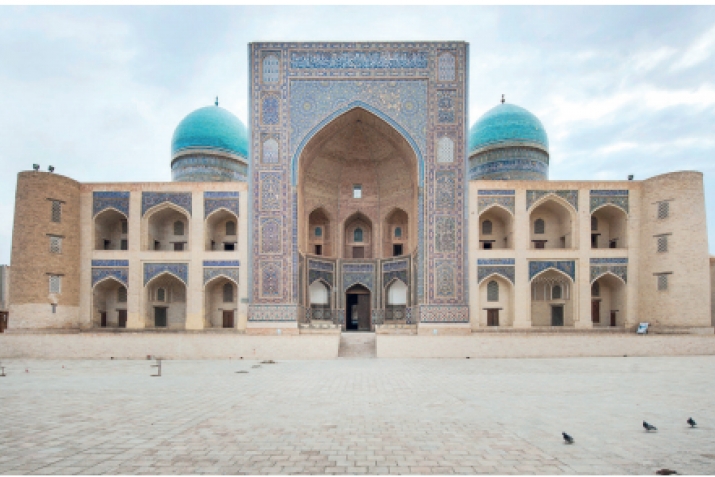
When the Kalon Mosque of Bukhara was built in 1127, its minaret was probably the tallest building in Central Asia. Bukhara (also spelled Bux oro) is a historic city of 255,000 people located 250 km downstream from Samarkand on the Zervshan River in Uzbekistan.
Bukhara was once home to more than 300 mosques and 100 madrasas (religious schools]. In the 9th and 10th centuries, it was the region's religious and cultural heart, hosting the famed philosopher scientist Avicenna, as well as the Persian poets Firdausi and Rudki.
Bukhara has been well preserved over the centuries and is still home to an astonishing array of mosques and madrasas. According to UNESCO, which has designated it as a world heritage site, “Bukhara is the most complete and unspoiled example of a mediaeval Central Asian town which has preserved its urban fabric to the present day.” The city centre includes some 140 historic buildings and monuments, most of which are religious in nature. Bukhara’s non-religious historic sites include several bazaars and caravanserais.
The Kalon Mosque in Bukhara was built by the Karakhanid ruler Arslan Khan. It was known also as the Jamia (Friday) mosque because all male inhabitants of the city were expected to attend Friday prayer there. The courtyard was very large. When Genghis Khan conquered Bukhara and went inside the mosque precinct, he thought he was entering the (local) royal palace. He was impressed by the tall minaret which flanked the mosque.
In a small octagonal building in front of the mosque a second imam (prayer leader] repeated to the crowd in the courtyard the prayers and sermons which were being said by the principal imam inside the mosque itself.
Kalon in Tajik means “great” and when the mosque was built the minaret was probably the tallest building in Central Asia, according to the Sacred Destinations website. It is 47m tall and is supported by deep foundations padded with reeds to make it earthquake-proof. All these years, it has hardly needed any structural repairs.
In addition to its primary function as a minaret, the Kalon Minaret served as a watchtower and a guide to approaching caravans on the Silk Route.
The Kalon Mosque was used as a warehouse in Soviet times and only reopened as a working mosque in 1991.
The Kalon Minaret has 14 ornamental bands, each of them different. They include the first use of the glazed blue tiles that became ubiquitous across Central Asia. One can climb the minaret for excellent views over the centre of Bukhara. Its 105 stairs are accessible from the mosque.
The congregational Kalon Mosque can house 10,000 worshippers. Although its roof looks flat, it actually consists of 288 domes. The mosque has been known by various names Kalon Mosque and Minaret; Kalyan Minaret; Kalyan Mosque; Majdid El Khalyan; Minaret Kalian; and Poi Kalyan Minaret.
Opposite the Kalon Mosque in the historic centre of Bukhara stands the Mir i Arab Madrasa. Founded in the 16th century, this Islamic school features two distinctive blue domes and other tile work. It was a working Islamic school from the 16th century until it was closed down in 1920. It was reopened by Stalin in 1944 in an effort to gain Muslim favour for his war effort.
The two luminous blue domes of the madrasa are beautifully tiled and stand out against the mostly brown architecture around it.
Built in 1417, the Ulughbek Madrasa is the oldest madrasa in Central Asia. Ulughbek was the grandson of Amir Timur. The design of the madrasa is similar to that which he built in the Registan of Samarkand, although its portal is smaller. At the time of its construction, Ulughbek was not the ruler of the country, but the governor of the region, as his father Shah Roukh preferred to live in Herat (in today's Afghanistan).
Ulughbek was fond of astronomy and he wanted stars to be part of the madrasa’s decoration. It is one of three built by Ulughbek; the others are in Samarkand's Registan and in Gijduvan (45 km from Bukhara towards Samarkand).
This elegant version in Bukhara contains many niches around a central courtyard and is decorated with blue tiles. The madrasa is located just east of the Taqi Zargaron (Jewellery) Bazaar.
Mohammed Alim Khan, the last emir of Bukhara, built a small madrasa next to the minaret.
In the second half of the 16th century, Abdullah Khan II built two madrasas facing each other. The exterior of both was extensively restored in the 1950s and again more recently. Nowadays they look quite new.
In a maze of alleys between Pushkin and Hoja Nurabad in Bukhara stands the Chor Minor (called Char Minar ([Four Minarets] in Tajik). From a distance the building has the appearance of an upside down stool. This interesting little building was actually a gatehouse of a now-lost madrasa built in 1589. Its architecture is more Indian in style than Uzbek. In 1998, UNESCO restored one of the towers that had collapsed.
MUHAMMAD HABIB “HAJJ AND UMRA” MAGAZINE