

Artistic treasures of Islamic Egypt
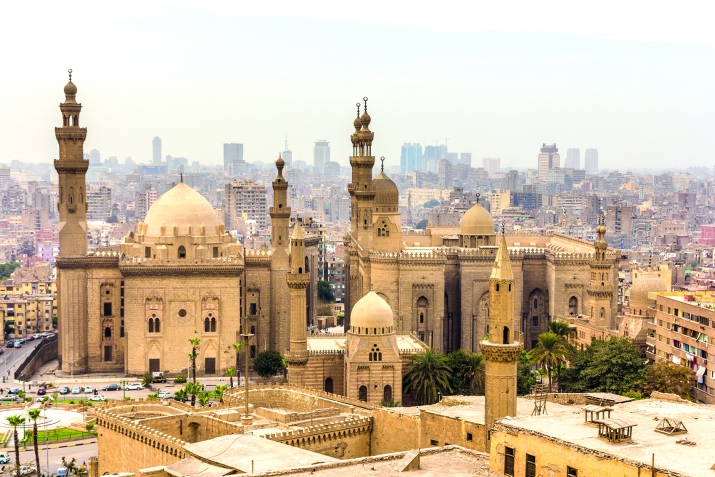
The mosque and madrasa of Sultan Hassan in Cairo are among the largest Islamic religious buildings in the world.
Egypt undoubtedly is an ancient country, full of artistic treasures. Two such treasures are the mosque and madrasa (religious school) of Sultan Hassan and the Abu Al Abbas AlMursi Mosque.
Built between 1356 and 1363 by the Mamluk ruler Sultan Hassan, the scale of the mosque is so colossal that its construction nearly emptied his treasury.
th and covers an area of 7,906 sq. m. Its walls rise to 36 m and its tallest minaret to 68 m.
Visitors enter the complex through a tall portal that is itself a work of art. A dark and relatively low-ceilinged passageway leads to the brightly lit sahn, a standard cruciform plan open courtyard.
The courtyard centres on a domed ablutions fountain, which was probably an Ottoman addition. Soaring on four sides of the courtyard are vaulted liwans (sitting rooms), accented by hanging lamp chains and red and black rims.
Each liwan is devoted to one of the four Sunni schools of jurisprudence. Skillfully structured between and behind each liwan is a madrasa, complete with its own courtyard and four stories of cells for students and teachers.
One of the liwan also has a mihrab (prayer niche indicating the direction of Mecca) and minbar (pulpit). It is distinguished from its roughlyplastered counterparts by soft-hued marble inlay and a band of Kufic script.
To the right of the minbar in this room is a bronze door, exquisitely decorated with radiating stars in gold and silver.
Cairo, the capital of Egypt, is a huge city of more than 12 million people spread in all directions.
The city did not begin with the pharaohs; they quartered themselves in Memphis and Heliopolis.
What makes Cairo unique is that each new ruler, rather than destroying what he found, simply built a new area of the city adjacent to the old one. Thus one can follow the progression of history by walking through the various districts of Cairo. Each district retains a distinct identity, not only in its buildings, but also among its residents and their way of life.
Alexandria, the Pearl of the Mediterranean, a charming and vibrant port city, presents to every visitor the fragrance of a past rich in history, civilization and culture. Founded by Alexander the Great in 331 BC, it became the capital of Greco-Roman Egypt and later of Islamic Egypt
The mosque of Abu Al Abbas AlMursi Mosque is the most historic and most beautiful in Alexandria. Built in 1775, it is named after Abu Al Abbas Al Mursi, a Spanish scholar, who was born in 1219 to a wealthy business family in the Andalusia region of Spain. He was well educated and was also known for his honesty and for his help to the needy.
He and his family left Spain for Tunisia in 1242. He later went on to Alexandria, a popular destination of many Muslim scholars at the time. Abu Al Abbas lived in Alexandria for 43 years as a scholar and teacher until his death in 1286.
The mosque was restored periodically over the centuries by a number of rulers. Most of the present structure dates from 1775, when the Algerian Sheikh Abu El Hassan El Maghrebi built a much larger mosque on the site. It was fully renovated in 1863.
The mosque complex was again beautified in 1943 when the Midan El Masajed, or Mosque Square, was built. It covers an area measuring some 43,200 square m and includes five other mosques centered around the Abu Al Abbas Al Mursi Mosque.
The walls of the cream-coloured mosque stand 23 m high and are dressed in artificial stone, while the minaret (tower), situated on the southern side, rises to 73 m. It is of Ayoubid design, with four sections. The first section is about 15 m high and square in shape.
The second is four m high with eight sides. The third is about 15 m high with 16 sides, while the uppermost level is 3.25 m high with a circular shape. The top of the minaret is covered with brass and has a crescent moon finale.
The mosque has two main entrances on the north and the east. The stairs of the entrances are made of Egyptian granite.
The main part of the mosque, internally, is an octagon, with sides measuring 22 m. The internal walls are also dressed in artificial stone. The entire space of the mosque covers an area measuring 3,000 sq. m. The ceiling, supported by sixteen columns, is made of Italian granite, which in turn support arches, and soars 17 m overhead. The ceilings are decorated with arabesque designs.
The columns are solid, or monolithic, including their capital and base. They are octagonal in shape, measuring 0.85 m in diameter and 8.60 m in height. In the centre of the ceiling is an elevated skylight with eight sides known as a Shokhsheikha that is 24 m above floor level and 51 m laterally.
Each side of the skylight actually has three windows of coloured glass in arabesque designs, set into metal frames. This skylight is surrounded by four domes, which have an inner and outer layer. The inner one forming the ceiling stands 22 m high and is five m in diameter.
The upper domes measure 7.5 m in diameter and stand 11 m above the lower domes. The floors are paved in white marble.
The doors, minbar and windows are made of joined and finely carved teak, citronia and walnut. The minbar is 6.35 m high, capped by a dome, and has Koranic verses written at the top in French gold. The mihrab stands at the base of the mosque's minaret. It is flanked by two columns of Egyptian granite measuring 3 m in height.
At the end of each column, the name of Prophet Mohammad (peace and blessings be upon him) is written in the Kufic style of Arabic calligraphy. The kalima “There is no god except Allah and Mohammad is His prophet,” is written twice, also flanking the mihrab.
The mosque has a special worship area for women with a private entrance. The mayda, an ablution area, with lavatories, is on the western side of the mosque with its own entrance overlooking the square.
Since the 19th century, Alexandria has played a new role as a focus for Egypt's commercial and maritime expansion. It attracted among the greatest men of letters in the world. Lawrence Durrell, British author of the famous series of novels about life in the city, “The Alexandrian Quartet”, described it as “The capital city of Asiatic Europe, if such a thing could exist.”
BY MUHAMMAD HABIB
