

Distant Pathways: Islam in Colonial and Contemporary Latin America
Distant Pathways: Islam in Colonial and Contemporary Latin America
By the time the hegemony of Spain gave way to nationalist independence movements throughout its colonies in the 18th and 19th centuries, variants of Hispano-American Mudejar architecture had become accepted as signature local styles and as such became part of the architectural iconography of the new republics. This was a time also when an intense fascination was developing amongst the educated elites of Western Europe for the ‘new-found’ wonders of Islamic art and architecture, particularly of the creations of the Alhambra.
One of those captivated by the beauties of Islamic art was a young Chilean, Manuel Aldunate i Avaria, who in 1862 designed the revivalist masterpiece, “El Palacio Alhambra”, in the capital Santiago for Don Francisco Ignacio de Ossa y Mercado, a mining magnate and aristocrat, who had sent him to study and travel in Europe and Africa.
Considered to be one of the joys of the Chilean architectural patrimony, the palace suffered substantial earthquake damage in 2010: King Mohamed VI of Morocco responded with assistance to restore it to celebrate the 200th anniversary of Chilean independence in 2018. Buildings and monuments evocative of classic Islamic architecture - as well as in a neo-Mudejar style which became popular in Spain at the turn of the 19th and 20th centuries - were also frequently constructed in many other Latin American republics.
Islam made itself felt in Latin America in a different way later in the second half of the 19th century and early 20th century through the immigration of Muslims to Argentina and Bolivia from the Ottoman territories bordering the eastern Mediterranean.
These “Levantines” from Syria, Lebanon and Palestine, were searching for a better life away from the ethnic crises occurring in the Ottoman Empire and as a reaction against the assumption of authority by European powers in the region after World War I.
As in the early centuries of Spanish colonialism, Muslims assimilated well and productively, one of the long term consequences being the many strong political and commercial alliances which developed between Latin American and Islamic states as the latter emerged from colonial domination in the course of the 20th century.
Some four million Muslims now live in Latin America. The country with the largest percentage of Muslims (13.5%) is one of the smallest in size, Surinam, while Brazil has the largest overall number of Muslims (c. 1,500,000) and Argentina approximately 1,000,000. In some states, particularly Mexico, Islam is generating new converts from marginalized indigenous communities. New mosques are being built across the region.
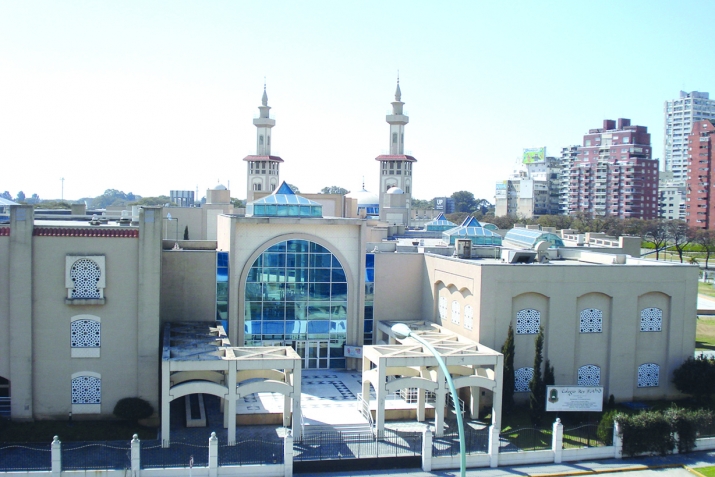
The largest in Latin America is the King Fuad Islamic Cultural Centre in Argentina’s capital, Buenos Aires. Built in 2000 on land personally donated by President Carlos Menem (of Syrian Muslim descent), as well as a magnificent mosque, it has primary and secondary schools, a madrasa and dormitory, a sports centre, exhibition auditorium, apartments for two imams and an underground carpark . The Islamic Organization of Latin America, its most active Muslim organization, is headquartered in Argentina.
