
Do you know the way the Kaaba is washed?
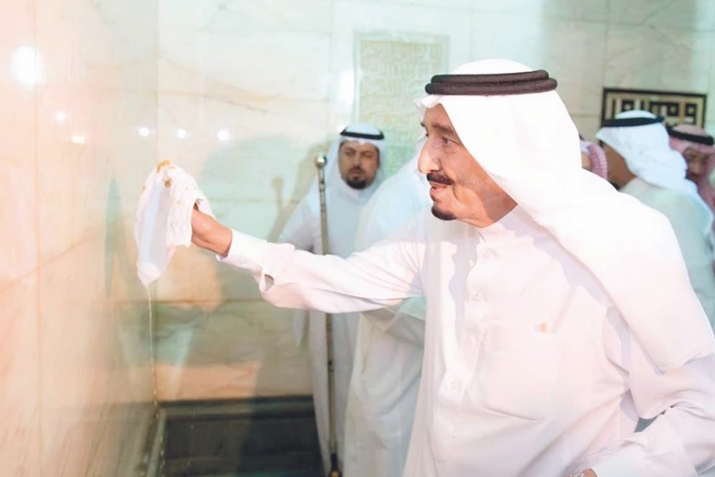
The Kaaba is the place revered by all Muslims. Believers all over the world turn towards it in prayer. It would seem that everything is known about the Kaaba in sufficient detail. However, do we know about the procedure for washing the Kaaba, who washes it and how? Let us share this with you in this article.
First, let us mention the keepers of the keys to the Kaaba, without whose permission no person, even the ruler, can enter this shrine.
When the Prophet Muhammad (peace and blessings be upon him) liberated Mecca from the pagans, he was given the keys to the Kaaba. However, the Prophet (peace and blessings be upon him) did not keep them for himself. Instead he returned them to Usman ibn Talha of the Bani Shayba clan, whose family had been the keeper of the keys to the Kaaba for many centuries. The Messenger of the Almighty (peace and blessings be upon him) approved this honorary role for them until the end of time. Now everyone (from a mere mortal to the rulers of the world), honouring the decision of the Prophet (peace and blessings be upon him), ask permission to enter the Kaaba from this small Meccan family. Today, this honorary mission is carried out by Salih bin Taha Al-Shaibi, who is the 109th custodian of the keys after Usman ibn Talha.
Washing the Kaaba is a Sunna of the Messenger of God (peace and blessings be upon him), who washed the House of God after the liberation of Mecca.
Today, not everyone can take part in this process. It is the Saudi monarch or one of his proxies who directs the ceremony of washing the Kaaba. Well-known Islamic scholars, political and public figures from Saudi Arabia and foreign countries, as well as representatives of diplomatic missions, also participate in it.
At the beginning of the washing ceremony, the king or a representative authorized by him goes inside the Kaaba. There he prays at the place where the Prophet (peace and blessings be upon him) prayed. After that, the rest of the participants enter the Kaaba to pray.
The ceremony of washing the Kaaba itself lasts an average of 1-2 hours. According to the previous keeper of the keys to the Kaaba, Sheikh Abdul Qadeer bin Taha Shaibi (d. 2014), the walls of the shrine are washed on the inside with 45 litres of Zamzam water with the addition of 50 tuls (1 tul = 12 ml) of rose oil, specially grown in the province of Taif, and Cambodian oud (an expensive herbal incense).
A cloth soaked in this scented liquid is used to cleanse the interior walls. The floor of the shrine is poured with Zam-zam water mixed with rose water, rubbing it with bare hands and palm leaves.
After the washing is completed, those present perform the rite of circumambulation around the Kaaba (tawaf) and then perform the two-rakah sunnah prayer.
In former times, the Kaaba was washed twice a year but more recently this has been done once a year.
Lilia Altynova
Islam.ru website writer