
Sheki, Azerbaijan: Window onto the Life of a Caucasian Muslim Khanate
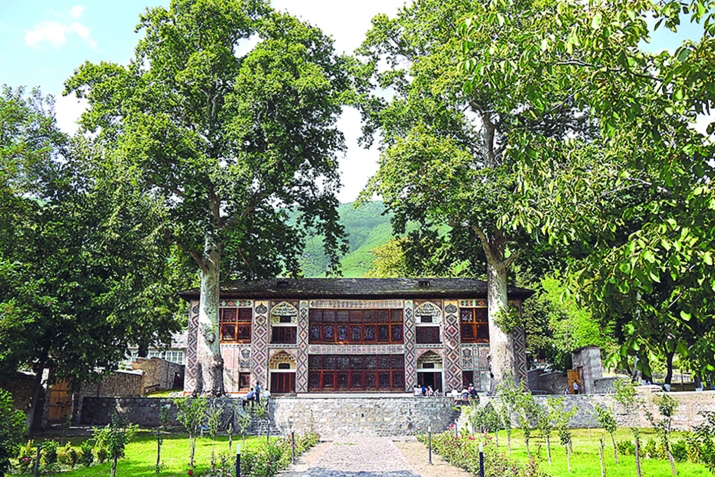
There are a number of smaller communities in the Islamic world, which have largely preserved their traditional townscapes and Muslim cultural heritage, which we present as destinations of special interest to Muslim travellers or to others who would like to explore and experience Islamic culture, while enjoying a safe and comfortable tourist experience to the best international standards. The town of Sheki in Azerbaijan is the second to be reviewed.

Nestled among the densely-forested southern slopes of the snow-capped Greater Caucasus range in northern Azerbaijan is the historic Muslim centre of Sheki. Located geographically just 20km from the mountainous border with the Republic of Dagestan of the Russian Federation, it is 300 km by road northwest of Baku and 500 km from Derbent. Today, the town with its 68,000 inhabitants, well-preserved historic monuments, charming meandering streets and tiled-roofed houses, lively bazaars, rich craft and culinary traditions and customary hospitality, provides us with a unique window onto the way of life typical of the many small Islamic khanates which governed much of the Caucasus prior to Tsarist Russia’s expansion into the region in the late 18th and 19th centuries.
Since ancient times Sheki had been an important agricultural, crafts and commercial centre on the east-west trade corridor skirting the southern slopes of the Great Caucasus range and linking Persia with the Black Sea and beyond. It was also close to the north-south trade route along the western Caspian coast linking Persia via Derbent with the Eurasian steppes and Russia.
From the mid-1730s to 1747, the entire Caucasus was disrupted by the invasions of the Persian ruler Nadir Shah Afshar. A local leader, Haci Celebi Khan (1703-1755), established the Sheki Khanate following Nadir Shah’s assassination in 1747. Under his rule the crafts for which Sheki was (and remains) famed - metal work, jewelry, decorative woodwork, pottery and silk textiles - flourished again. Commerce prospered and goods were traded from across Europe and Asia. The town once had five caravanserais, two of which survive, the Yukhari Caravanserai, the largest in the entire Transcaucasus, and the Ashagi Caravanserai. Haci Celebi Khan was a devout Muslim and built the Khan Mosque in Sheki in 1748-9 as well as madrasas, hamams and bridges. Other historical mosques in Sheki include the Juma Mosque with its elegant tall minaret, the Gilahli Mosque and the Omar Effendi Mosque.
Haci Celebi Khan’s grandson, Hussein Khan, ruled the Khanate from 1752 to 1779 and built a palace complex in the upper citadel area of Sheki, lavishing attention on two buildings which were intended to display Sheki to the world as a sophisticated centre of courtly power. These were his winter palace and a summer reception pavilion popularly known as the Sheki Khan Saray or Palace.
The Sheki Khan Saray, built in 1761-62, is a two-storied pavilion with panoramic mountain and river views over the town below. The ground floor was conceived for administrative use and interaction with the Khan’s subjects, and the second for the summer pleasure of the Khan and his family and official court receptions. The facade and interiors were all richly decorated by northern Azerbaijani craftsmen in wood, tile, glass, plaster and paint. The result is a sublime manifestation of the creativity and technical mastery of those vernacular builders and decorators who worked in what is known as the “tulip period” or “edirnekari” style across the Turkic-speaking Ottoman world – from the Balkans to the Transcaucasus – in the 18th century. Their work was inspired by that Islamic aesthetic which delights in the whole of the natural world and in designs which evoke the complex, yet ordered, infinity of the Almighty’s creations. As an artistic achievement in this regionally popular genre, it is rivalled only by the intimate dining room (Yemis Odasi) of Sultan Ahmet III (1673-1736) in selamlik of the Topkapi Saray in Istanbul, which is remarkably similar. It is hoped that UNESCO’s World Heritage Committee will approve Sheki Khan Saray’s current nomination as a monument of cultural significance to humankind.
In the mid-18th century the Sheki Khanate was one of the strongest states in the Caucasus. However, under severe pressure from the Persian Qajar dynasty at the end of the century, it sought military assistance from Russia. In 1805 Mustafa Selim Khan signed a treaty with Tsar Alexander I by which the khanate became a Russian protectorate. In 1819 it became a Russian province.
During Tsarist Russian rule Sheki was the foremost centre of silk production in the empire – a prominence it held subsequently in the USSR. It continued to be a focus of Muslim worship and learning. Among its noteworthy native sons of the period is Mahammad Hasan Moulazadeh Ismayl oglu Shakavi (1854-1932), who received his first religious education at the Sheki Mollakhane and became Sheikh ul-Islam of Muslims of the Caucasus in 1908, the year he published the Kitab al-Bayan fi Tafsir al-Quran – the first translation into the Azerbaijani language of the Koran together with his accompanying commentary (tafsir).
Today, Sheki is the second most popular tourist destination in Azerbaijan after the capital Baku from which it easily accessible by public transport. By bus or marshrutki (public minibus) from Baku to Sheki the journey takes 6-7 hours, by taxi 4.5-6 hours and by train 9.5 hours. Wikivoyage (en.wikivoyage.org/wiki/Sheki) has up-to-date information on transport to and within the town. Those travelling by land from Dagestan must travel via Baku. Azeri, Russian and Turkish are spoken in Sheki. Accommodation ranges from very basic to very comfortable and prices are reasonable; bookings can be readily made through the internet. Sheki has a wonderful local cuisine, including the delicious piti, a rich lamb stew baked in a ceramic pot, and sweet Sheki halva, a local baklava. As Azerbaijan is a predominantly Muslim country, most restaurants serve halal foods.
Foreign nationals wishing to travel to Azerbaijan are required to possess a valid passport. Nationals of the Russian Federation do not require a visa and can stay for up to 90 days. The Government of Azerbaijan now has an eVisa system enabling the citizens of many countries to obtain visas online.
Azerbaijan is taking the development of a Muslim-friendly tourism industry most seriously. In the first half of 2017 tourists from Arab countries were first place among visitors to the country and the Organisation of Islamic Cooperation currently rates it amongst the 20 most favoured Muslim tourist destinations. The Muslim travel market is one of the fastest growing sectors of the global travel industry and Azerbaijan’s attractiveness as a destination is further amplified by the enormous general global popularity of cultural tourism.