
Islamic cultural heritage destinations: Gjirokastra, Albania – the best-preserved ottoman period town in Europe
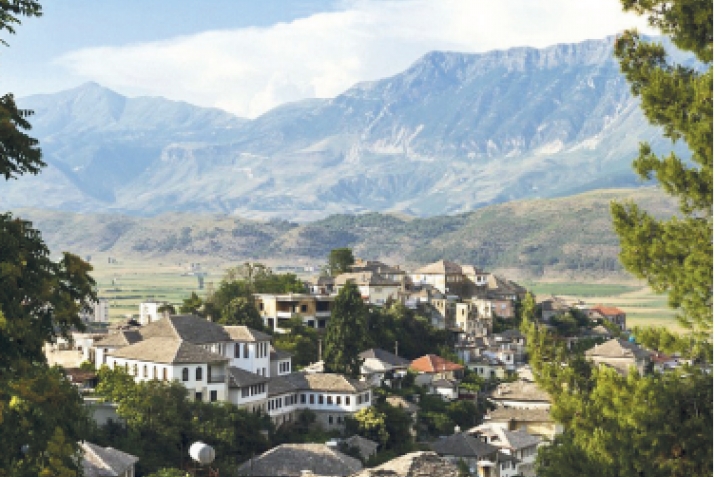
There are a number of smaller communities in the Islamic world, which, to a very significant degree, have preserved their traditional townscapes and material and non material Muslim cultural heritage, which we present as destinations of special interest to Muslim travellers or others with an interest in exploring and experiencing the depth and diversity of Islamic culture, while enjoying a safe and comfortable tourist experience to the best international standards. All of these communities have been proclaimed as World Heritage Sites by UNESCO. The first to be reviewed is the town of Gjirocastra in Albania.
Gjirokastra is located in the south of Albania, close to its border with Greece and not far from the Adriatic Sea coast. It is the bestpreserved Muslim majority town in Europe in terms of its historical built environment and traditional way of life. It was inscribed by UNESCO in 2005 as a World Heritage Site of outstanding global significance to humankind “a rare example of a wellpreserved Ottoman town”.
The Republic of Albania today has a population of approximately 3,000,000, with a Muslim majority of 60.88% (2011 census other surveys estimate it as high as 82.1%), together with Catholic and Orthodox Christians and those of other affiliations.
The region had long been Christian prior to the early 15th century when it became part of the Ottoman Turkish domains. While much of the Balkans converted quite quickly to Islam, the process of Islamization was gradual in the south of Albania where there was a substantial Greek Orthodox Christian population. It gained momentum in the 19th century: the Gjirokastra region not becoming majority Muslim until 1875.
During the course of the 19th century when Balkan Christian Greeks and Serbs were fighting for their independence from the Turks, Albania’s majority Muslim population became increasingly concerned about losing their identity by being absorbed into the new state entities and became a major force in the movement towards Albanian independence, which was declared in 1912.
In the 19th century Muslims constituted about 70 % of the Albanian population, a proportion which remained quite constant between the First and Second World Wars, when Albania was the only Muslim country in Europe.
Gjirokastra is a beautiful town built on the slopes below a protective citadel (the largest in Albania) which dominates a strategically important route along the Drinos River valley. Its modern Albanian name, Gjirokastra, is derived from its Greek name, Argyrokastro, meaning “silver castle” an apt description of the silvery grey stone from which it and the town’s houses, roofs and cobbled streets are built.
The area has preserved not only its traditional built environment but also its natural beauty largely intact, together with its traditional rural way of life and economy rare nowadays anywhere in Europe.
This way of life was moulded over a long period of time by the traditions of Islam. However, this process was within a particularly Ottoman context, which also respected the traditions of the Balkan Orthodox Christian community (administered by its Patriarchate in Istanbul), which has thus been able to continue its spiritual and cultural development to the present day.
This “City of Stone”, as it is popularly called, has about 44,000 inhabitants. Some 500 traditional twostory and fortified houses (officially designated “cultural monuments”) and other buildings, built primarily by wealthy Ottoman landowners and prominent officials, line cobble stoned streets with wide views over the river plain below.
The town was the capital of an Ottoman sanjak (district) and had a major regional bazaar, selling agricultural produce, livestock and locally made leather and textiles. A French consul in the 18th century noted that the town’s products had already gained a reputation in Europe.
The famous Turkish traveler, Evliya Celebi, who visited Gjirokastra in 1670, recorded that it had two thousand houses, two covered bazaars with two hundred shops, eight congregational and seven neighbourhood mosques, three Sufi lodges (tekke), three madrasas, five primary schools (makhtab), one hamam, three churches, five fountains and five guesthouses for visiting merchants.
Celebi described the inhabitants as “a race of warriors, mournful, somber, chaste, virtuous and brave.” In 1727, another madrasa was established there which functioned without interruption until it was closed by the state in 1967.
The whole presents a cultural landscape which is outstanding testimony to the wealth and diversity of the urban and architectural heritage of the region.
The majority of Gjirokastra’s buildings date from the 17th to the early 19th centuries (the town’s most prosperous period) and have stone built, window less lower stories for livestock and storage, and upper stories of wood and plaster, where families lived and hosted their honoured guests. Many are built as defensive structures, reflecting tensions between competing families and clans.
These rooms are often cantilevered outwards above the street so as to create more space, while at the same time ensuring privacy a feature typical of Islamic Ottoman town architecture across the Balkans and Anatolia throughout this period.
Wandering through this pleasant town, one becomes immersed in the feeling of being back in the world of the Balkans of the 19th century and earlier, when a diversity of cultures and occupations coexisted under a Turkish umbrella.
Following the forced mass exchange of Christian Greek and Muslim Turkish populations (2,000,000 in total) which took place between Turkey and Greece in 1923, and the destruction of traditional Muslim communities and townscapes in other parts of the Balkans during later 20th century conflicts, Gjirokastra provides a unique opportunity to step back into a world which has all but vanished elsewhere.
Nevertheless, Gjirokastra also experienced the savage effects of aggression in this case also political and ideological. In 1967, the hardline socialist regime then in power in Albania proclaimed an Ideological and Cultural Revolution on the model of that being implemented by the People’s Republic of China, with which Albania was closely aligned with catastrophic impacts on its society and its heritage.
The overarching object was the eventual destruction of all organized religion in Albania; as a national literary publication of the time phrased it, the regime had “created the first atheist nation in the world”.
All religion was construed as a social threat that undermined the cohesiveness of the nation. Consequently the state’s policies and actions attempted to destroy the Muslim way of life and culture throughout Albania. Mosques became a particular target as their very physical presence was considered to be an ideological presence in the minds of the people.
In 1967 over 2,000 religious buildings and other monuments, including some 700 mosques, were rapidly destroyed. Those few that remained were either repurposed or abandoned.
Twelve of Gjirokastra’s mosques were demolished, leaving only the mosque and its minaret adjacent to the bazaar standing (it was saved by being granted the status of a “cultural monument” in 1973).
Religious institutions of all faiths were forbidden to be involved in any way with education of the young, and were prohibited from owning property or operating philanthropic and welfare bodies, hospitals, etc. Religious services were prohibited with very severe penalties.
Personal possession of a Koran and other religious literature was forbidden and parents were advised not to give their children Muslim or Christian names and ordered those with names which did not conform to state ideological perceptions to change them.
Paradoxically, however, this ideological pogrom was to result in the preservation of most of Gjirokastra’s built character and traditional occupations, as the Albanian leader, Enver Hoxha, who was born in Gjirokastra, proclaimed the town and that of Berat (also inscribed as a UNESCO World Heritage Site) as “Museum Towns”.
Considerable effort and funding, including the support and training of specialists craftsmen and restorers, was expended to conserve and restore the town’s material (if not spiritual) environment.
GUY (GHAYDAR) PETHERBRIDGE
PROFESSOR, EXPERT ON CULTURAL HERITAGE AND HISTORY OF ISLAM, AUSTRALIA, RUSSIA