
The ird batik motif Covid: a refl ection of the «Contemplation» koranic mode of thinking
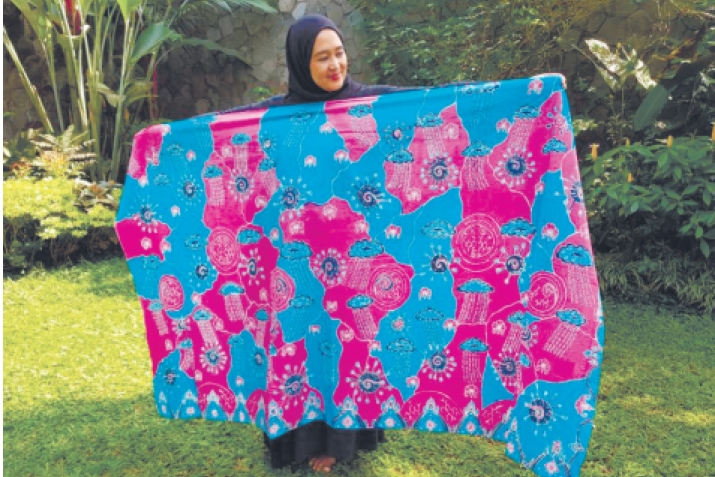
The batik textile art has travelled a very long historical journey through the culture and civilization of Indonesia to today’s modern designs or patterns that adorn items of fashion. In addition to batik’s uniqueness as a textile art, there is also never a design exactly the same as the others: in each example are incorporated many stories and philosophical values. Batik is a cultural achievement part of the cultural heritage not only of Indonesia but of the world as a whole. The craft of batik making has also always been perpetuated and developed as an important feature of the people’s economy.
The batik design “IRD Pesona (Enchantment) COVID 19 Endorphin” produced by the Indonesian Islamic fashion house, IRD Batik, which is illustrated here, incorporates «batik motifs reflecting da'wah, education, and Sharia business». A reconstruction of the teachings of Muslim ulama and scholars are poured into its motifs.
They contain a number of philosophical components: firstly, the transformation of Koranic content in an affective manner; secondly, education characterized by the value of the teachings of ulama and scholars; and thirdly, the implementation of local wisdom derived from the teachings of the ulama through the development of a confident attitude to their community. It can also be said that batik as a work of art is associated with religious teachings that reach humans through revelation from Allah.
In Arabic terms, the word tafakkur means contemplation of the bridging of perceptions and conceptions of the life of this world to that of the hereafter and from the created to the Creator, Allah. Tafakkur extends beyond this life to a wider realm, that of the hereafter, and beyond the superficiality of materialism to a deeper horizon, that of the «spirit», which can motivate all external and internal deeds of Muslim believers.
Ibn Khaldun in his book Muqadimmah provides us with a broad understanding of its significance. Education is not only a teaching and learning process limited by four walls but rather one through which humans consciously capture, absorb, and transmit the experience of natural events across the ages. For a person of faith, understanding the meaning of tafakur and Islamic education as explained above assists in dealing with the novel coronavirus COVID 19 that was first discovered in Wuhan, China in December 2019 and which has since shocked the world. This virus is currently thought to have originated from a species of host bat which migrated to humans who ate its flesh. There are also those who say that COVID 19 is a mutation of the SARS virus, which was also first discovered in China (in 2002). This quickly spread to various countries, although it did not develop into a global pandemic and ceased to appear after 2004.
In relation to the epidemic that is now upon us, we may cite an outbreak of plague during the Caliphate of Umar bin Khattab which began in Amwas, a city west of Jerusalem in Palestine. In the biography of Umar bin Khattab by Muhammad Husain Haekal, is described how the plague spread to Sham (Syria) and even to Iraq. It is estimated that the outbreak occurred at the end of 17 Hijri and triggered a mass panic at that time.
Abdurrahman bin Awf told Umar that the Prophet said, “If you hear the news of an outbreak of an epidemic (ta’un) in a certain place, do not enter that place: and if the epidemic falls in a place while you are present in it, do not leave that place to escape from the epidemic.” (Muttafaqun ‘alaihi, HR Bukhari and Muslim).
In the end the plague ceased when a friend of Amr ibn al Ash’s (may Allah be pleased with him) led Sham. It was through his intelligence and with Allah’s permission that Sham was saved. Amr bin Ash said: «O people, this disease spreads like a fire. Then you must take refuge from this disease in the hills!» At that time, all local people followed his advice. Amr bin Ash and the refugees continued to survive in the highlands until the spread of the Amwas plague subsided and disappeared altogether.
The Koran directs human attention to the contemplation of the creation of the universe: sky, stars, oceans, natural phenomena such as night and day, wind, rain, etc. Contemplation is encouraged of the creations of Allah, peace of mind, the remembrance of Allah, the reminding of thinking people of «responsibility» and the necessity of its fulfillment, the observation and responsible use of the universe the goal being to find the laws of the universe in order to revive the earth and build civilization.
Likewise in understanding the meaning of contemplation of ayat 164 of the Sura Al Baqarah, as expressed through the IRD Batik motifs of «Pesona COVID 19 Endorphin» as a medium of Islamic education and a mode of Koranic thought, we have a more detailed explanation based on the interpretation (tafsir) of Ibn Kathir, as follows:
Almighty Allah says:
إِنَّ فِي خَلْقِ السَّمَاوَاتِ وَالأَرْضِ,
“Verily, in the creation of the heavens and the earth,” namely in terms of height and breadth, as well as moving and silent stars, their circulation in their paths; lowlands and highlands, mountains, seas, deserts, solitude, crowds, and all the myriad benefits found in nature. Substitution day, and night; one went the other came to replace it by not overtaking each other and not the slightest delay even if only for an instant. Sometimes one is long and the other short. Sometimes one takes the other part, then replaces one another, as He says in Sura Al Hajj, ayat 61; that is, adding night to day, and day to night.
وَالْفُلْكِ الَّتِي تَجْرِي فِي الْبَحْرِ بِمَا يَنْفَعُ النَّاسَ,
“And the ark which sails in the sea brings what is useful to humans”. That is, in the expanse of the sea created by Allah so that the ark can sail from one side to the other for the benefit of human life and so that they can benefit from the inhabitants of an area and bring it to other regions one after another.
وَمَا أَنْزَلَ اللَّهُ مِنَ السَّمَاءِ مِنْ مَاءٍ فَأَحْيَا بِهِ الْأَرْضَ بَعْدَ مَوْتِهَا,
“And Allah has sent down rain from the sky and given life thereby to the earth after its lifelessness.”.
وَبَثَّ فِيهَا مِنْ كُلِّ دَابَّةٍ,
“And He places on this earth all kinds of animals, “in various shapes, colors, and benefits, small and large. And He knows all of that and gives it fortune; none of the animals are unreachable or hidden from Him.”
وَتَصْرِيفِ الرِّيَاحِ
“And the disposition of the wind” meaning sometimes the wind blows with grace and sometimes it blows with havoc. Sometimes it brings good news by stopping in front of a cloud so that it rains, and sometimes it blows and brings a cloud down, sometimes it collects it and sometimes it scatters it. Sometimes it blows from the west which hides the back of the Kaaba.
وَالسَّحَابِ الْمُسَخَّرِ بَيْنَ السَّمَاءِ وَالْأَرْضِ
“And the clouds are controlled between heaven and earth”. This means walking between the heavens and the earth, directed by Allah towards all the regions and places He wants, as He has controlled them.
لَآيَاتٍ لِقَوْمٍ يَعْقِلُونَ
“There are indeed signs (oneness and greatness of God) for the people who think about it”. That means that in all of this there is clear evidence to demonstrate His satisfaction. In other words of his.
وَالْفُلْكِ الَّتِي تَجْرِي فِي الْبَحْرِ بِمَا يَنْفَعُ النَّاسَ
(“And the ark which sails in the sea brings what is useful to humans”), we can see in Sura Al Baqarah, ayat 24-25, relating to aqidah, Sharia and morals, that there are two principal things that must be addressed in Islamic education, the first being concepts and the second the implementation of society and science. The understanding of education in the context of Islamic education is synonymous with the words ta'lim, tarbiyah and ta'dib. Generally, the word tarbiyah is often used for Islamic education, whereas the word ta'lim, which is associated with the word ‘allama which means teaching, is used for the giving or delivering of understanding, knowledge and skills.
Besides all that is stated in the Koran, there is also a hadith recorded by Bukhari that Aisha once asked the Prophet about the plague. The Messenger of Allah said, “It is a punishment that Allah sends upon whoever he wills, but Allah has made it a mercy for the believers. Any servant who resides in a land afflicted by plague, remaining patient and hoping for reward from Allah, knowing that nothing will befall him but what Allah has decreed, he will be given the reward of a martyr.”
To be continued…
DR. HJ. INDRIYA RUSMANA, M.PD.I
IBN KHALDUN UNIVERSITY, BOGOR, INDONESIA