

Fazl ibn Yahya and the world’s first paper mill
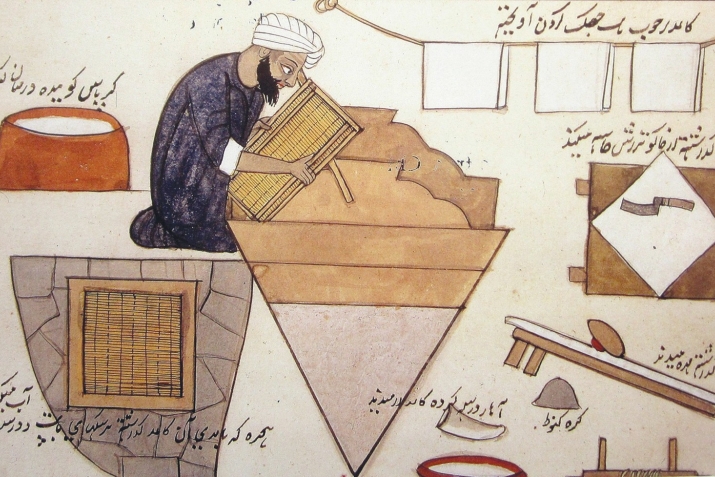
Although paper was invented in China in 105, the secret of its production remained hidden and mass production was not established elsewhere.
This changed after the Battle of Talas (in today’s Kazakhstan) in 751, when Muslims captured Chinese prisoners who shared their knowledge of papermaking technology. This event marked the beginning of the spread of paper throughout the world.
Based on this knowledge, in 794, the Abbasid vizier Fazl ibn Yahya founded the first paper mill in history. The Muslims modified the production technology by using easily available flax and cotton fibres, rather than the plant fibres used by the Chinese. This, in turn, contributed to the wider adoption of paper.
Who was Fazl ibn Yahya?
Fazl ibn Yahya, born in 766, was the eldest son of the vizier Yahya ibn Khalid and belonged to the renowned Barmakid dynasty. He was the foster brother of the famous Caliph Harun al-Rashid and studied with him. At various times, Fazl served as governor of Mosul and was appointed to positions in Armenia, Azerbaijan, Khorasan and the Caspian regions. Under his leadership, the taxation system was streamlined, allowing funds to be allocated for the construction of water canals, mosques and caravanserais.
When Harun al-Rashid came to power, he appointed Fazl as vizier and entrusted him with the care of his children. During his 17 years in this position, Fazl ibn Yahya implemented numerous reforms, including the establishment of paper production. The Caliph then banned the use of other materials on which books were written, mandating a switch to paper.
The impact of the paper mill on the world
The creation of the first paper mill changed not only Islamic civilization but history as a whole. Baghdad’s Dar al-Qazz (House of the Silkworm) neighborhood became a renowned centre of paper production. The availability of inexpensive paper made books more affordable, which contributed to the growth of their number and the dissemination of knowledge. Numerous bookstores quickly opened in Baghdad.
Growing interest in literature
The spread of books led to the emergence of new professions associated with the creation and sale of literature. Mustansihs (scribes), warraqis, and sahafas (sellers of books and related materials) emerged. Islamic historian Ahmad ibn Wahid al-Ya’qubi reports that by the 9th century, over one hundred bookstores were already operating in Baghdad’s Waddah neighborhood.
Paper and its route to Europe
After the founding of the paper mill, paper production began to develop in other regions. As historian William Durant notes in his work “The History of Civilization”, Muslims, trained in papermaking techniques, spread this art to Sicily and Spain, from where it soon spread to France and Italy. By 797, paper was already in use in Mecca, by 800 in Egypt, and then in Spain, Byzantium, Sicily, Germany but only in 1309 in England.
Professor Jacques Risler of the Islamic Institute of Paris, in his book “Arab Civilization”, emphasises that the introduction of paper to European civilization is one of the most significant achievements of the Muslim world.
