
Eight Interesting Facts About the Prophet’s ﷺ Mosque
Eight Interesting Facts About the Prophet’s ﷺ Mosque
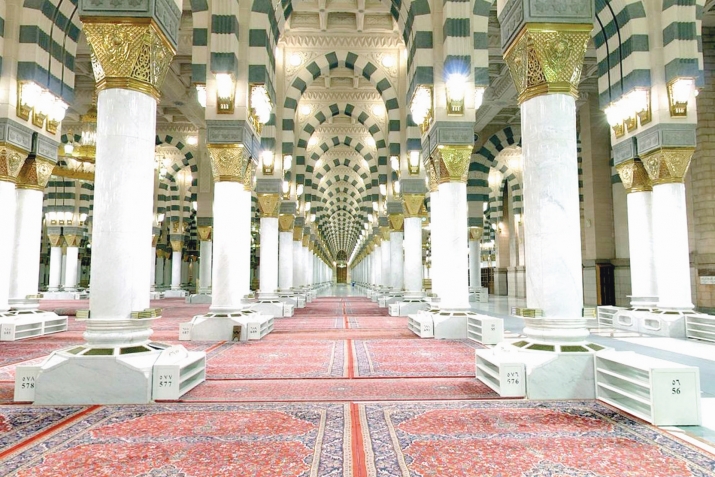
Millions of pilgrims from all over the world visit the holy places of Mecca and Medina all year round, especially in the Hajj season. The hearts of all Muslims arriving in the Blessed Medina are directed towards the Prophet’s ﷺ Mosque. In this article, we will tell you about some facts related to this mosque that are little known to the general public.
- The area of the modern mosque is larger than the area of the old Medina
The size of the modern mosque is a hundred times larger than the size of the very first building of the House of Allah on this site. In fact, the mosque now covers the area of the entire old city. This is confirmed by the location of the Jannat al-Baqi cemetery, which during the time of the Prophet ﷺ was located on the outskirts of the city and is now adjacent to the walls of the mosque.
- Previously, there was no dome over the grave of the Prophet ﷺ, but now there are two
For almost 650 years after the passing of the Prophet ﷺ to the next world, there was no dome over the room where the Messenger of the Almighty ﷺ and his caliphs rest. It was first erected by the Mamluk Sultan in 1279. The first dome was wooden. The green dome seen today is its outer shell. Below it is a smaller dome, on the inside of which the names of the Prophet ﷺ, Abu Bakr ﷺ and Umar ﷺ are inscribed.
- The dome was blue-violet in colour
The dome acquired its modern appearance about 150 years ago. Before that, it was repeatedly repaired and its colours were changed. At one time, the colour of the dome was white but most of the time it was blue-violet. This colour was the favorite colour of the Arabs of the Hejaz.
- What is in the room of the Prophet’s ﷺ daughter Fatima ?
The things that belonged to the Prophet ﷺ were located in his room, as well as in the room of his daughter Fatima. In the course of large-scale expansion, these two rooms were combined. During the First World War, Medina was under siege and the Ottomans secretly evacuated many valuable relics to Istanbul, where they are still kept in the Topkapi Palace.
- Electrification of the Arabian Peninsula began with the Prophet’s ﷺ Mosque
When work began on the electrification of the Arabian Peninsula, the first building to be connected was the Prophet’s ﷺ Mosque in 1910. Even the Sultan’s Palace in Istanbul received electricity only a few years later.
- Zamzam water is delivered to the Prophet’s ﷺ Mosque from Mecca every day
120 tons of Zamzam water are delivered daily from Mecca to the Prophet’s ﷺ Mosque. The water is delivered in huge tanker trucks. It is filled into plastic containers, which are then placed inside the mosque. During the Hajj, when the number of people increases sharply, the volume of water delivered also increases. At this time, up to 250 tons of Zamzam are delivered daily.
- The Prophet’s ﷺ Mosque contains one of the best places on Earth
The most honuorable place in the Prophet’s ﷺ Mosque is Ravza, which is one of the best places on Earth. Ravza in Arabic means ‘Paradise Garden’. From the east, it is bordered by the room of Aisha, on the west side is the minbar of the Prophet ﷺ, on the south is the wall of the mosque with the mihrab and on the north is a passage for movement from the side of the house of Aisha.
A hadith says, “Between my house and the minbar is located Ravza - one of the gardens of Paradise.” (Narrated by Al-Bukhari and Muslim).
Scholars interpret the word ‘Ravza’ as follows: 1. In this place, the worshiper experiences peace and happiness from the mercy sent down by God. 2. The worship performed in this place will become the reason for finding Paradise in eternal life. 3. In the next world, this place will become one of the places in Paradise.
- The reward for praying in the Prophet’s ﷺ Mosque is equal to the reward for 1,000 prayers in other mosques
Prayer performed in the Prophet’s ﷺ Mosque is equal to a thousand prayers performed anywhere else, with the exception of the Sacred Mosque in Mecca. Other good deeds performed here are also multiplied a thousandfold.
The Messenger of God ﷺ said, “Prayer in the Prophet’s Mosque is better than a thousand prayers performed in other mosques, except the Mosque of the Kaaba.” (Narrated by Al-Bukhari and Muslim).
Some hadiths say that prayer performed in this mosque is equal to one hundred thousand prayers performed elsewhere.
Therefore, we should appreciate this opportunity and strive to perform worship and good deeds while in the Prophet’s ﷺ Mosque.
May the Almighty grant us all such an opportunity! Amin.