

The IRD Batik motif “Pesona (Enchantment) COVID-19 Endorphin”: a reflection of the «Contemplation» Koranic mode of thinking, based on Sura Al-Baqarah, ayat 164
The IRD Batik motif “Pesona (Enchantment) COVID-19 Endorphin”: a reflection of the «Contemplation» Koranic mode of thinking, based on Sura Al-Baqarah, ayat 164
It is narrated that Usama bin Zaid was heard saying, “Allah's Messenger mentioned the plague and said, ‘It is a means of punishment with which some nations were punished and some of it has remained, and it appears now and then. So whoever hears that there is an outbreak of plague in some land, he should not go to that land, and if the plague breaks out in the land where one is already present, one should not run away from that land to escape from the plague’.” (Narrated by Bukhari and Muslim).
Al «Allamah ibn Qayyim al Jauziyyah in his book, Zaadul Ma'aad (IV 42-43), observed, “The Prophet's prohibition of entering a country that was attacked by ta'un (plague), or leaving the country that was attacked by the plague was an optimal measure to maintain safety from the disease. Because, by entering it means one is challenging the disaster, deliberately coming to the area impacted upon, and causing others to sacrifice their lives. This act is contrary to Sharia and reason. On the contrary, distancing oneself from the country includes preventive measures, as indicated by Allah , including taking refuge in order to stay away from places and air that may cause illness.
The prohibition on leaving a country affected by plague has two meanings:
- 1) To make our souls believe in Allah, to trust, be patient and be pleased with all the qadha that He has determined, and
- 2) as the experts say, it is mandatory for all who want to protect themselves from a disease outbreak to remove bodily fluids and reduce their food intake, and to choose activities that do not cause perspiration (fluids), excepting exercise, because the body is not always free from noxious liquids within.
In essence, the prohibitions against entering an area affected by plague is directed at being ever vigilant and preventive, while at the same time not challenging the cause of the destruction. Meanwhile, the prohibition against fleeing away from a country affected by the plague is in the nature of a command to trust, submit and surrender everything to Allah . Thus, the first is education and teaching, while the second is submission and surrender (to the certainty of God).
The Prophet Muhammad also said, “Almighty Allah does not send down a disease unless He also sends down its antidote.” (Narrated by Bukhari).
Further, it was narrated by Abdullah bin ‘Umar that the Prophet said: “Immorality never appears among a people to such an extent that they commit it openly, but plagues and diseases that were never known among the predecessors will spread among them.” (Narrated by Ibn Majah and Al Hakim).
For that, prayers of salvation should be multiplied; one example that has been taught by the Prophet e to be recited every morning and evening is the following: “Bismillahi lladzi laa yadhurru ma’asmihi, shay'un fil ardhi wa la fi ssamaai wa huwa samiul «alim.” Meaning: “In the name of Allah, who with His name nothing can cause harm in the earth nor in the heavens, and He is the All Hearing, the All Knowing.”
It is narrated that “Whoever recites it three times in the morning will not be afflicted by any calamity before evening, and whoever recites it three times in the evening will not be overtaken by any calamity before morning.” (Narrated by Abu Dawud, AtTirmidhi, Ibn Majah and Ahmad).
Anas reported that the Prophet e would pray, “O Allah, I seek refuge in you from skin diseases, mental illness, communicable diseases and all malignant illnesses.” (Narrated by Abu Daawud)
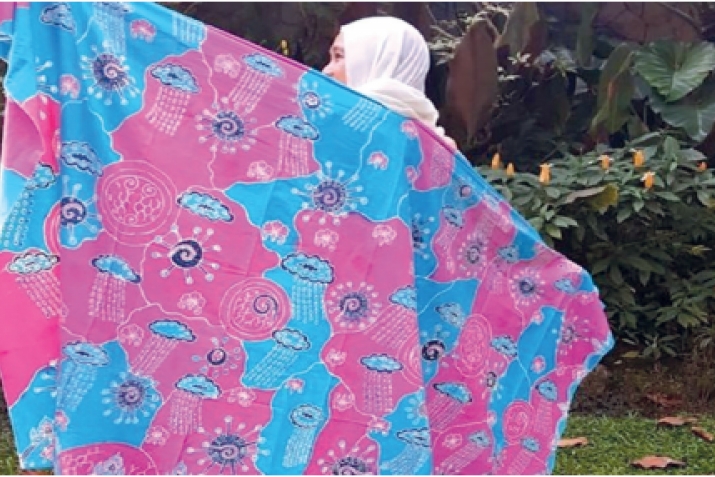
The contemplation and learning of all the above are translated into the skills of batik, which are the joint embodiment of the sensory, philosophical and spiritual in works of art and culture. In each batik textile are contained symbols, philosophies and cultural expression: each constitutes a part of the nation's civilization. The batik work, “Tafakkur COVID 19 Endorphin” derives from a particular mode of Koranic thought contemplation as a medium of Islamic education that has its own philosophical values. The batik motifs discussed here are nuanced with religious meaning through the Koran as follows:
First: COVID 19 and Endorphin: Symbols of the creation of paired creatures, where COVID 19 has negative and deadly properties, while endorphin has positive qualities that make humans happy when this hormone is produced in the brain, as in His Word Sura Al Baqarah, ayat 164: “Indeed, in the creation of the heavens and earth, and the alternation of the night and the day, and the [great] ships which sail through the sea with that which benefits people, and what Allah has sent down from the heavens of rain, giving life thereby to the earth after its lifelessness and dispersing therein every [kind of] moving creature, and [His] directing of the winds and the clouds controlled between the heaven and the earth are signs for a people who use reason.”
Second: Water rain: grace and the source of life, and symbolized as a contributor to the existence of COVID 19 on earth, as in His Word Sura Al Baqarah, ayat 22 (meaning), “[He] who made for you the earth a bed [spread out] and the sky a ceiling and sent down from the sky, rain and brought forth thereby fruits as provision for you. So do not attribute to Allah equals while you know [that there is nothing similar to Him].”
Third: The kapilaya flower: A symbolic plant motif from the Cirebon Sultanate which is associated with a tariqa followed by Sunan Gunung Jati, one of the Nine Walisongo (highly revered spiritual mentors). Charisma, morals, teachings, da'wah and leadership are poured into the kapilaya flower designs and motifs, all reflecting the path of worship of Almighty Allah, which may be said to be a symbol of the journey of human life, from birth to the end of life, where everything is always in Allah’s hands. As in His Word Sura Al Dhariyat, ayat 56, “And I did not create the jinn and mankind except to worship Me.”
This seventeenth batik work of IRD Batik embraces 4 motifs: of COVID 19 Endorphin, water rain, kapilaya flowers and spears. It is hoped that “every piece of the “Pesona COVID 19 Endorphin” batik that is used, both as cloth and as clothing, serves the same function of spreading the concepts of contemplation and spirituality against the plague which is now raging, in order to immediately return to the teachings of His tawhid.”
As the concept of Islamic teaching is a transfer of values it, of course, will be associated with emotional intelligence (emotional quotient) and spiritual intelligence (spiritual quotient). Emotional intelligence is intelligence that can influence psychological states so that people are motivated to become mature individuals, in the form of the ability to feel, understand, and effectively apply emotional power and sensitivity as a source of energy, information and human influence.
According to Sinetar (2000), spiritual intelligence is a mind that gets inspiration, encouragement and effectiveness that is inspired by theism or the appreciation of divinity in which humans become part. Through links based on the understanding of contemplation and the spiritual, it can be said also that someone who has a high spiritual level will have more endorphin hormones compared with those with low spiritual levels. Why is that?
For example, when experiencing stress, the hormones that work are adrenaline, norepinephrine and cortisol. Stress hormones will cause stomach acid to rise and the immune system to go down, inducing susceptibility to disease. On the contrary, when people always think positively through (belief and trust), the hormone oxytocin works better, so that it will produce higher levels of endorphin that cause peace and calm so that the body's immune system becomes stronger and logically more resistant to the COVID 19 virus.
These four batik motifs are a reminder of the creator of the universe, Almighty Allah, who with all his power is able to create both the deadly COVID 19 virus and also the endorphin hormone as one of the remedies which can be produced by our own bodies when we feel happy as one of our natural immune responses. This is also one of Allah's mercies given to all people on His earth.
Thus it may be said that this study through the medium of batik is also a spiritual psychotherapeutic approach, by increasing the belief in the uniqueness of the single God by drawing closer to the Creator in order to aid dealing with, overcoming and preventing anxiety disorders within the community. By contemplating and learning from the motives and meanings of the batik based on the Koran, it is hoped to be able to reduce anxiety disorders due to the coronavirus COVID 19 and assist the community in managing them. Psychotherapy is a therapeutic interaction involving psychoanalysis for a person’s welfare through the understanding of the self (Buchanan
The impact of spiritual psychotherapy has also been pointed out by Moazedi et al. in their religious based research rooted in the teachings of Islam: it had a profound effect on the quality of life (Moazedi et al. 2019). This is because (as al Ghazali's expressed it), there are four spiritual components, al nafs, al qalb, al ruh and al aql, which constitute the foundation of every individual (Salasiah 2016). Therefore, according to al Ghazali, anxiety disorders are illnesses that can be overcome by spiritual healing (Zarrina 2001).
All this explanation can also be seen in His Word Sura Al ‘Ankabut, ayat 2, “Do the people think that they will be left to say, «We believe» and they will not be tried?” This is why we as His creatures should accept all of His will as has been conveyed and lead back to His Word in Sura AnNaml, ayat 75, “And there is nothing concealed within the heaven and the earth except that is recorded in a glorious book (Lawh Mahfuz).”
Thus we contemplate ending with His Word Sura An Naml, ayat 77, “And surely (the Koran) is a guide and a blessing to those who truly believe.”
Ismail Hamid believes that: “Art in Islam instills a sense of khusyu» to Allah in addition to giving peace to the human soul as a creature of Allah who was created with a disposition that is fond of art. Therefore art in Islam is not considered as art for art’s sake, but as a manifestation of man’s worship of God Almighty by His will.
As a Muslim, if you contemplate further, all of these current outbreaks are a blessing. They are a warning for those who think, to continue to make them Wasilah, and a way to continue drawing closer to Allah, so that when the level of surrender is high there will be a sense of calm and with everything there will be submission and prayers of salvation to Allah, always involving Him and hoping that all these outbreaks will end and that the cause can also be immediately found, if God wills.
DR. HJ. INDRIYA RUSMANA, M.PD.I
