
Where is the stone from which the Prophet Muhammad ﷺ ascended to heaven?
Where is the stone from which the Prophet Muhammad ﷺ ascended to heaven?
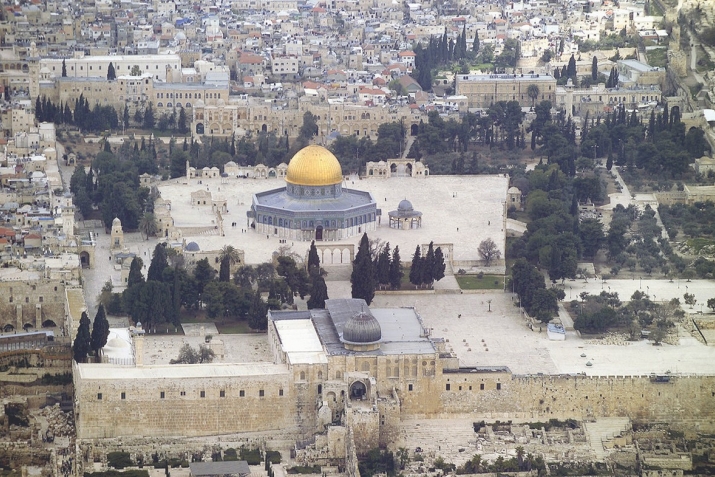
This stone is actually a rock that is widely known in the Muslim world. It was from this rock that the Prophet Muhammad ﷺ made his ascension (Mi’raj). This happened in Jerusalem in the area next to the Al-Aqsa Mosque.
The Messenger of God ﷺ, riding on Buraq and accompanied by the angel Jabra’il , was transferred from Mecca to Jerusalem. When they arrived in Jerusalem at the Al-Aqsa Mosque, the Prophet ﷺ tied Buraq to the ring to which all the prophets tied animals, and then entered the mosque and performed a collective prayer of two raka’ahs along with all the prophets as an imam. Then, when he left the mosque, Jabra’il approached him with two vessels containing wine and milk, and asked him to choose. The Prophet ﷺ chose milk. Jabra’il said, “You have chosen purity.”
Then a ladder of Divine light (nur) descended from the sky, on which the Messenger of God ﷺ ascended to heaven. This ladder descended onto a rock, which is the subject of our article.
This rock is 17.7m long and 13.5m wide. Under it is a depression known as a cave. It is small, almost square in shape and has an area of 4.5 square metres and its average height is 3m. If you look at the ceiling while in the cave, you get the impression that the rock is hanging in the air.
The cave also has two altar niches-mihrabs. One of them is located near the eastern wall. Its history dates back to the Umayyad era. And the second mihrab is located near the western wall, its appeared in later times.
A mosque was erected above the rock, which became known as the “Dome of the Rock” (Qubbat al-Sakhra). This mosque is one of the most important monuments of Islamic architecture in the world.
Qubbat al-Sakhra was built on the orders of the Umayyad Caliph, Abdul Malik bin Marwan. Construction work took place between 685 and 691 CE. The names of the two engineers at the head of the project are known as Yazid ibn Salam from Jerusalem and Raja ibn Haywa from Bisan in Palestine.
The plans for the mosque were drawn up with great engineering precision of proportions, which testifies to the high degree of creative engineering thought of Islamic architects and builders, who used three circles as architectural elements in the design of the building’s framework and during its construction to subsequently create this great Islamic palace-monument. These three circle-elements look like this: two equal squares intersecting each other form octagons in the plan – one external, the other internal, which surround the dome itself, built over the Rock and surrounding it with columns in the shape of a circle, on which the dome rests. Between the two octagons there is an internal gallery, which has the same octagonal shape.
The dimensions of the Qubbat al-Sakhra Mosque are as follow: the internal diameter of the dome is 20.44 m; the height of the base (neck) of the dome is 19.8 m; the total diameter of the building is 52 m; the total height of the building is 54 m; the length of each side of the octagon is 20.6 m; and the height is 9.5 m.