
Ismail’s Dirham of the Samanid Dynasty
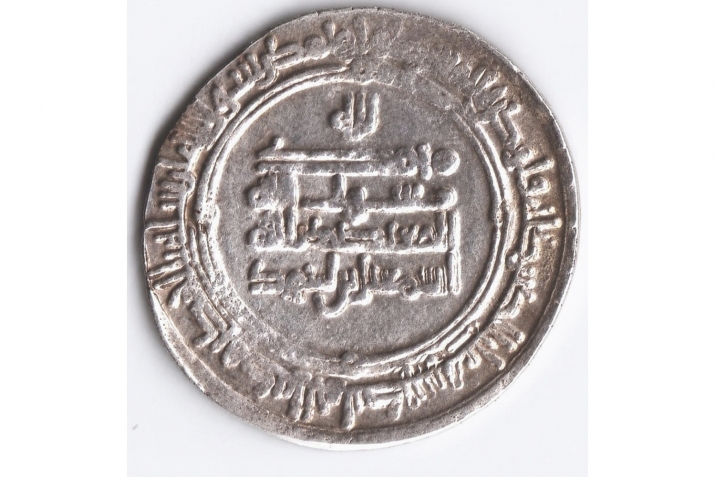
Saman, a native of the city of Balkh, is considered the founder of the Samanid dynasty.
He converted to Islam and enjoyed the patronage of the governor of Khorasan. His grandsons Nuh, Ahmad, Yahya and Ilyas served the caliph himself and by his order, the governor of Khorasan appointed them governors of four provinces.
Nuh was given control of Samarkand, Ahmad of Fergana, Yahya of Shash (Tashkent) and Ustrushana and Ilyas of Herat. Outwardly, it appeared that each brother was the patron of his own province and reported directly to the governor of Khorasan. However, this was far from the case.
By governing their assigned territories, the brothers were able to stimulate production and trade, build caravanserais and ensure security along caravan routes. They also collected taxes on time and sent the collected money to the caliph. These successes allowed Saman’s grandsons to confirm the correctness of their chosen policy of subordinating the head of the family dynasty and passing the provinces to their children as inheritance.
This was also recognized by Caliph al-Muhammad when, in 260 AH (875 AD), he declared Nasr, the son of Ahmad, head of the dynasty and confirmed his right to govern all of Transoxiana (Central Asia).
Managing relatives proved far from easy for the new head of the dynasty. He had to constantly demand obedience, sometimes even by force of arms. His relationship with his brother Ismail, who had been given control of Bukhara, was particularly difficult.
In Ismail’s hands, Bukhara was a grant of fief, in exchange for his services. After some time, while governing Bukhara, Ismail stopped paying his brother the due taxes, keeping all the collected taxes for himself.
The failure to pay the money led to military conflicts between the brothers’ armies, with varying success but this internecine strife did not result in Ismail losing Bukhara. After Nasr’s death, his brother Ismail became the head of the dynasty and he was now forced to fight other relatives for obligatory submission.
But then an external threat arose for the new state.
In 284 AH (898 AD), Caliph al-Mu’taddid invited pilgrims from Central Asia to Baghdad to his palace, where they were read a rescript deposing Ismail and appointing Amr Saffarid as the new ruler of Transoxiana. By pitting Amr against Ismail, the Caliph sought to weaken them both in the interests of strengthening his power in Central Asia.
Receiving the Caliph’s orders, Amr and his army marched against Ismail but suffered a crushing defeat at the walls of Bukhara. This victory effectively marked the final formation of a new state in Central Asia and part of Khorasan (northeastern Iran), which is also confirmed by the Caliph Ismail’s granting him the right to mint silver dirhams. Ismail ruled the state from 279 to 295 AH, creating a state apparatus modeled on the Abbasid caliphs and minting both copper and silver dirhams, as well as gold dinars, at a dozen mints under his control, the main ones being in Bukhara, Samarkand, al-Shash (Tashkent) and Andarab (modern-day Afghanistan).
This coin is frequently found during excavations, including in Russia. It was used in Rus’ not only as money but also as jewelry.