

TREASURY OF BLESSED KNOWLEDGE
TREASURY OF BLESSED KNOWLEDGE
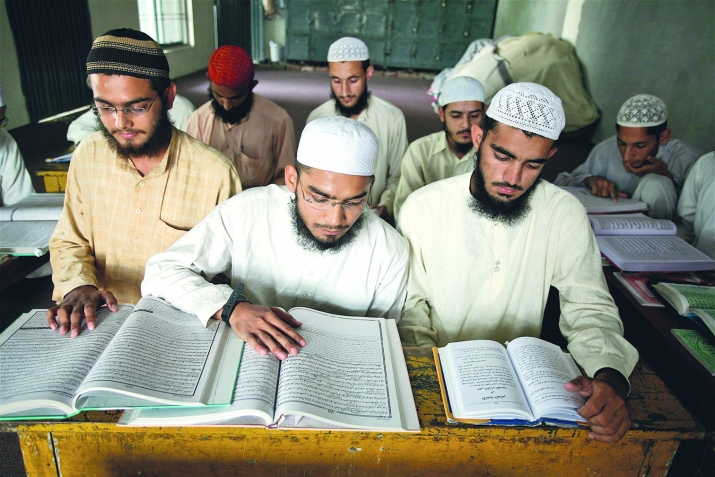
Ibn ‘Abbas said, “The interpretation of the Quran is divided into four parts.”
The first part includes knowledge, which a person cannot do without and which cannot be altered. For example, this is the knowledge that Allah ﷻ is one.
The second part is the interpretation, which is related to the knowledge of the Arabic language: it is enough to know the Arabic language to convey the meaning. For example, the following words from the Quran, “When Allah asked the Prophet Musa, ‘What is in your right hand, Musa?’ he replied, ‘The staff on which I lean and with which I knock leaves from the branches for the sheep.’” (Quran, 20: 17-18).
The third part is one that no one can interpret except theologians and people with perfect, comprehensive and deep knowledge of religion (ar-rasihun). In order to be called by the word "ar rasihun", a scholar must have four qualities: firstly, he must be truly God-fearing in fulfilling his duties to the Almighty ﷻ ; secondly, in a society of people, he must see himself as debased in his own eyes; thirdly, he must be completely detached from the worldly; fourthly, he must be able to resist his base soul (nafs) and possess a sufficient level of knowledge to be able to draw knowledge from the Quran and hadith.
I do not know a person who is more stupid than one who considers himself to belong to such people. Theologians who have established themselves in deep knowledge (ar-rasihun) say, “The basis of unbelief lies in the interpretation of the Quran according to an external inference or literal translation.
The fourth part includes the interpretation of those verses, the true meaning of which is known only to Allah ﷻ .
Who can say anything beyond what Ibn ‘Abbas said? Obviously he said enough. How can we assert that there are places in the Quran that the Prophet ﷺ did not understand when he was sent down to explain it to people? Indeed, the Quran itself says, “I sent down to you, O Muḥammad, the Quran so that you would explain to people those norms of the Sharia that they do not understand - commands, warnings, the permitted and the forbidden." The hadith of the Prophet ﷺ themselves are the explanation (sharh) of the Quran.
Therefore, one of the scholars (‘ulama) said that if a contradiction arises between the understanding of the Quran and the hadith, then preference should be given to the hadith, since the Quran is a concise summary in form, where everything is conglomerated and therefore it is impossible to comprehend it. The above verse is proof that the hadith are interpretations of the Quran.
One of the sheikhs said, "The Almighty ﷻ informed the Prophet ﷺ about the time of the coming of the Day of Judgment."
The companion of the Prophet ﷺ, Khuzaifa, said, “The Prophet ﷺ revealed to me everything that will happen before the Day of Judgment”. The Prophet ﷺ was not allowed to reveal to people one of the three sciences that the Almighty ﷻ taught him on the Night of the Ascension (Laylat al-isra ’wa-l-miraj). And, probably, there was everything in this science. And how can there be verses in the Quran, the knowledge of which the Almighty ﷻ did not pass on to His Prophet ﷺ?
Sha’abiyu, one of the greatest scholars who attained the knowledge of Allah ﷻ said figuratively that knowledge exists in the sizes of three hand spans. The first is when one who has acquired an inch of knowledge and ascending to the very top of a mountain, begins to be proud of the knowledge he has received. The second is when a person who has acquired knowledge sees his nafs as humiliated and feels and considers himself to be a person who does not know anything. And the third is knowledge that a person will never comprehend.
Brothers in faith, look at how thorough is the speech of the perfect scholars who have the knowledge of Allah ﷻ ! Just as a tree grows heavier from the growth of the number of fruits and leans towards the earth, so a person, as his knowledge increases, understands himself more and more.
What types of innovations are differentiated?
We talked earlier about what is hidden behind the word "innovations”. By their nature, innovations are divided into desirable (Sunna), forbidden (harâm), permitted (halal) and undesirable (karâha). For example, writing and publishing books on religious studies is a welcome innovation. Why? Because if there were no such books, how would people comprehend the religious sciences? If a person publishes a book based on the Sharia, then he will receive a reward for it. An equal reward for this will be received by those who read it and use it. The person who published this book will receive a reward not only for publishing it but also for the fact that it benefits people as long as they use it.
Smoking also belongs to the category of those things that did not exist before. Smoking is an innovation that, according to some scholars, is forbidden (haram), and according to others, undesirable (makruh). The one who invented tobacco potentially participates in all the processes associated with it - in the sense that he receives an equal sin for this plus a sin for the fact that he introduced this harmful innovation among people.
In short, all innovations that serve the good of Islam, its prosperity, the spread and perfection of the Muslim faith, are desirable or permitted, and those who introduced and used them will receive due retribution. Innovations that are not in accordance with Islam are, of course, forbidden. Everything that we see today and we use in our everyday life is an innovation. Ultimately, we will receive a reward or, conversely, fall into sin, depending on how our actions will comply with or contradict the Sharia.
Is it possible to eat in the house of the deceased during the first three days after the death of a person?
Eating or preparing food for three days in the place where a person has died is an undesirable innovation. An undesirable innovation, in turn, is subdivided into undesirable, close to forbidden, and undesirable but close to permitted. Cooking food at funeral gatherings is an undesirable innovation that is close to permissible. There is no sin in this. When, for example, the news came that Ja’far, brother of ‘Ali and a companion of the Prophet ﷺ, died a shahid'’s death during a battle with the infidels in the Mutat area, the Prophet ﷺ said, “Prepare food for the Ja’far family, for burdensome news has befallen them and they cannot prepare food." Based on this hadith, it is desirable if relatives or neighbors of the deceased prepare food and bring it to them, expressing their sympathy and comfort to the family of the deceased. Today in Dagestan the Anditsi follow the Prophet ﷺ in this matter. Others do the opposite. However, due to the fact that this innovation does not harm the deceased, it does not receive much attention. The Prophet ﷺ said, “For the deceased, there is no night harder than the first night in the grave, so show pity for him by distributing charity.”
If there is nothing to distribute, then pray in two raka’at [1]. In both raka’at read after sura “Al-Fatiha ", the verse" Al-Kursi " [2], the 102nd sura of the Quran "At-Takasur" and the 112th sura "Al-Ikhlas" 11 times. After completing the prayer, ask Almighty Allah ﷻ to give a reward for this prayer which is called the prayer that relieves loneliness in the grave (salat ul-uns). The intention for prayer is declared as follows: “I intend to perform two raka’at of sunna prayer salat ul-uns for the sake of Allah Almighty ﷻ . Allahu akbar!”
Now we see that the undesirability of cooking in the house of the deceased is caused by the fact that at this time the loved ones of the deceased are not up to thinking about food, which could comfort them and increase their patience (sabr). It is also advisable to remind them that it is Sunna if one wants to help the deceased as much as possible. There are many other things more undesirable than the question of food discussed here, which it is forbidden to support as a custom. These are associated with those moments when women scratch or tear at their faces or beat themselves about the breast. It is especially forbidden to sob and scream loudly in order to cause tears in others. If possible, such mourners should be escorted out of the house and not given food. It is forbidden to lament and impart qualities that were not inherent in the deceased person. The suffering of the deceased increases if he willed that he be wept for.
There are theologians who believe that the torment of even a person whose will does not say anything about not crying for him will increase. Therefore, when a will is drawn up, it is better to write it in this way: “After my death, do not cry and do not lament loudly, scratching faces and pulling out hair. Do not do or say anything that could lead to disbelief." At the same time, quietly crying and shedding tears for a person whose death is so closely felt by the heart is not pretentious. The best thing is to be patient. It is desirable to recall the good qualities inherent in the deceased but not those which are made up. Anyone who has reached the age of majority must draw up a will, be it a woman or a man. Anyone who dies without a testament will not be able to speak until the Day of Judgment. It is not necessary to indicate a large amount of property in the will. The will itself can be, for example, as follows, “My testament is a ring, a watch and a hat. Send what I owned in a good direction after my death." If a person possesses nothing at all, then it is not necessary to draw up a will. In order to make a will, a person must have personal, clean property obtained by legal means (halal).
_______________________________________
[1] Raka’ah (pl. raka’at), a cycle of prayer postures accompanied by the recitation of prayer formulas.
[2] 255th verse of sura “Al-Baqara”.
