

TREASURY OF BLESSED KNOWLEDGE
TREASURY OF BLESSED KNOWLEDGE
Is it necessary to perform the midday prayer additionally after the collective Friday prayer (salat ul-juma’a)?
In his last decision, Imam ash-Shafi'i pointed out that, if there are not forty people who meet the prescribed conditions, then an additional midday prayer must be performed. Muḥammad Takhir from Karakh, Abdullah from the village of Chokh and other Dagestani theologians passed on their knowledge to us. Who are more knowledgeable theologians, they or us? If what they have chosen is not enough for us, why then talk about them; if so we must consider them ignorant. The books "Fath ul-'allam" [1] and "Tanwir ul-kulub" [2] describe in great detail how one of the famous Muslim scholars, Ramali, answered this question. You can also refer to these books. In short, if we call ourselves Shafi'ites, should we not follow the word of Imam ash-Shaf’i-i? Instead of paying so much attention to this issue, it would be better and easier to teach everyone who is obliged to perform the Friday prayer to read the sura "Al Fatiha" correctly, especially since it is mandatory. If forty adult Muslims are taught to read sura “Al-Fatiha” and At-Tahiyat according to the rules of reading the Quran, then there will be no question of completing an additional prayer. Should we not be ashamed if there are not forty such people in every village?
In our village of Chirkei there lived the scholar, Tahir-haji. For thirty years he was a village imam. He taught “Mahalli” lessons [3] to four hundred students. But even then he said, “Until now, I have not reached the level of complete understanding of the “Mahalli”. At that time, our village of Chirkei was one of the largest in Dagestan and in our mosques, after Friday prayers, a midday prayer was also performed. One scholar from the village of Burtunai named Khaibulla was exiled to Chirkei because a man had died at his hands. He taught children to read the Quran according to the rules (makhraj), after which a well-trained Muslim community (jama’at) was formed. After reading one Friday sermon, Tahir-haji said, “Now we have enough people and a large, strong community. From now on, after Friday prayer, we can skip the midday prayer." After that, the midday prayer was no longer performed. So said Haji, the son of Yakub and Haji, the son of Patal. May Allah ﷻ endow them with such blessings in eternal life that they forget the blessings of this world!
If even for Tahir-haji, who taught fiqh lessons from the “Mahalli” to four hundred students, some parts of this book remained incomprehensible, then I do not know how smart people should respond today!
One who says that he is knowledgeable is an ignorant person. This was repeated more than once by the companion of the Prophet ﷺ Ibn ‘Abbas. May the Almighty ﷻ grant intelligence to the entire ummah of Muḥammad ﷺ to follow knowledgeable people!
Can women attend Friday prayer?
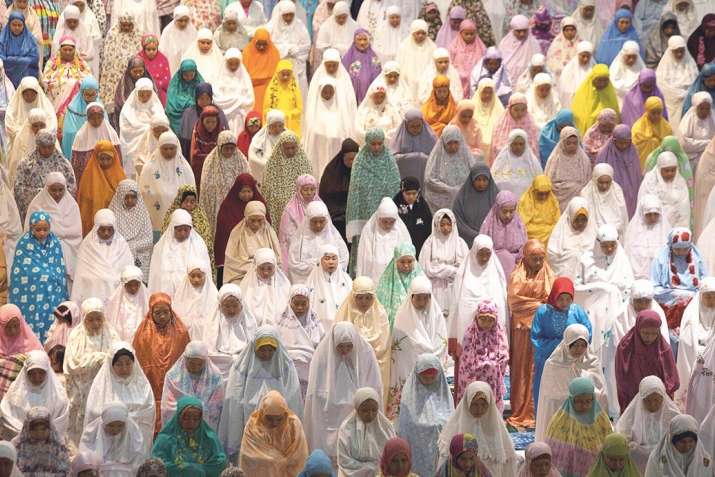
From the above, it follows that women can perform Friday prayer instead of midday prayer. If salat ul-jum'a is performed by people who observe the appropriate conditions, then there is no need to perform additional prayer. For women, it is preferable to perform Friday prayers.
The Prophet ﷺ said, "Do not forbid women to go to the mosque." A woman named Atikat attended the mosque but when she found it more convenient to pray outside the mosque, she prayed at home. The reason women are not obligated to pray on Friday in the mosque is that they do not gather where men gather. It is very commendable for women to be at home. And yet, if a mosque has a separate entrance for them and a special place separated from men, and if they are dressed in the clothes prescribed by the Sharia, then, taking into account the reward they will receive for collective prayer and the need to gain knowledge from sermons and edifications, how can they be banned from visiting a mosque? But we must also think that if they stay at home, then no one will blame them for this.
Many people ask if it is possible to perform communal prayer at home without visiting a mosque? If someone prays at home with their children, wife, guests, or friends, they will receive 27 times the reward as a result but the reward for prayer performed in the mosque is higher. If there is a valid reason that does not allow going to the mosque - for example, illness, or the owner is forced to stay at home because he is receiving and serving guests or the mosque is so far from home that it is difficult to reach it - then collective prayer is performed at home. But one who has the slightest opportunity to go to the mosque should use it to pray in. If everyone stays at home, citing the presence of a jama’at, then what will happen? Try to visit the mosque at the slightest opportunity, for the mosque is the House of Allah ﷻ! If a husband prays while being the imam for his wife, then they will receive a reward equal to that given for communal prayer. Also, prayer performed with minor children is counted as communal. But staying at home and praying by oneself is great ignorance. This is the result of the influence of Satan.
Here we should also mention the issue of the fulfillment of the obligatory pillar of Islam - pilgrimage (Hajj) by women. If a woman intends to make the pilgrimage for the first time, then the road open to her is not very wide. She is allowed to do this without the accompaniment of a mahram (a person permitted by the Sharia), but only if certain conditions are present and met.
After performing the Hajj for the first time, it is forbidden to go on the pilgrimage again without a mahram - without a father, son, brother or uncle. Allah ﷻ is pleased with His creation, bestows upon him a reward, elevates him in degree and cleanses him from sins when he follows the precepts of the Sharia and not when he obeys the whims of his nafs. If women follow the Sharia, then after performing the obligatory Hajj, they must stay at home. But, one can perform the Hajj at least every year, if accompanied by a mahram. Also, I think it is wrong when women go on Hajj for their mother or father.
And here again the question arises about women who travel to foreign countries for the purpose of trade. As there is no Sharia permission for such trips, no one can give it to them. Maybe these women get permission from their husbands, who are completely indifferent to from where and how wealth comes to their home? Is it not puzzling that men stay at home and send their women out for a week or a month to do business? Why do they not go on their own, leaving their women at home, or why do they not at least go together? May Almighty Allah ﷻ have mercy!
To be continued…
_____________________________________
[1] "Opening (hearts) to the Omniscient."
[2] "Lighting Hearts".
[3] A theological book on jurisprudence according to the Shafi'i-i madhab, written by Muḥammad ibn Ahmad Mahalli.
