
Symmetry in our life
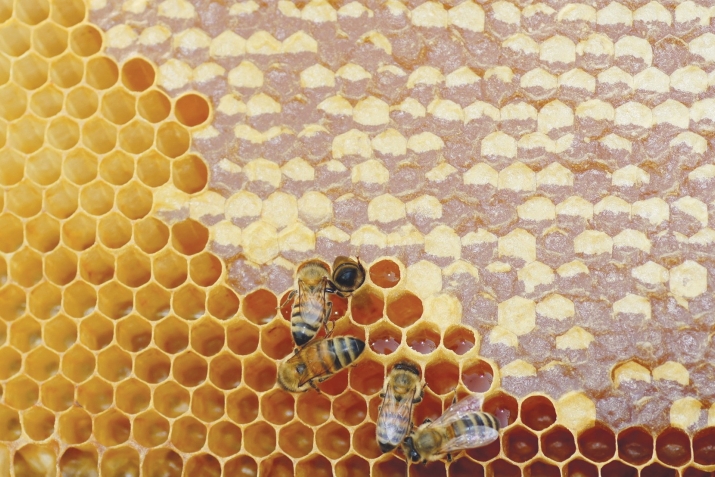
Have you ever seen a honeycomb? Have you ever wondered how skillfully bees build a perfect honeycomb from wax and then use it as storage for honey? Today we will talk about symmetry in nature – examples of the unique beauty of symmetrical forms in our universe.
Most examples of symmetry in the world around us can be described in terms of geometry and this is almost everything we see in living nature, even, for example, broccoli. Although we usually think of broccoli as a product, at the same time it is one of the many examples of fractal symmetry in nature.
In geometry, a fractal is a complex pattern, where each part has the same geometric pattern as the whole. In fact, sometimes the simplest forms of symmetry in nature can represent amazing geometric patterns that we have the opportunity to observe every day and that decorate our lives.
Almighty Allah created this entire amazing world and its strange creatures, plants, seas and oceans in a beautiful and harmonious form so that people could know, love and believe in Him. A person who loves to observe the world around him will easily see all this perfection and beauty almost everywhere he looks.
Sometimes we do not even think about how harmoniously and perfectly the world we live in is created. For thousands of years, people have been amazed at the perfect shape of honeycombs and wondered how bees can instinctively create a shape that people can only reproduce with a compass and ruler.
But in His wisdom, Almighty Allah granted bees the knowledge that this shape is the ideal form for storing honey using the least amount of wax. The fact is that the structure of honeycombs in the shape of regular hexagons provides them with a fairly high strength with a minimum wall thickness: hexagonal honeycombs hold more honey than three- or four-sided honeycombs made from the same amount of wax could hold. And yet, how do bees manage to build honeycombs of such an ideal hexagonal shape?
The results of a study recently conducted by Chinese and British scientists indicate that bees initially build not hexagonal, but round honeycombs, sealing the triangular gaps at the joints of their walls with wax. Then the body heat of the worker bees and the physical properties of the wax come into play.
At a temperature of about 45° C, the wax turns into a very viscous liquid that begins to flow slowly. Surface tension forces squeeze the wax out of the joints of the honeycomb walls, as a result of which the walls become flat, and the honeycombs themselves become hexagonal.
We surely agree that nature and its laws, as well as the science that explains these laws, amaze our imagination. And every time, while enjoying delicious honey, let us pay tribute to the hardworking bees and their ideal honeycombs, and also thank the Almighty, who granted all these blessings and mercies...
The hexagonal shape, similar to the shape of honeycombs, is the basis of another amazing natural phenomenon - the crystallization of water. It is this that gives the variety of patterns that form on our window panes on frosty days. It turns out that water particles (steam) tend to fill all the gaps between the crystals, creating more or less solid formations, but individual snowflakes amaze not only with their bizarre patterns, but also with the fact that there are no two identical snowflakes in the world!
This was proven by the amateur naturalist Bentley. He lived in Vermont, USA, took photographs and compiled a wonderful collection of photographs of snowflakes taken under a microscope for 50 years. There are more than 5,000 pictures in this collection - and no two are alike!
He called them “snow jewels”, and you might really think that the pictures depict diamond jewelry made by a skilled jeweler. All praise be to Almighty Allah!
In this piece, of course, we do not have the opportunity to consider the structure of all living organisms and inanimate objects found in nature.
But it is obvious that all of them, although they have no connection or similarity with each other, were nevertheless created according to a certain mathematical formula. This is the most striking proof of their conscious creation according to a certain project or plan.
According to this law, the Merciful Creator created galaxies, plants and microorganisms, the human body, crystals, living beings, the DNA molecule and the laws of physics and today scientists and artists are only on the threshold of studying this law. In their works, they try to imitate it and to embody this law in creativity. Examples of ideal forms and symmetry in nature, as well as the formula of the golden section are very well known to artists, because these are the main rules of aesthetics.
Any work of art designed in strict accordance with the proportions of the golden section is a perfect aesthetic form. Have you ever admired the examples of wonderful Arabic calligraphy that were so skillfully used in mosques and other buildings?
This is also an example of how people today apply the laws of symmetry. Without a doubt, everything in our world and in the life around us, was ideally created by Almighty Allah. And we, people, only reproduce with a greater or lesser degree of skill the likeness of the perfection of life forms that surround us everywhere. All praise to Almighty Allah!