

Secrets of Quran & Sunnah
Secrets of Quran & Sunnah
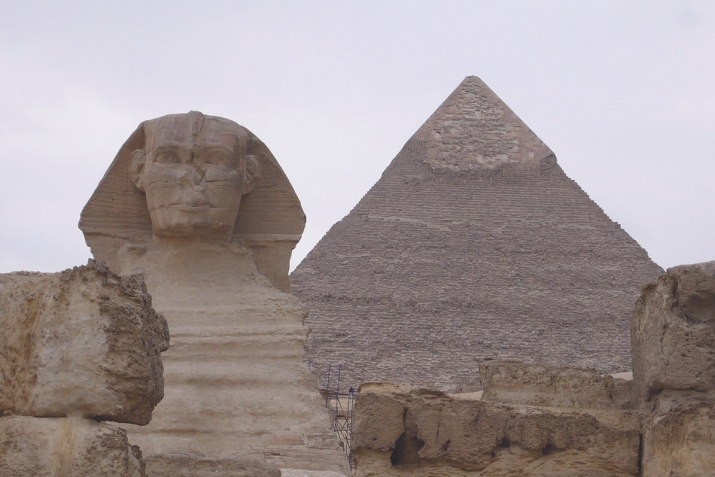
Drought and ancient Egypt
Archeologists say that one of the most serious events that affected ancient Egypt was a drought which happened 4200 years ago and caused famines, thus playing a significant role in bringing about the downfall of the kingdom of ancient Egypt. Glory be to Allah, who says in the Holy Koran (meaning), “Then will come after that (period) seven dreadful (years), which will devour what ye shall have laid by in advance for them, - (all) except a little which ye shall have (specially) guarded.” (Sura Yusuf, ayah 48).
This verse raises one question which is, how did Prophet Muhammad (peace and blessing be upon him) know about this famine which took place thousands of years ago and talked about it, if he were not truly the messenger of Allah?
The Rivers of Ancient Egypt
Archeologists have lately proven that the historical places where the Egyptian pyramids are found (according to the Daily Mail, 17.08. 2012) were once full of rivers and forests. Such a scientific fact was not proven until mid-2012 based on a scientific study that lasted for several years. Amazingly the Holy Koran talked about such a fact 1400 years ago. The Holy Koran tells in several verses the story of the Pharaoh of Egypt and the bliss he enjoyed, as well as the gifts that God granted him. However, but he was arrogant and disbelieved in God; thus God destroyed him and made him drown in his sins. Almighty Allah says (meaning), “And Pharaoh proclaimed among his people, saying: ‘O my people! Does not the dominion of Egypt belong to me, (witness) these streams flowing underneath my (palace)? What! See ye not then?’” (Sura Az- Zukhruf, ayah 51).
The miracle lies in the use of the words “and these streams flowing” which means that there were streams in ancient Egypt, a fact that was not known at the time of Koranic revelations. All glory to Allah.
The escape of pharaoh in his body alone
Pharaoh was a tyrant of his age, but God’s will was to drown pharaoh and deliver his body to be seen by our age so that he became a phenomenon that puzzled the scientists. Pharaoh’s body was still in its perfect shape, in a way that amazed the scientists who supervised on analysis of his corps, how did he escape in his body in spite of his drowning? How was he pulled out from the sea depth and come to us today? This is mentioned in a great verse in the Koran which was a reason of embracing Islam by one of the western scientist! Almighty Allah said (meaning): “So this day we shall deliver your (dead) body (out of the sea) that you may be a sign to those who came after you! And verily, many among mankind are heedless of our verses.” (Sura Yunus, ayah 92).
Allah willed that Pharaoh be drawn out and that only his body survives so that the people after him can witness that phenomenon that scientists marvel at. The body of Pharaoh was found intact. The scientists who participated in the autopsy of the corpse were astonished how his body survived and recovered intact despite him drowning to such depths.
Maurice Bucaille embraces Islam
When French doctor Maurice Bucaille first studied the dead body of the Pharaoh, he stated that he had discovered that Pharaoh had died of drowning in the sea, and that his limbs were broken, except that he had miraculously survived, after which he was mummified and preserved to this very day. To his great surprise, a Muslim friend informed him that this fact was actually well known to Muslims, by virtue of a Koranic verse in which God Almighty addresses Pharaoh as he drowns (meaning), “This day shall We save thee in thy body, that thou mayest be a sign to those who come after thee! But verily, many among mankind are heedless of Our Signs!” (Sura Yunus, ayah 92). This was the catalyst by which he eventually chose to accept Islam and Dr. Bucaille has now authored several books on Islam and its relationship with science, one of the most notable being the Bible, the Koran and Science (2001).
Viewing past deeds
If we contemplate the following Koranic verse: “They will find all that they did, placed before them.” (Sura Al-Kahf, ayah 49), we will realize that it confirms the fact that people would find their past deeds placed before them on the Day of Judgment. The question that needs be answered is how man could imagine that all he did in this world would be placed right in front of him. According to the theory of relativity, if man could walk as fast as light, time would come to an end. If he exceeds the speed of light, however, he would find the past nothing but a reality placed in front of him. Therefore, Allah the Almighty says (meaning), “They will find all that they did, placed before them.” (Sura Al-Kahf, ayah 49).
This is scientific evidence that the past indeed could be viewed!
