
Great Muslim Discoveries
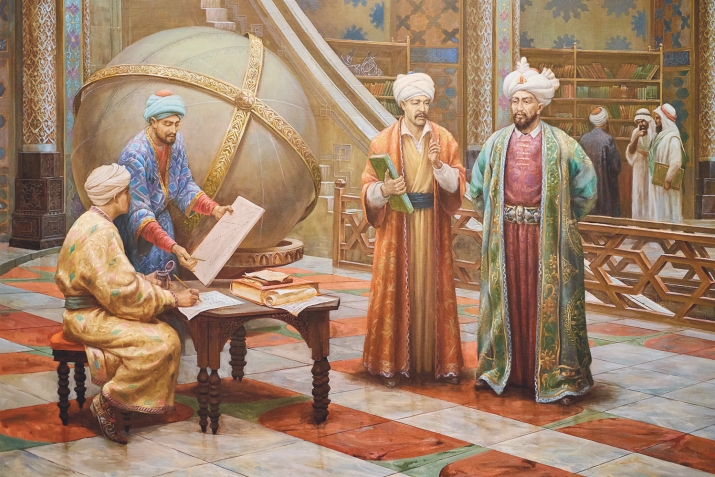
We often view the Western world as the primary source of scientific progress, recalling great scientists such as Aristotle, da Vinci and Einstein. However, it is worth noting that scientific achievements are not limited to Western culture alone. Beginning in the 9th century AD, Muslim scholars from the Arab world laid the groundwork for scientific development in Europe and across the globe through their discoveries. Had history taken a different turn, a green flag bearing a crescent moon might well have appeared on the Moon.
The Intellectual Center of the East
While Europe was gripped by religious fanaticism and ecclesiastical restrictions, the East was emerging as a major centre of knowledge. European libraries, housed within monasteries, contained primarily religious texts. In contrast, Baghdad’s “House of Wisdom” held thousands of scientific manuscripts.
While European physicians employed crude methods, such as using a hammer to induce unconsciousness before amputating a limb, Arab doctors developed sophisticated medicines and treated patients free of charge, with costs covered by the Caliph. They selected hospital sites by hanging pieces of meat from trees and identifying the best locations based on where the meat took the longest to spoil. Although the field of microbiology did not yet exist, they clearly possessed their own understanding of hygiene.
Islamic scholars discovered substances such as nitroglycerin and various acids, as well as methods for water desalination, all while maintaining a profound faith in the Almighty. To them, nature was a miracle of the Lord; unlike their European counterparts, they did not attempt to separate the laws of nature from divine miracles.
The Influence of Arab Culture
In the 9th century, some Christians complained that talented young people were eager to study the Arabic language and read Arabic literature, as they were captivated by its appeal.
The Evolution of Numerals
The word sifr (meaning “zero” or “emptiness”) gave rise to the Latin “cifra” and the French “chiffre” – the latter becoming synonymous with “cipher” (code). Al-Khwarizmi wrote a treatise titled “The Book on Restoration and Use”, from which the word “algebra” is derived. “Algorithm” is a derivative of his name.
Alchemy and Scientific Discoveries
Discussions about alchemy often overlook the contributions of Islamic scholars. Yet, it was they who developed essential tools such as the alembic and the retort and who first isolated and described acids and alkalis. One of the most prominent figures was Geber or Abu Musa Jabir ibn Hayyan, who established fundamental chemical processes like distillation and crystallisation. Geber sought to create “life in a test tube”, leaving behind ancient instructions for the laboratory generation of scorpions and snakes. He was also the first to produce pure alcohol, known as “al-kuhl”. Muslims utilised alcohol in medicine, a practice subsequently adopted by the Crusaders.