
Accessing Information about Islamic Science: Specialist Museums, Science Centres, and the Internet
“His throne comprises the heavens and earth” Koran 2: 256.
While in recent centuries knowledge of their achievements had been overshadowed by a focus on the achievements of scientists from outside the world of Islam, the situation is now quite significantly altered, with a rapidly increasing worldwide awareness of both historical and contemporary advances by Muslim scientists.
Here we survey some of the most significant ways through which access to the knowledge of Islamic science is now being provided through specialist museums and science centres, through specialist internet websites and through emerging public education initiatives.
While a number of scientists throughout the 19th and 20th centuries have explored and published the history of various specialized aspects of the Islamic natural sciences, it was not until 2008 that the first major museum specifically dedicated to this subject.
the Museum for the History of Science and Technology in Islam opened in Istanbul, Turkey. Here visitors can obtain a unique insight into the evolution of the Islamic scientific tradition by examining exact replicas of scientific and technical achievements from the 9th through the 17th centuries.
Islamic innovations are displayed side by side with medieval and later European adaptations. Visit: www.ibttm.org. A well conceived small museum at the other end of Turkey in Gaziantep, the Islamic Science and Technical Museum, has also recently opened.
One of the oldest museums devoted to the general history of science is Oxford University’s Museum of the History of Science, including contributions by pioneering Muslim scientists. In 2010-2022 it created an exhibition, “Al-Mizan: Sciences and Art in the Islamic World”, in collaboration with the Oxford Centre for Islamic Studies, revealing the links between scientific inquiry and artistic beauty through the decorative and practical work of Islamic craftsmen. Visit: www.mhs.ox.ac.uk.
While the Istanbul Museum for the History of Science and Technology in Islam is as yet! the only major individual museum dedicated to this subject, a number of other museums and institutions, particularly those established by the oil rich states of the Arabian peninsula, have created major permanent displays devoted to Islamic science.
In Paris, France, a major museum forms part of the Institut du Monde Arabe, an organization founded in 1980 by 18 Arab countries and France to research and disseminate information about the Arab world and its cultural and spiritual values.
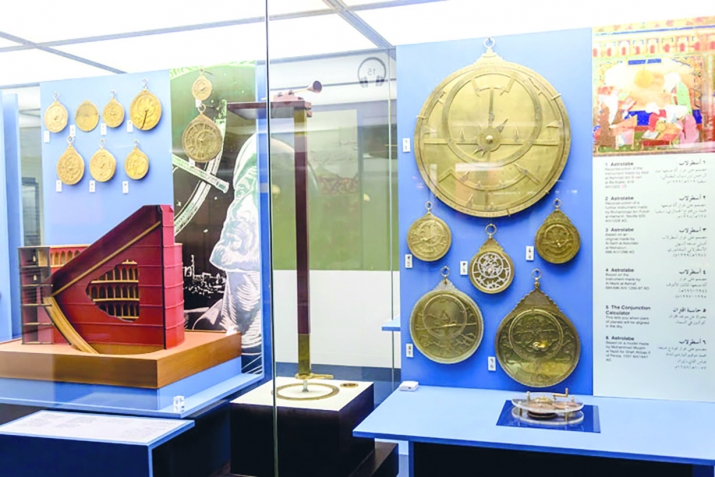
This museum has a display with important items relating to the history of Islamic science. Visit: www.imarabe.org/fr. Modest in scale (but not in quality) is the Museum of Science and Technology in Islam at the King Abdullah University of Science and Technology, Thuwal, Saudi Arabia (founded in 2009).
Its collection, celebrating the first Golden Age of Islam from 650-1650 CE, uses cutting edge technology to showcase major contributions of Muslim scholars to science and technology. Visit: www,museum.kaust.edu.sa.
In Granada, Spain, the last historical stronghold of Islam in the Iberian peninsula, whose advanced culture exerted such a positive role on science, technology and education in medieval Europe, a magnificent new pavilion devoted to Islamic science in Andalusia (Al Andalus y la Ciencia) has been established at the Parque de las Ciencias.
The collection interprets Muslim Spanish contributions to astronomy and other sciences, architecture, gastronomy and everyday life. Visit: www. parqueciencias.com.
Another adventurous approach to Islamic science museology is underway in Kuwait City, where construction has commenced on the Sheikh Abdullah Al Salem Cultural Centre.
Here there will be four worldclass museums, including one devoted to Islamic Science. A national Museum of the History of Islamic Science is also soon to be opened in Muscat, Oman. Among museums which have dedicated permanent gallery areas to the history of Islamic science, is the Sharjah Museum of Islamic Civilisation, which opened in 2008.
Its Ibn Al Haytham Gallery of Science and Technology, showcases the achievements of Islamic science and the contributions of great Islamic scholars to world civilisation.
Visit: www.islamicmuseum.ae Other museums, like the impressive new Museum of Islamic Art in Doha, Qatar (www.mia.org.qa), are pursuing a different museological strategy by providing both real and virtual visitor tours of items of Islamic science interest which are scattered individually throughout the museum in displays grouped in other ways, e.g. as textiles, metals, ceramics, etc.
or in associated in-house learning programs about the history of Islamic science structured around items in their collections.
The latter approach has been developed to a high degree of sophistication by the Metropolitan Museum of Art in New York, USA (which has an outstanding collection of Islamic art).
The museum’s Art of the Islamic World course is partly devoted to Islamic science, and is available as an educational resource in book form. Visit: www.metmuseum.org
The Sharjah Museum of Islamic Civilisation, the Oxford Museum of the History of Science, and the Museum of Islamic Art, Doha, Qatar, also have specially structured educational outreach programmes relating to the history of Islamic science.
The Doha museum has ‘Science in Art Tours’ and ‘Science in Art Workshops’, the latter designed for school students, while the magnificent new Aga Khan Museum in Toronto, Canada, also has educational offerings focusing on ‘Science and Learning’.
Visit: www. agakhanmuseum.org. Parallel to the establishment of specialist museums and permanent displays devoted to the history and achievements of Islamic science, this decade has seen a number of major travelling exhibitions on this theme aimed at a broad international public.
Prominent in quality, scale and the breadth of geographical coverage have been two international endeavours: “1001 Inventions: Discover the Muslim Heritage in Our World” and “Sultans of Science: Islamic Science Rediscovered”. “1001 Inventions” is an ongoing global educational initiative, promoting awareness of a thousand years of scientific and cultural achievements of Muslim civilization from the seventh century onwards.
It was created by the British non-proft Foundation for Science, Technology and Civilization (FSTC). To date “1001 Inventions” has been held in multiple venues in Asia, North America and Europe. Over 8 million people are calculated visited it and 300 million are engaged in its global campaigns.
This initiative is truly a massive undertaking, in terms of both attention to quality and to global logistics. Displays are meant to be both educational and entertaining, with a particular appeal to younger visitors to inspire them to take up careers in science and technology and to be interested in improving the quality of society.
There is a parallel stress on the contributions of the different cultural and scientific traditions, faiths and backgrounds which combined and flowed through the Muslim world, and which helped pave the way for the European Renaissance. Visit: www.1001inventions.com.
To be continued...
GUY (GHAYDAR) PETHERBRIDGE