

Ummu Ma’bad’s Bowl from which the Prophet Muhammad drank Milk during the Hijrah
When Prophet Muhammad (peace and blessings be upon him) left Mecca he made his way to Medina. Abu Bakr (may Allah be pleased with him), his servant and guide, followed him.
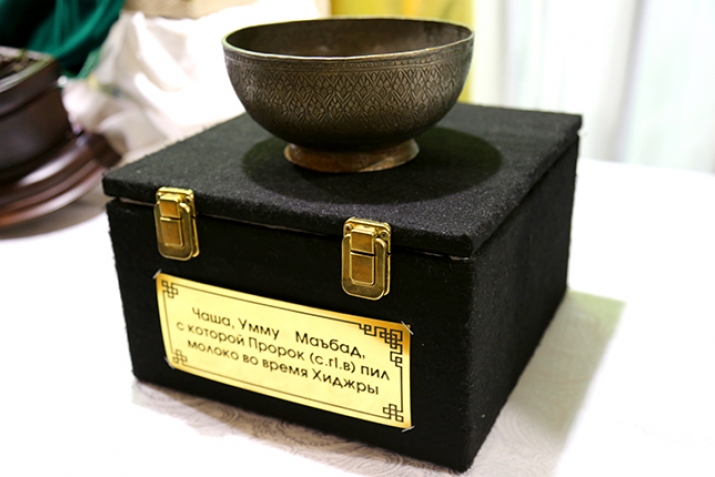
On the way, they came upon tents. In one of them there lived an old woman, known as Ummu Ma’bad. She used to sit near one of the tents and give food and drink to needy travelers.
The Prophet (peace and blessings be upon him) and his companions ran out of food. They went to her to buy some meat and dates, but that day Ummu Ma’bad had nothing at all. There was a sheep near the tent, and the Messenger of Allah (peace and blessings be upon him) asked, “Oh, Ummu Ma’bad, what sheep is this?”
She answered, “It is weak and therefore lagged behind the rest of the flock.”
“Does it give milk?” – “No, it is too weak.”
Then the Messenger of Allah (peace and blessings be upon him), beckoned to the sheep, made a prayer, and then milk came from its udder.
The Prophet (peace and blessings be upon him) asked for a vessel. When it was filled with milk, the Prophet (peace and blessings be upon him) handed it to the woman. Ummu Ma’bad and the rest of the travelers drank their fill. The Prophet (peace and blessings be upon him) drank last. After that, they moved on.
After a while the husband of the elderly woman, Abu Ma’bad, returned home. He brought back some scrawny sheep, which could barely stand on their feet.
Abu Ma’bad was surprised when he saw the milk and asked. “Oh, Ummu Ma’bad, where did you get this milk from? The sheep are hungry, they were grazing far away from here, and there are no other sheep in the house who could have given milk.”
She replied, “By Allah, the blessed man passed by us …”
And Ummu Ma’bad told her husband what had happened.
