

Flowers of devotion: women who cook – gift to mankind
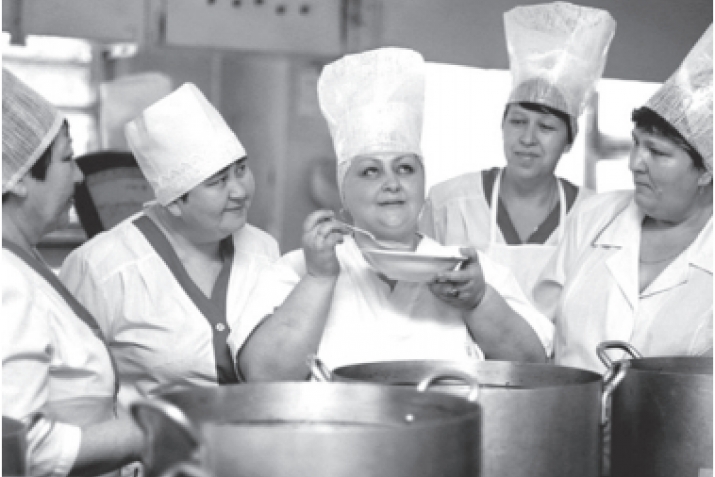
There is an old saying, “The road to a man’s heart is through his stomach.” Inherent in this popular expression, of course, is that it is a woman who does the cooking and that it is a gift of love and her desire for reciprocation.
From the moment of our birth, a mother’s most basic duties are feeding us and providing us with security, both physical and emotional. Thus, there are a number of Koranic verses relating to the feeding of infants by both mothers and foster-mothers. The majority of us, who have been fortunate to have been nurtured in this way, continue throughout our lives to feel a primordial link with, and warmth and respect for, those women intimate to us who regularly feed us our mothers, our close female relatives and (for those who are male) our wives.
In Russian the verb used by women about feeding their families, “kormit” (“to feed”), is a very accurate expression of this precious dynamic. In many societies, such as those traditional in the Islamic world, many men are cooked for by their mothers and other females of the household until they are married, when their wives assume the primary role of cooks and emotional nurturers. Cooking and the meals women create become part of our personal domestic heritage. Over time every cultural group has aggregated the most appreciated or most available raw materials of food, and the techniques of cooking and presenting them, into its own treasured cultural heritage.
Fundamental to Islam’s understanding of a woman’s cooking for others is that it is a gift to her husband and her household. There is no specific verse in the Koran which mandates (fard) that a woman is obliged to cook, and while there are differences of opinion amongst Muslim jurists (fuqaha) about the matter, there is general agreement that the principal relevant Koranic verse is, “We have created everything in a determined measure.” (25:2) Thus, everything in life has its measures and there is much in the Koran that gives insight about “determined measure” in husband wife relations.
The key principles may be expressed as mutual consideration and reciprocation. Prophet Muhammad said, “The best of you is the one who is best to his wife, and I am the best of you to my wives,” (Tirmidhi 3895, Ibn Majah 1977). Imam Ahmed reported that Aisha said:» I was asked about what the prophet used to do in his house? I replied, ‘He was an ordinary man, he used to sew his garment, milk his goat, and serve himself,’ and Al Aswad reported, “I asked Aisha, “What did the Prophet, peace and blessings be upon him, do when he was with his family?” Aisha said, “The Prophet would do chores for his family and he would go out when it was time for prayer,” (Sahih Bukhari 644.)
A number of Islamic scholars, such as Abu Bakr ibn Abi Shaybah, Abu Ishaaq al Jawzjaani, consider that it is a woman’s duty to serve her husband within the bounds of what is reasonableand in accordance with what is customary among people like her and her husband. This differs according to circumstances, time and place.
While religious jurists occupied themselves with the nuances of these legal interpretations, other Islamic writers approached cooking and food from different perspectives.
The earliest surviving Muslim cookbook is the 10th century “Kitab al Tabikh” (The Book of Cookery) by Ibn Sayyar al Warraq al Muzaffar ibn Nasr. It not only gives recipes for the preparation of the different foods and drinks but also regarding kitchen hygiene and table manners. Interesting in the present context of women and cooking is a late 15th early 16th century book of recipes (“Nimmatnama”) in Urdu produced for Sultan Ghiyath Shahi and his successor Nasir Shah of Mandu, Madhya Pradesh state, India. It contains recipes for cooking a variety of delicacies, as well as providing health remedies, and is illustrated with elegant paintings showing the Sultan observing women of his court as they prepare and serve him various dishes.
There are many exemplary women who share their blessings of cookery skills with others as professional chefs. Most of these women cook day after day without special acclaim beyond the satisfaction of their customers who have just had a tasty meal those myriad women throughout the world who help support their families as street vendors, or by running humble cafes or market food stalls. A recent (2016) short film from George Town, Malaysia, titled “A Strong Woman” (available on Youtube) poignantly documents just such a woman, courageously maintaining her family market café in the face of personal adversity.
Muslim women authors of cookery books and hosts of national cookery shows have done much to raised the knowledge and prestige of the richness and diversity of cooking traditions across the Islamic world, while at the same time educating the international public about tenets relating to food, cooking and the eating of food common to all Muslims.

Other women exploit their particular skills and opportunities to grow large, impressive businesses related directly to food. A number of enterprising Muslim women around the globe have made a giant step into the world of commerce by building on their cookery skills and their knowledge of food. It is indeed notable that among recent national, regional and global surveys of Muslim women entrepreneurs (who are increasingly a topic of popular press coverage} such ‘women who cook’ are regularly included amongst the ‘stand out’ leaders.
For instance, a 2014 survey publication of the Wharton Business School, one of the world’s leading business schools, “Arab Women Rising: 35 Entrepreneurs Making a Difference in the Arab World”, highlights Egyptian entrepreneur Heidi Belal, who co founded with her sister the successful Egyptian bakery enterprise, Cookies ‘n More. In the early days of developing the business, Heidi Belal had to shuffle back and forth between her stovetop, laptop, and caring for her daughters, but by co opting the technological capabilities of a web development firm which she had established with her husband, the sisters were able to set up an innovative website to help market, track and place orders and thus were able to advance a successful national business.
In Britain, another successful entrepreneur, Shahin Hussain, has responded to the growing consumer demands of the British Muslim market by creating the Mocktail Company, a producer of non alcoholic drinks for Muslims. In an interview with the BBC, she stated: «I’d always known growing up in Britain that the culture of being British and being Muslim sometimes conflicted, particularly at university when a lot of my friends were drinking alcohol. As I grew older I saw that no one had filled the gap in the market for non alcoholic drinks aimed at Muslims.» The BBC commented on her venture thus,” with Muslim consumer demand growing so quickly, such female entrepreneurs look like they are in a good place right now”.
To be continued…
GUY (GHAYDAR) PETHERBRIDGE PROFESSOR, EXPERT ON CULTURAL HERITAGE AND HISTORY OF ISLAM, AUSTRALIA, RUSSIA
