
Index

Ramadan recipes: pamper yourself with persian poached pears
Ramadan recipes: pamper yourself with persian poached pears

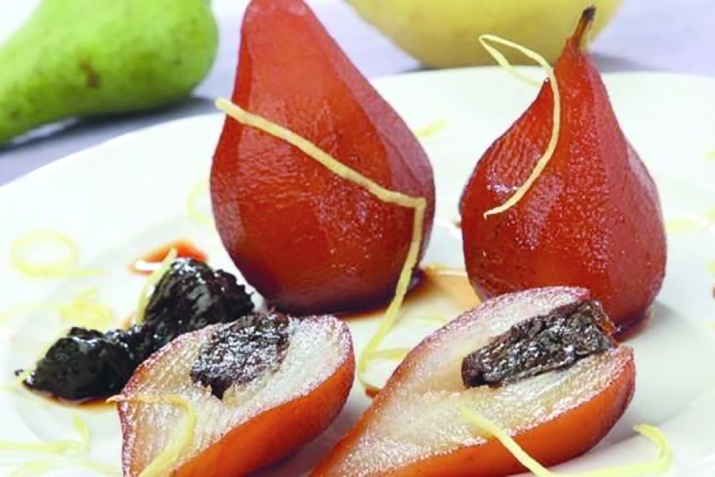
As Ramadan draws to a close why not treat yourself with a truly indulgent, special dessert – a poached Persian pear.

Juicy, delicate and aromatic, cooking this delicacy will fill the house with a spiced aroma and leave you dreaming of more!

Step-by-step recipe

Ingredients:

  • 4 large Bosc pears
  • 1 cup water
  • 1 cup pressed grape juice
  • 2 tablespoons sugar
  • 2 tablespoons honey
  • 4 dried apricots
  • 2 (3 x 1.5 cm) lemon rind strips
  • 1 (7.5 cm) piece vanilla bean, split lengthwise, or 1 teaspoon vanilla extract 1 whole clove
  • 4 reduced-calorie vanilla wafers, crushed
  • 5 tablespoons coarsely chopped pistachios, toasted and divided

Method:

  1. Peel and core the pears, leaving the stems intact. Slice about 0.5 cm from base of each pear so it will sit flat.
  2. Combine water and next 7 ingredients (water through clove) in a large saucepan; bring to a boil. Add pears; cover, reduce heat, and simmer 10 minutes or until tender. Remove pears and apricots from cooking liquid using a slotted spoon; chill pears and apricots. Bring cooking liquid to a boil; cook until reduced to 1 cup (about 15 minutes). Strain cooking liquid through a sieve over a bowl; discard solids. Chill.
  3. Chop apricots. Combine apricots, wafer crumbs, and 1 tablespoon pistachios. Stuff about 2 tablespoons of apricot mixture into each pear cavity. Place pears in each of 4 bowls. Spoon 1/4 cup syrup over each pear; sprinkle each with 1 tablespoon pistachios.
  4. Note: Use a melon baller to core pears.

Source: Islam.ru.en

2026-04-01 (Shawwal 1447) №4.


It is faith that changes character and attitude toward the world

From resentment to forgiveness and patience Life is full of injustice, grievances and trials. The common human reaction is anger, rancor, revenge or despondency. Islam offers a different, higher strategy, based on the concepts of sabr (patience) and ‘afw (forgiveness). Patience in Islam is...


How to express gratitude to the Almighty?

Gratitude is an important spiritual quality, expressing acknowledgement to the Almighty Creator for all the blessings He has bestowed. It manifests itself in the heart, words and deeds. It is one of the highest manifestations of faith and an essential part of worship.   The Almighty Lord...


Healing Foods

Salt has a hot and dry substance. A hadith from Anas reports that the Prophet ﷺ said, “The master of seasonings is salt.” (Narrated by Ibn Majah). Ibn Umar reported that the Messenger of God ﷺ said, “Almighty Allah has sent down four blessings from heaven: iron, fire, water, and...


A Persian slave who loved the Koran

“There was no one among the Companions who knew the Koran better than Abu al-‘Aliya, followed by Said ibn Jubayr.” (Narrated by Abu Bakr ibn Dawud).   Rufai ibn Mihran, who bore the kunya (nickname) of Abu al-‘Aliya, was one of the most famous and distinguished...


Dirham of the Caliph al-Mansur

My collection includes a silver Kufic dirham minted during the reign of the Caliph al-Mansur, who ruled from 136 to 158 AH (the Muslim calendar).   The coin was minted in 146 AH at the Kufa mint (now in Iraq) and weighs 2.88 grams. It was in Kufa that local calligraphers developed a unique...