

Islam and Technology: Keeping Cool
Prior to the overwhelming dominance of modern buildings which are dependent on air conditioning, ventilation and heating systems powered by electricity or gas, in both the hot and dry, and the hot and humid areas of the Islamic world, architecture was used to create domestic micro-climates, the courtyard house being the most common example. In Islamic popular architecture, the insulation properties of many natural materials have been exploited and a range of ventilation systems developed, some very sophisticated in conception and design.
Where the courtyard house was the normal dwelling type the interior courtyard performs an important function as a modifier of climate. It allows domestic outdoor activities with protection from the wind, dust and sun. Interior courtyards serve both as light-wells and as air-wells into which the cool, dense night air sinks. Because they are protected by walls, the sun’s rays do not heat courtyards until later in the day. When the sun does reach the interior court, and heated air rises, convection currents set up an air-flow that ventilates the house and keeps it cool. In certain Moroccan houses, convection currents are exploited by piercing the floors of successive storeys along a vertical line to encourage the free circulation of air within the interior.
The courtyards of wealthy townhouses may contain interior gardens, which are usually richly paved with stone or tiles, and lushly planted. A fountain or pool is often situated in the courtyard - even those of poor houses may contain some tree, plant or a modest tank. In very dry climates the evaporation of water and the presence of plants raise the humidity and help to keep the air cool. In moderately humid climates such as in Algiers, on the other hand, traditional houses do not contain courtyard pools because any increase in the already high relative humidity would cause discomfort.
A simple and ubiquitous response to local climate is through the orientation of dwellings. In Egypt, the orientation of traditional buildings tends to be constant: courtyards are open to the north to receive the cool prevailing breeze of the evening. Traditional houses in Salalah, Oman, are situated in a relationship to one another that encourages the maximum circulation of air with care being taken that each house is built well beyond the ‘wind shadow’ of a neighbouring house.

While most natural materials, such as mud, brick and stone, are efficient insulators, certain materials may be consciously selected for use in specifically orientated parts of the construction. Thus in the exposed Bekaa Valley of central Lebanon, village houses have their windowless southern wall built of stone as protection against cold southerly winds, although the rest of the structure is of mud-brick. In Lebanese coastal cities, the porous sandstone walls of the houses are usually rendered only on the south-west side to resist the penetration of rain-water. In the eastern regions of Iran, such as Mazandaran, houses have wide porches and overhanging eaves as protection against the heat; walls on the south side are often massively thick, absorbing heat without transmitting it to the interior - in effect, storing up heat against the short cold spells of winter.
In many areas of the Muslim world the natural insulation properties of the earth are used to great advantage, either by excavating underground chambers or using natural caves for dwellings, stables, storage areas and cisterns. Houses may also be semi-excavated. In design and construction, the most complex Islamic underground dwellings are those southern Tunisia and western Libya. These dwellings are essentially interior courtyard houses, each consisting of a deep, open courtyard from which are tunneled living, work and storage spaces, often on two levels. A cistern for collecting rain-water is usually excavated below the courtyard. Not only houses but underground and semi-underground mosques also were built in this region.
While underground dwellings are effectivesolutionsinhot,aridclimateswith extreme diurnal or seasonal temperature ranges, they are not as effective in hot, humid climates where ventilation rather than insulation is of prime importance. There a range of structures was devised to deflect selectively the outside airflow into building interiors to create an artificial ventilation system.
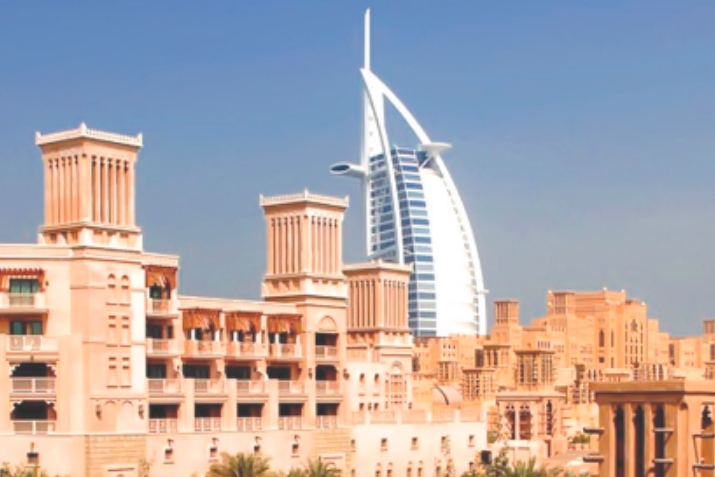
There are two basic categories of wind-ventilation structures: the unidirectional wind-scoop and the multidirectional wind-tower. In both types the inlets are placed high above the roof terraces where wind velocity is greatest and the air cleaner - the wind-towers of southern Iran and the Gulf often rise to fifteen metres above the ground.

The unidirectional wind-scoop in its simplest form was a traditional feature in Baghdad, in the lower Sind district of Pakistan, where traditionally every building had one, and in Herat in Afghanistan, where almost every room contained one. The wind-catcher consists of a fixed inlet made of brick, timber or metal, and inclined at about 45° to the prevailing wind, which it deflects into a channel built in the wall of the building. After passing through the rooms, the air disperses into the courtyard, pushing warm air upwards. In the traditional Baghdad houses, each room, depending on its size or function, may have two or more independent scoops. In the old townhouses of Cairo, wind-catchers, malqaf, are used to ventilate the principal reception halls and living rooms. The inlet of the wind-catcher faces north into the evening breeze and communicates through a large opening in the ceiling, and is the only ventilation inlet for these inner chambers.
A very simple form of wall wind-scoop, or ventilating screen, is found in southern Iran, and in those areas of the Gulf settled by immigrants from the Iranian coast. These are blank-facaded screens, double-walled with an interior cavity, which form part of the exterior or courtyard wall. Outside air enters at the top, passes down through the cavity wall and enters the room at the level of people sitting on the floor. In some rural areas of the Gulf, where much of the housing was of light palm-frond and wood construction, cloth wind-catchers, designed on the same principles as the masonry wind-towers, ventilated the houses, and could be easily dismantled during cool winters.
In some areas the prevailing wind changes direction seasonally or diurnally, necessitating a multidirectional wind-tower. The simplest solution to this problem is to incorporate a sail- or fin- like projection into a scoop rotating on a pivot, in the manner of a wind-vane, so that it always faces into the wind. In central and southern Iran and the Gulf, high multidirectional wind-towers, or badgir, were a characteristic architectural feature. They consist of a tall structure with vertical openings in all directions, and with internal walls arranged diagonally, so that any breeze entering it is forced downwards and up again before it can escape. In torrid areas such as Kashan and Yazd the air is channeled into sub-basement chambers. The inward flow of air is matched by a strong updraught in the opposite side of the wind-tower, and it is immediately beneath the wind-tower that people sit or sleep during sultry weather.
Incoming air may be further cooled by placing porous water jars or damp matting in its path. Evaporation cools both the air and the water in the jars, which is used for drinking. This principle of evaporative cooling is documented in Iranian palaces from the 10th century onwards, where fans and curtains of scented felt were saturated by a steady drip from overhead pipes.
Traditionally, Iranians of all classes have had a passion for drinks and sherbets cooled by snow or ice. In their desert environment, by a method possibly introduced by the Mongols, ice was produced cheaply and in substantial quantities in ice manufactories. During frosty winter nights water was left to freeze in successive shallow layers in a long channel or pond, protected during the day from the sun’s rays by a high, massive mud wall. The ice was broken up and stored between layers of insulating straw in a large domed ice-house of mud-brick, from which it was distributed throughout the year.
GUY PETHERBRIDGE
