
History of Islam in Russia
History of Islam in Russia
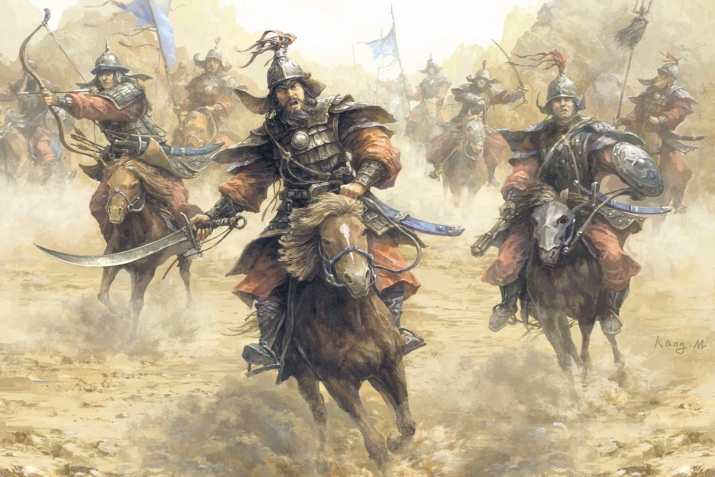
Islam and the Golden Horde
The first Mongolian ruler who embraced Islam was Berke Khan (in Mongolian «Falcon»). Indeed, he became the falcon of Islam. He, who was the Temuchzhin’s (Genghis Khan’s) grandson and participated in the numerous campaigns of his grandfather and brothers, including those against Moslems, adopted Islam from Boharzi Sheikh in the city of Bukhara. And he, mighty heir of the throne of one fourth of the Empire which included most of the inhabited world, the grandson of “Conqueror of the Universe“, is said to have waited for three days for an audience at the doors of the Sheikh – a resident of the subdued country! Truly, what patience, what faith he had!
Immediately after adoption of Islam, Berke Khan establishes relations with the largest Muslim state in the middle of the 13th century – that of the Mamluks’, which included Egypt, Al-Sham (the historical region of modern Syria, Lebanon, Palestine and Jordan), Sudan, Hejaz (the part of modern Saudi Arabia which includes Mecca and Medina).
After the Mongols conquered Baghdad, the Mamluks negotiated with the Abbasids and declared the Caliphate. Despite the power of the Caliph being just a formality, it, however, gave the Mamluk government some sacral status and opportunity to disseminate sovereignty to the rest of the Islamic world. Beside the Mamluk state, in the world at that time there existed Muslim Spain (Al-Andalus), the Seljuk sultanates of Asia Minor and the independent emirates of North Africa.
Who are the Mamluks?
Salah ad-Din al-Ayûbi, having set free most of Al-Sham from the Crusaders and defeated the Ismaili State of the Fatimids in Egypt, created on this territory an independent state, formally resubmitted under the authority of the Abbasid Caliph in the 12th century. His troops mainly consisted of the Mamluks - slaves-warriors, brought up specifically for combat. The Mamluks were both white and black. If the blacks came from Sudan, the whites represented peoples of what is today Russia – e.g. Kipchaks and Circassians. Kipchaks were steppe natives and Circassians was the name given to Caucasian mountaineers irrespective of their origin. What is very important, is that all the Mamluks at the time they were enslaved were not Muslims but adopted Islam while in captivity. This fact played a very significant role in the dissemination of Islam in the West Caucasus, but this was to happen later.
The Mamluks played a stupendous role in the military operations of Salah ad-Din al-Ayûbi, being the core of his active armed forces, consisting also of Kurds (his fellow tribesmen), hired Turkmen and Bedouins. Subsequently, when the descendants of Salah ad-Din dropped the banner from their hands, former slaves, who had become emirs from the Mamluks, picked it up. There came a time when the Mamluk sultans - our compatriots - who, by the will of Allah, had arrived as slaves to Egypt, adopted Islam and became governors of this vast land. The first in the chain of the sultans was Kotuz, who ruled for a short period and was succeeded by Zahir Rukn ad-Din Bejbars (1260-1277).
The Mamluk emirs and sultans left indelible traces in the history and culture of Egypt and Syria. Having protected these regions from the Crusaders and Mongols, they became patrons of sciences and arts. Many of them became scientists – including the Hanafi faqih Argun-naib, Khalil ibn Kikladi al-Alai, also known as «the Keeper of the East and West». Bearers of the literary traditions of their peoples, some of the Mamluks became excellent writers in the Arabic language: al-Ashraf Khalil (son of Kalaun Emir), Emir Bashkerd and many others. For instance, about the Emir of Damascus Ala ad-Din ibn Abdallah at-Tanbag al-Jawali (d. 1343-44), known as «the most poetical Turk”, his contemporary Ibn al-Adim al-Katib wrote, «I have always thought that the Turks are distinguished for their charming eyes and eyelids. I found divine rhymes, an excellent divan and became assured that all is wonderful in them». The madrasas of Saragatmyshiya and Beibarsiya, built by the Mamluks, have been shining for ages in Egypt. A lot of historical information of that time is found in the works of Ibn Tagribardi, a historian and Mamluk by origin.
Sarai Berke
As mentioned above, one of the first deeds of Berke Khan, as the Muslim ruler of the Juchi ulus (in the Russian-speaking tradition called the Golden Horde), was the establishment of diplomatic relations with the Mamluk state, the keeper of the power of the Caliph. Moreover, he even ordered the armies fighting on the party of his cousin Hulagu Khan against the Mamluks, to come over to the side of the latter. During the reign of Berke Khan from 1256 to 1266 his state several times exchanged embassies with faraway Egypt. Sarai Berke, the new capital, built by Berke Khan, fast became one of the greatest cities of Europe. As describes the geographer Ibn Batuta, who visited the city in the 14th century, it took a traveler half a day to go around it. According to archaeologists, its population was around 75-100,000 people. In comparison, the population of Rome was 35,000, and Paris had 58,000 inhabitants. (Right after the formation of the Juchi ulus, the fourth part of the empire, given by Temujin to the descendants of Juchi’s sons, - Batu Khan placed its capital in Bulgar, the central city of the cultural and developed area of the country. But shortly afterwards it was transferred to the Lower Volga, where the city of Sarai Batu had just been built.
Sarai Berke, or Sarai-al-Jadid, was not only one of the largest cities in Europe of that time. While in Paris a riding messenger could be bogged down in filth, Sarai Berke had a developed system of water pipes and sewers (it should be noted, that that this was a feature of many large Muslim cities of that time). According to Ibn Arabshah, for Berke Khan, Uzbek, Djanibek, and other rulers of the Horde there worked such sheikhs as Kutb ad-Din al-Islam al-Razi, Sheikh Saad ad-Din at-Taftazani, Sheikh Jalal ad-Din and other scholars of Hanafi and Shafii schools and Hafiz ad-Din al-Bazzazi, Ahmed al-Hadjandari, etc. Sarai-al-Jadid, being a young city, would first invite scientists from many scientific and cultural centres of the world, and then produce its own personnel with such knowledge, who were to glorify the capital city.
Unfortunately, the legacy of our ancestors is poorly studied. This is the result of systematic destruction of the collections of Muslim books, initiated by “the oprichniks in cassocks” during the time of Ivan the Terrible, continued by their heirs, and so on, down to the “commissars in the dusty helmets”. One of the largest collections of books in Turkic is in Cairo (assembled by the great service of the Mamluks), but it is still waiting to fully studied.
In just ten years of reign, Berke Khan achieved a situation whereby the Muslims stopped perceiving the Mongols as something hostile, at least within the territories of their possession. After his death, khans would succeed each other on the throne of the Juchi ulus. Most were Muslims and a few were pagans-tengrians or Christians. However, the main objective was achieveded – the Juchi ulus gradually acquired the image of a Muslim State. Finally, Uzbek Khan, who ruled in 1312-1340, dotted his i’s and crossed his t’s in this matter. He declared Islam as the state religion of the Juchi ulus, which had become a sovereign power by that time. This happened in the city of Narovchat (now the Penza region), the centre of the ulus. Unfortunately, according to the Religious Board of Muslims of the Penza region, there are no longer Muslims there and no functioning mosque any more.
Notable is the fact that of all the khans of the Mongolian State, the khan of Juchi ulus, whose territory is nowadays mostly located in Russia, was the first to embrace Islam. Other Mongol rulers subsequently adopted Islam: the Djagatai ulus - in 1378, the Tuluy ulus - in 1294-95, although the percentage of the Muslim population there was quite a lot higher. Of course, when adopting Islam in those countries, it could not go without annoying curiosities. For example, the ruler of Tuluy ulus, Ilhan's son Ghazan, before adopting Islam, had been fighting against Muslims, the Egyptian Mamluks, over a long period. Having adopted Islam, with the new title of «great Sultan, Sultan of Islam and Muslims, victorious in the world and faith Mahmoud Ghazan», he continued to fight against them. Having taken Damascus, he read out a decree, «We have heard that the rulers of Egypt and Syria are shying away from the path of faith, do not adhere to Islam, breach their obligations, take unholy oaths; have neither fidelity nor duty; when one comes to power, he seeks for lands to bankrupt them, though Allah does not love ruination: the religious interests of protecting Islam led us to this country to eliminate such injustice.»
To be continued…