
Islam’s tolerance in a multi-confessional society
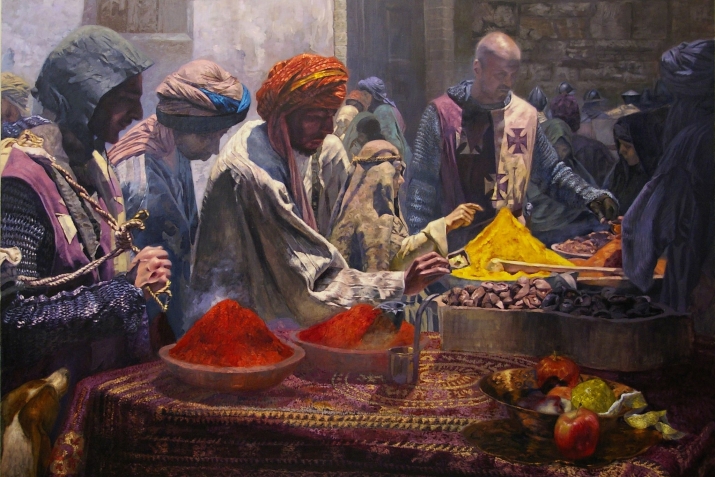
Visual confirmation of the tolerant attitude of Islam to representatives of other beliefs is the following wellknown historical event. During the reign of Omar bin Khattab, in the 14th year Hijra or 635th year after Christ, the city of Hummus was taken. But the next year, having received the news that Heraklius with two hundred thousand troops was preparing to attack, the Muslims were forced to leave the city. When leaving, they returned the Jizya (tax for protection) to the population and declared the following,
“When we charged you a tax, we guaranteed you safety. However, we are not able to protect you now. Take care of yourself!» The population of Hummus understood what the rule of Byzantium meant, therefore both Christians and Jews were not happy about this circumstance and were upset. And the representatives of the Christians said, - Your leadership and your justice are more to our liking than the despotism and arbitrariness that we experienced before you. Together with your wali (ruler and commander in chief), we will defend your city. And the Jews said the following: - We swear by the Torah, the ruler from Heraklius will not enter the city of Hummus until he wins and defeats us.
As a result, the local population, locking the gates, began to defend the city. The troops of Heraclius, not having achieved their desire, left their positions and retreated. After that, residents of the city happily opened the doors and accepted the Muslims. Historians describing this case and many other similar situations write, “Other Christian and Jewish cities that prefer Muslim rule did the same and noted, ‘If Byzantines and their followers defeat Muslims, then we will continue to live as before. Otherwise, even if at least one Muslim remains alive, we will remain faithful to the agreement.’” [1].
Along with the fact that Muslims allowed adherents of other religions to practice and live according to the laws of their religions, they also did not see anything wrong with the fact that the mosque, the church and the synagogue were located next to each other. Of course, the source of this understanding, tolerance and independent lifestyle, religion, language, culture, etc.
is Islam. In one of the hadiths, the Prophet Muhammad (peace and blessings be upon him) says, “I am a rival to him, who will oppress a non-Muslim who is a subject of an Islamic state. And I will settle the scores with my rival on the Day of Judgment.” Will a man who believes on the Day of Judgment dare to appear before the Prophet (peace and blessings be upon him) for the sake of accounting scores? In another hadith it is said, “He who slanders a non-Muslim, subject of the Islamic state, as if he had committed adultery, will be punished with fiery whips on the Day of Judgment.” [2].
It is necessary to note one more circumstance. The subjects of the Islamic state were free to apply their own laws in matters of justice. The subjects of the Islamic state were free to apply their own laws in matters of justice. This is a necessity resulting from the recognition of their freedom of religion. If they appealed to an Islamic court, they were judged according to the principles of justice. For in the Holy Quran the Most High commands (meaning): “If you judge between them, then judge with justice, since Allah loves the just” [3].
In confirmation of this, it would be appropriate to give a decree of one of the Ottoman sultans, namely Mustafa III, written to the Vizier, “If you look at complaints from Bogdan and Eflyak (the name of the country with its centre in Bucharest, which was part of the Ottoman state), then you did not pay particular attention to problems of the Christian population.
At a time when work is being done on the appointment of new leaders in Mora and Hejaz (the name of the provinces of the Ottoman state), I have the following requirement for you, as my Vizier: when choosing people, choose from among the pious. I would not like to see a dismissive relationship on your part only for the reason that someone may have a different faith and language. They are my subjects and let it be known to you that they have the same rights as those who live in Istanbul. Look, do not hurt anyone!” [4].
Thus, Islam regards religious freedom as an inalienable right of a man, the worthiest of creation, possessing consciousness and will. Therefore, Islam takes as a basis the elimination of all kinds of interferences between Allah and the consciousness of man, his mind and will. For this reason, in many Quranic verses it is noted that the Prophet Muhammad and the rest of the prophets are not charged with anything but clear counsel, bringing the truth to the people.
The peaceful, humane attitude of Muslims to non-Muslims and religious tolerance of Islam, even during war, are confirmed by outstanding historians and orientalists of our time. Thus, during the 88 years of the rule of the crusaders in Jerusalem, all Muslims were killed.
And the Crusaders, who remained in the city after the entry of Salahutdin Ayubi’s troops into it, fearfully expected that they would suffer the same fate. However, he did not harm any of the city’s Christians. Moreover, he ordered only Catholic Christians, who considered themselves to be a crusader army, to leave the city, while Orthodox Christians remained in the city and continued their usual way of life and conducted their divine services without any oppression or prejudice.
The English historian Karen Armstrong writes about this, “On October 2, 1187, Salahuddin and his army entered as victors into Jerusalem and now the city was to be Muslim for 800 years ... Salahuddin, as he promised Orthodox Christians, did not commit reprisals, executions and murders and the inhabitants of the city lived in complete peace and harmony. He established high principles of Islamic justice in the city. As commanded in the Qur’an, he did not use violence against anyone and did not avenge the innocent victims of the co-religionists who had been exterminated in the city by the crusaders since 1099. Not one Christian was executed and not one of them was oppressed [5].
Here it is also appropriate to present the historical facts of the Caucasian War period, which took place during the Imamat of Shamil [6]. The famous historian R. Magomedov writes that Abdurakhman, Shamil’s son-in-law, left information about the residence of the fugitive and captured soldiers in the Imamat. “There were a lot of runaway Russian soldiers and officers and the Cossacks, and Imam Shamil very much appreciated them. A separate village was built with a church and a chapel for prisoners and deserters near Vedeno.” [7].
“In the capital of the Imamat there lived Russians, Poles, Georgians, and many other Russian-speaking people. They lived on a par with the mountaineers and with their faith,” writes another historian-writer Shapi Kaziev. Describing the life of Shamil in Kaluga after his capture, the author writes in surprise, “Soldiers who previously were in his captivity came to see Shamil.
They bowed to the imam, and when they were asked why they were doing this, they answered, “Because it was good for the prisoners who lived with Shamil or where he passed. He did not order to that we be offended, moreover, even if a little complaint happened to reach him, he would take away the captive and look after him himself and would severely punish the offender no matter who they were.» [8].
The famous Jewish historian Moshe Hammer, a professor at Tel Aviv University, writes that “Shamil never imposed an appeal to Islam. All those who adhered to their faith lived in the “Russian settlement” near the Imam’s residence, first in Dargo, then in New Dargo. Here they had the right to live according to their customs and traditions ... There was an Orthodox Church and a priest there.” Further, M. Gammer writes: “... Shamil, having learned about the existence of the population groups persecuted by the Russian government (foreigners, such as Poles or religious sects, such as the Old Believers), provided them with a refuge where they could live peacefully and freely practice their religion» [9].
To be continued…
IBRAHIM ABDULAEV
Theologian
References:
[1] Ibrahim Janan, 2005, op. cit.
[2] Tabarani, Musamil Kabir, 22/57.
[3] Jalaludin Suyuti. Qu’ran commentary. Sura Maida, ayah 42. Temir-Khan-Shura, 1905. [in Arabic]
[4] Ibrahim Janan, 2005, op. cit.
[5] Armstrong K., Holy War, MacMillan, London, 1988.
[6] Dadaev Y., On the trails of the battles of Shamil, Jupiter, Makhachkala, 1997.
[7] Shamil. Illustrated Encyclopedia, Echo of the Caucasus, Moscow, 1997.
[8] Kaziev S., Imam Shamil, Young Guard, Moscow, 2001.
[9] Hammer M., Shamil. Muslim Resistance to Tsarism. The conquest of Chechnya and Dagestan, Kron Press, Moscow, 1998, pp 344-345.