
Arabs – the founders of geography
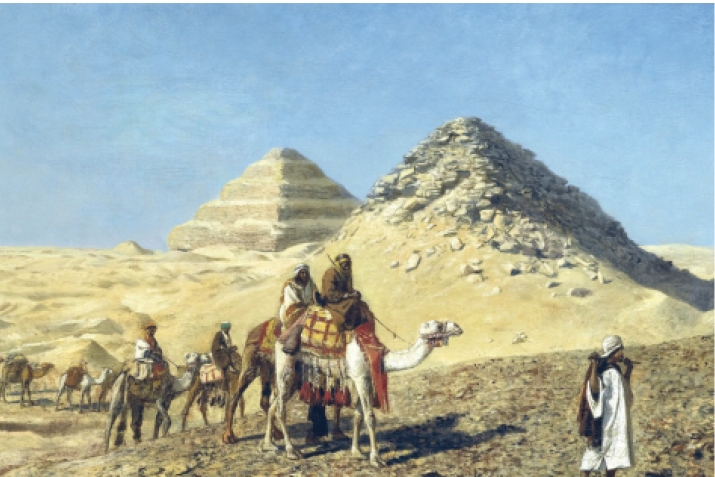
In the Middle Ages Arab geographers were the most versed in the knowledge of paths, roads and routes.
Interest in the observation of natural phenomena was an intrinsic characteristic of the Arabs from the very beginning. They determined routes on land and at sea with the help of the stars. Some aspects of knowledge of astronomy helped them to determine the weather, time of sowing, etc. This knowledge was passed on from one generation to another.
Arabs used to attribute great significance to the stars, their appearance and disappearance. They called these phenomena “al Anwa”, that is, attributing a phenomenon (example, the rain) to the appearance of a star. They studied stars thoroughly and named several hundred of them. This topic is addressed in the book of Abu Rayhan Muhammad Ibn Ahmad alBayruni, who died in 1048.
The orientalist V.V. Barthold notes that the development of Muslim civilization began with putting in order matters in their own state and managing the command of the army. Muslim rulers started with the organization of the postal service and for this purpose they paved and repaired roads.
Prophet Muhammad himself paid great attention to the postal service. During the reign of Caliph Umar Ibn al Khattab e, the work of the postal service advanced, while under the Umayyads it became the first issue in state affairs. As such, the caliph Abd al Malik Ibn Marwan ordered that the road from Damascus and Jerusalem to the southern cities of Al Sham be paved to maintain their activities and to facilitate tax collection.
At the time of the Abbasids, Muslim scholars took a keen interest in the shape of the Earth and everything on its surface. Thus, Caliph Abu Jafar al Mansur ordered the translation of texts in various sciences, particularly astronomy, into Arabic. It was during this period that Claudius Ptolemy’s book “Geography” was translated into Arabic at the request of Caliph al Ma’mun. This book was frequently referred to in the works of the great mathematician and astronomer al Khwarizmi.
His book “The Shape of the Earth” opened a new age in geographical knowledge. This is the first work of Arab geography an early copy is kept in the library of Strasbourg.
In the 2nd-3rd centuries AH, astronomy in the Islamic world gained widespread development. Thus, in the 4th century AH, Muslim scholars laid the foundation for a descriptive geography based on maps. Many orientalists note that in the Middle Ages Arab geographers were the most versed in the knowledge of paths, roads and routes. They were able to determine the precise distance of lines of communication. Among these geographers were Ibn Hardazabah and Abu al Faraj Ibn Jafar.
The book “Al masalik wal mamalik” (“Roads and Provinces”), written by Ibn Hardazabah, is considered to be the first book of this school of Islamic geography. Ibn Hardazabah was a Persian by birth; he worked as chief of the postal service in Maida, the mountainous province of Iran. He described in detail the sea routes leading to India and China, as well as routes to Central Asia, Byzantium and Andalusia. He described the culture, agriculture, plant and animal kingdoms of various countries, as well as the trade routes between the Orient and Europe.
Abu al Faraj Kudamat Ibn Jafar headed the chancellery during the reign of al Muktadir Billahi al Abasi (272 AH). He travelled to all parts of the Abbasid Caliphate, using his knowledge of history, human activities and lines of communication. He wrote the book “Al Haraj” which was constantly used by the Caliph to supervise affairs of state in the Caliphate and to move troops to desired locations.
The book “Al Buldan” (“Cities and Countries”) is one of the earliest writings about geography. Its author was historian and geographer AbulAbbas Ahmad Ibn Ya’qub Ibn Ja’far, known as al Yaqubi. He made long journeys to Armenia, Iran, India, Egypt and western countries.
It was in the 4th century AH, that Islamic geography, as well as other sciences, started to develop extensively. Journeys are the basis for descriptive geography, while astronomy is the basis of cartography. Islamic geography was based on the maps created by al Idrisi.
The eminent geographer of the 4th century AH Abul Hasan Ali Ibn al Husayn al Masudi, a descendant of the Companion of the Prophet , Abdullah Ibn Masud, travelled to the cities of the ancient world, from India to the Atlantic Ocean and from the Red Sea to the Caspian. He also undertook journeys to Asia Minor and Iraq and then settled in Egypt in 341 AH, where he died four years later. Among his books, the most famous are “Marwaj azZahab” (“The Place of Gold Sales”) and “Madin ul Jawhar” (“The Place of Jewelry Extraction”), which were translated into French in 1861 by orientalist Ernest Renan.
The Arab traveler Ibn Fadlan holds a special place in the development of geography. His journey in 309 AH is still being studied by European researchers. Abu Ishaq al Astarahi in his book “Roads and Provinces” divided the Muslim world into twenty geographic regions, described their boundaries and listed the cities and the roads leading to them, as well as the lives of the people, conditions of trade and agriculture. Abul Kasim Muhammad Ibn Ali Ibn Hawkal was a merchant, who visited most of the cities of the Islamic world from 336 to 340 AH, including the cities of Egypt, Armenia and Azerbaijan. In the period from 350 to 358 AH, he travelled to Iraq, Khorasan and Persia.
Shamsuddin Abu Abdullah Ibn Abi Bakrin al Maksidi, also known as al Bashari, is considered the most significant figure of classical Islamic geography. He visited most Islamic countries and wrote a book “Ahsan ut Takasim fi Marifat il Akalim” (“The Best Way of Regional Division in Terms of Climate”).
Another great expert in geography was Abdullah Ibn Abi Musaib al Akri (died in 487 AH), who lived in Andalusia. Kut al Hamawi also lived there and was the author of works on the history of Western Asia, as well as the book “Muja al Buldan” the main geographical guide of his time.
Muhammad Ibn Abdelziz al Sharif al Idrisi was considered the most famous Muslim scholar in geography. He developed the theory of the seven parts of the world and studied the Arabic version of Greek scholar Claudius Ptolemy’s “Geography”. AlIdrisi was born in 493 AH (1100 AD) in the Moroccan city of Ceuta. He studied at the University of Cordoba and visited the cities of Andalusia, France, England and North Africa.
While performing the pilgrimage, he visited the Hijaz, Egypt, Asia Minor and Greece. If we speak of Arab travelers and geographers, we cannot but mention the name of alIdrisi’s fellow countryman, Muhammad Ibn Ab Dar Rahim Ibn Sulayman Ibn Rabiga al Granadi, known as Abu Hamid. He was born in Granada in 473 AH. A manuscript of his is kept in Madrid at the Academy of Historical Sciences. In 500 AH, Abu Hamid left Andalusia. He visited the most remote cities in Europe and then travelled to Africa to Tunisia and Alexandria by sea. He described the islands and volcanoes of the Mediterranean Sea, and also gave a detailed presentation of one of the Wonders of the Ancient World the Pharos of Alexandria. Abu Hamid is thought to be among the last Arab travellers to see the Pharos in operation.
Arab Seafaring
Arab seafaring is referred to in the ancient writings of Strabo and Ptolemy. They mention that the maritime activities of Arabs date back to ancient times. The sea is inseparably linked with fishing and trade and with the aspiration to get to know other people and their culture. Long journeys of experienced sailors gave the Arabs an opportunity to specify and expand knowledge in the fields of astronomy and geography.
The Arabs were the first to use the seasonal winds in the trade journeys between the Red Sea, East Africa and India. They held leading positions in the trade between the East and the West due to their ethical superiority in trade relations. The Indian Ocean was open to all who wished to compete with Arabs in trade, and it was safe, due to their generosity.
As the rule of Arabs in Andalusia started to weaken, the influx of adventurers from Europe and scientific delegations to study the eastern countries began. At the beginning of the 17th century Portugal and Spain began to carry out geographical research.
The large profits which they received from trade with the East forced the European rulers to think about new ways for trade. Thus, King Henry of Portugal sent several delegations to India via Western Africa.
The Portuguese explorer Bartolomeu Dias managed to reach Southern Africa and named the southernmost tip of the mainland as the Cape of Storms. And in 1498, another Portuguese explorer Vasco da Gama with the help of the famous Arab navigator Ahmad Ibn Majid Shihabuddin reached the Cape of Storms and named it the Cape of Good Hope.
The eminent scientist Ahmad Zaki Basha confirmed that da Gama met with Ibn Majid and found that he had many maps and marine devices. He also said that it was Ibn Majid who had shown the Spaniard the way to India and accompanied him there. Da Gama testified that Arabs had very well developed marine sciences.
The confidence of Arab geographers in the Earth being spherical helped Christopher Columbus eventually to the discovery of a new continent America.
Source: Spiritual and Educational Magazine “Islam”, № 1 (11), 2005