

The Meccan Parliament. What do we know about Dar an-Nadwa?
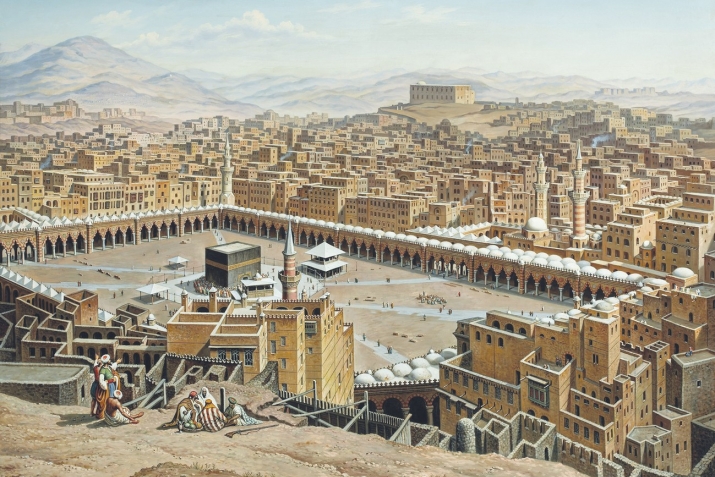
Of course, the pre-Islamic system of governance in Mecca can hardly be called parliamentary in the classical sense of the term but the House of Councils (Dar an-Nadwa) is not so far from the basic principles of parliament, since it was the highest advisory body of Mecca, where representatives of the tribe (a kind of deputy) sat and made decisions.
The tribal Meccan tribal society, of course, cannot be called democratic but it clearly expressed a sense of responsibility for the fate and future of its city. Dar an-Nadwa served as a multifunctional platform where everything related to the homeland of the Meccans, from small to large, was discussed.
The founder of Dar an-Nadwa was the fifth ancestor of the Prophet Muhammad ﷺ on his father’s side - Qusayu ibn Kilab. It is unlikely that he could have known then that the council house he organised would be relevant for several centuries to come, as well as that this house was destined to sink ingloriously into history. Dar an-Nadwa became one of Qusayu’s reformist ideas, under which Mecca not only flourished, but also became entirely Quraysh. It was Qusayu ibn Kilab who united all the Quraysh in Mecca and he himself retained all branches of supreme power, becoming, in fact, the sole king of this city. Having established power, Qusayu distributed the social functions of Mecca, some of which were associated with the sacred Kaaba and the reception of numerous pilgrims arriving in the holy land. These functions are as-Sidana (service at the Kaaba), as-Sikaya (supplying water to the pilgrims of Mecca) and ar-Rifada (providing pilgrims with food). Then Dar an-Nadwa appeared.
Initially, Dar an-Nadwa was not built as a centre for political decision-making, but rather as the home of Qusayu ibn Kilab. Moreover, it met in the first residential building built in close proximity to the sacred Kaaba. Before him, the Meccans were afraid to build any structures near the Kaaba, but Qusayu showed by his own example that this was not an ungodly act, and that such a reaction was merely superstition. Thus, the house of Qusayu ibn Kilab turned from an ordinary residential building into a strategic council house, where wars were declared and ended. Dar an-Nadwa also became a point of attraction, from whence Meccan trade caravans departed and where they arrived. The Quraysh also married in this house and even circumcised their sons there. In other words, the entire military, political, economic and social celebrations of Mecca were overseen in the council house.
During the prophetic period, it was decided to declare a boycott of Muslims in the council house, and the Quraysh came to an unanimous agreement there to assassinate the Messenger of God ﷺ. Preparations for such important military campaigns as Badr, Uhud and Khandaq were also underway in Dar an-Nadwa. The last major meeting in the council house took place on the eve of the capture of Mecca by Muslims in the eighth year of the Hijra. The Quraysh tried to defend the city and resist Islam but their efforts were in vain.
When he died, Qusayu ibn Kilab bequeathed Dar an-Nadwa to his eldest son Abd ad-Dar, and he bequeathed it to his son Abd Manaf. Like the keys to the Kaaba, Dar al-Nadwa remained in the family of Abd ad-Dar until the ruler of the Muslims, Muawiya ibn Abu Sufyan, bought this ancestral house from them. There is a version that the house was bought by Muawiya from Hakim ibn Hizam for 100 thousand dirhams (silver coins).
When purchasing such a historically important house for the Meccans, Muawiya slightly reproached Hakim, “You have sold the greatness and dignity of your ancestors.” Hakim confidently replied, “There is no other virtue left except piety. By Allah ﷻ, in the pre-Islamic period I bought this house for a skin of wine and now I have sold it for 100,000 dirhams. You are my witnesses that this money will be spent in the way of Allah ﷻ. So, who among us has suffered a loss in this deal?”
During the reign of Muawiya, the house of councils received a second life, although it lost its former status. Muawiya and subsequent rulers of the Umayyad dynasty stayed there when visiting Mecca. Dar an-Nadwa acquired an expanded governmental character under Caliph Abd al-Malik. The Abbasid dynasty that replaced the Umayyads saw in the council house the same thing as their predecessors – a temporary refuge during their stay in the holy city. This meant that the council house was living out its days and gradually leaving the political arena. As soon as Caliph Harun al-Rashid moved to use another Meccan house, Dar an-Nadwa fell into disrepair - but not immediately.
Abu Muhammad al-Khuzaa witnessed the beginning of the end of the council house, “I saw it in various states. The part of the house that was intended for women was rented out to strangers and pilgrims. The steeds of the rulers of Mecca were kept in the pavilion which had been used for men. Then the slaves of the rulers from Sudan and other countries lived there. They behaved outrageously and harmed their neighbors. After that, this place became a dumping ground and pilgrims also performed ablution there.” The resulting garbage flowed into the al-Haram Mosque during precipitation, resulting in unsanitary conditions in the Sacred Mosque. This circumstance became the last straw and the Abbasid caliph al-Mu’tazid gave the order to destroy the council house and incorporate its area into the territory of the al-Haram Mosque. This happened in the year 281 Hijri (the Muslim calendar). This was the end of the centuries-old house of Qusayu ibn Kilab. But was it necessary to preserve Dar an-Nadwa for future generations? As a valuable museum exhibit – of course. But in all other respects, the council house was a product of its era and should have remained in the past, which is what happened.
